

WASHINGTON–The CFPB is reporting its exams have helped return $140 million to consumers hit by illegal junk fees, while most institutions have eliminated NSF fees, “saving consumers $2 billion every year.”
In a special edition of its Supervisory Highlights focused on the agency’s efforts to “protect consumers from illegal junk fees,” the Bureau said those fees include fees for fake paper statements and worthless add-on products for auto loans, which “can strain the financial stability of even the most financially savvy families.”
The CFPB said $120 million of the $140 million companies have returned to consumers represents “surprise overdraft fees and double-dipping on non-sufficient funds fees.”
The new Supervisory Highlights special edition, according to the CFPB, covers junk fees in the areas of bank account deposits, auto loan servicing, and remittances found during examinations between February and August 2023.
Examples of Junk Fees
The CFPB said its oversight has identified instances of companies charging a variety of junk fees, including for:
- Fake paper statements. “Some institutions charge customers monthly fees for sending paper bank statements. CFPB examiners found instances where banks charged fees for statements they never actually printed or mailed.”
- Worthless add-on products for paid-off auto loans. “When people purchase cars, they sometimes have purchased loan add-on products, like guaranteed asset protection (GAP) insurance. In situations when borrowers paid off their loan early or had their vehicle repossessed, CFPB examiners found that loan servicers continued to charge fees for the add-on products, which no longer offered any value.”
- Sloppy international money transfers. “CFPB examiners found remittance providers charged hidden fees by taking money out of the funds consumers sent without properly disclosing them,” the Bureau said. “In other instances, CFPB examiners found remittance providers failed to refund fees when the money consumers sent failed to arrive on time.”
Additional Findings
In addition, the CFPB said its examiners found how service providers contribute to many banks’ illegal fee practices.
“These companies provide critical deposit, payment, and data processing services to many banks’ operation systems,” the Bureau stated. “Those operation systems have contributed to banks’ double-dipping on non-sufficient funds fees on a single transaction. The CFPB directed these service providers to stop supporting banks’ ability violate the law.”
According to the CFPB, when its examiners uncover problems, “they share their findings with companies to help them remediate violations.
“Typically, as with many of the instances identified within today’s report, companies take actions to fix the identified problems,” the CFPB explained. “For more serious violations or when companies fail to take corrective actions, the CFPB opens investigations for potential enforcement actions.”
Non-Sufficient Funds Report
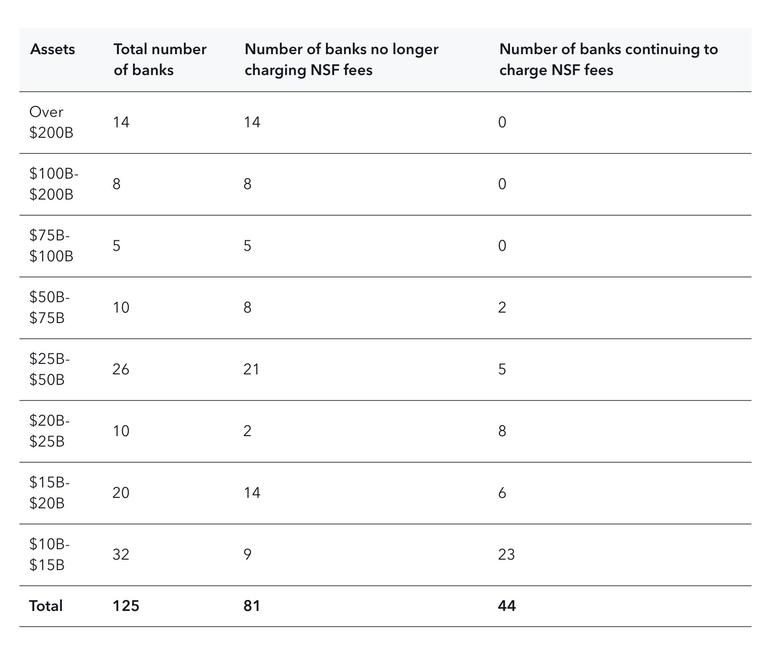
Separately, noting it has enhanced its supervision and enforcement scrutiny of banks that are “heavily dependent” on fees, the CFPB said, “Over the past several years, more financial institutions have voluntarily moved away from charging non-sufficient funds fees.”
In its new data spotlight, the CFPB said it found the vast majority of reported NSF fee revenue “has been eliminated.” The policy changes among financial institutions that led to this change are expected to save consumers $2 billion annually.
The report includes a listing of the top 75 reporters of overdraft/NSF revenue as of 2021. The list does not include any credit unions.
The CFPB report comes at the same time the first report has been published on what California’s state-chartered CUs are seeing in revenue earned from overdraft fees and nonsufficient funds fees. CUToday.info has coverage here.