

WASHINGTON–The CFPB said it is rescinding seven policy statements issued in 2020 that provided temporary flexibilities to financial institutions in consumer financial markets that include mortgages, credit reporting, credit cards and prepaid cards.

Separately, President Biden has signed the PPP extension into law.
The seven rescissions, effective today, provide guidance to financial institutions on complying with their legal and regulatory obligations. With the rescissions, the CFPB said it is providing notice that it intends to exercise the full scope of the supervisory and enforcement authority provided under the Dodd-Frank Act.
CUNA expressed disappointment in the CFPB announcement.
“It’s disappointing the CFPB chose to rescind several temporary COVID-19 policy statements while the pandemic continues to affect the finances of millions of consumers," the trade group said in a statement. "This kind of unilateral action, taken without the benefit of notice or an opportunity to provide feedback, reduces flexibility and undermines the Bureau's own appeal for service providers to make sizeable accommodations for consumers. Regardless, credit unions will continue to assist members in need as they have done throughout the duration of the pandemic.”
The CFPB said it is also rescinding its 2018 bulletin on supervisory communications and replacing it with a revised bulletin describing its use of matters requiring attention (MRAs) to effectively convey supervisory expectations.
“We are now over a year into the disruptive and deadly COVID-19 crisis. The virus has affected industry as well as consumers, but individuals and families have been hardest-hit by the pandemic’s health and economic impacts,” said CFPB Acting Director Dave Uejio, in a statement. “Providing regulatory flexibility to companies should not come at the expense of consumers. Because many financial institutions have developed more robust remote capabilities and demonstrated improved operations, it is no longer prudent to maintain these flexibilities. The CFPB’s first priority, today and always, is protecting consumers from harm.”
According to the CFPB, the rescinded policy statements were issued between March 26 through June 3, 2020, and temporarily provided financial institutions with flexibilities regarding certain regulatory filings or compliance with consumer financial laws and regulations.
“The rescissions announced today reflect the Bureau’s commitment to consumer protection, and the fact that financial institutions have had a year to adapt their operations to the difficulties posed by the pandemic,” the Bureau said.
The rescinded policy statements and MRA Bulletin are:
Statement on Bureau Supervisory and Enforcement Response to COVID-19 Pandemic (March 26, 2020)
The CFPB said the rescission also withdraws the CFPB as a signatory to the Interagency Statement on Loan Modifications and Reporting for Financial Institutions Working with Customers Affected by the Coronavirus (April 7, 2020) and the Interagency Statement on Appraisals and Evaluations for Real Estate Related Financial Transactions Affected by the Coronavirus (April 14, 2020).
Statement on Supervisory and Enforcement Practices Regarding Quarterly Reporting Under the Home Mortgage Disclosure Act (March 26, 2020)
The CFPB said the rescission also instructs all financial institutions required to file quarterly to do so beginning with their 2021 first quarter data, due on or before May 31, 2021, for all covered loans and applications with a final action taken date between January 1 and March 31, 2021.
Statement on Supervisory and Enforcement Practices Regarding CFPB Information Collections for Credit Card and Prepaid Account Issuers(March 26, 2020)
The Bureau said the rescission also provides guidance as to how entities should now meet the specified information collections requirements relating to credit card and prepaid accounts.
Statement on Supervisory and Enforcement Practices Regarding the Fair Credit Reporting Act and Regulation V in Light of the CARES Act (April 1, 2020)
According to the Bureau, the rescission leaves intact the section entitled “Furnishing Consumer Information Impacted by COVID-19” which articulates the CFPB’s support for furnishers’ voluntary efforts to provide payment relief and that the CFPB does not intend to cite in examinations or take enforcement actions against those who furnish information to consumer reporting agencies that accurately reflect the payment relief measures they are employing.
The CFPB said the rescission instructs land developers subject to ILSA and Regulation J to resume filing of annual reports of activity and financial statements as specified in Regulation J.
Bulletin 2018-01: Changes to Types of Supervisory Communications
The CFPB said the rescinded bulletin is replaced by Bulletin 2021-01 announcing changes to how CFPB examiners articulate supervisory expectations. The new bulletin states that the CFPB will continue to rely on MRAs, explains the circumstances under which it will do so, and announces that the CFPB
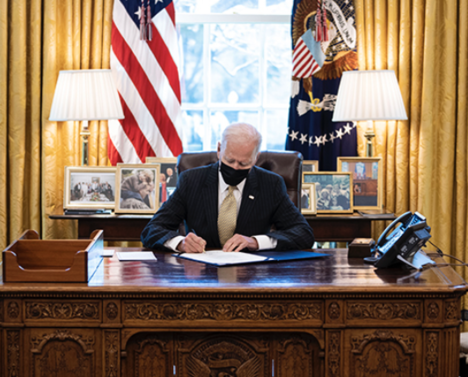
Biden Signs Extension of PPP Into Law
Separately, President Joe Biden has signed into law legislation to extend the Paycheck Protection Program's (PPP) loan application deadline to May 31 and allow the Small Business Administration (SBA) to continue processing pending applications until June 30.
In addition, the SBA issued a second procedural notice to provide guidance related to hold codes on first-draw PPP loans and other error messages.
The procedural notice highlights that the agency is now using a machine learning scoring model that allows automated dispositioning of first draw loans with hold codes that are minimal risk of non-compliance, fraud, or abuse in hopes of reducing the amount of hold codes, NAFCU noted.
Request for Lenders
Lenders are still being asked to clear hold codes through lenders' certification as outlined in the SBA’s first procedural notice on this topic until the new model is fully deployed. In addition, the procedural notice updates the lender certification method for Table 1 holds. The SBA has noted it is allowing lenders to resolve hold codes or compliance check error messages by obtaining a written borrower certification that must be signed under penalty of perjury and must attest to the accuracy of the certification and supporting documentation – alleviating the burden placed on lenders to certify certain information, NAFCU explained.