

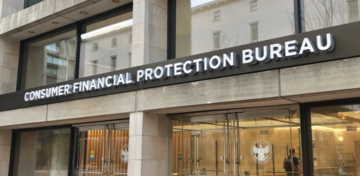
WASHINGTON–In a move welcomed by credit unions, the CFPB announced it is providing temporary, targeted flexibility during the coronavirus pandemic for credit card issuers when it comes to electronic provision of certain disclosures under truth-in-lending laws that are required to be provided in writing.
The relief allows some required consent and affirmation requirements to be satisfied orally by phone call.
“We thank CFPB Director Kathy Kraninger for lifting unnecessary roadblocks that have delayed the opening of consumers’ credit card accounts and the extension of credit-related relief,” said NAFCU Director of Regulatory Affairs Ann Kossachev in a statement. “While this is strong first step, broadening electronic and verbal approval processes to cover additional disclosures would provide further benefit and promote employee safety amid the coronavirus pandemic.
“Currently, credit union employees may be put at risk as they return to their offices to physically print and mail disclosures to their members,” Kossachev continued. “NAFCU will continue to push for additional reforms that lessen administrative burdens and remove red tape that have prevented quick and remote delivery of essential financial services to credit union members.”
CFPB Says It ‘Understands’
In its statement announcing the change, the Bureau said it “understands that during the pandemic, some credit card issuers are receiving far more phone calls from consumers than usual and may be operating with reduced staffing or servicing capability. Consumers may reach out to issuers seeking relief that issuers may not be able to provide without first providing certain written disclosures required by Regulation Z.”
In response, the CFPB said it will take a flexible supervisory and enforcement approach during this pandemic regarding oral telephone interactions where a card issuer may seek to open a new credit card account for a consumer, to provide certain temporary reductions in APRs or fees applicable to an existing account, or to offer a low-rate balance transfer.
This will apply only under provisions of Reg Z governing non-home secured, open-end credit, the agency said.
“In these instances, the Bureau does not intend to cite a violation in an examination or bring an enforcement action against an issuer that during a phone call does not obtain a consumer’s E-Sign consent to electronic provision of the written disclosures required by Regulation Z, so long as the issuer during the phone call obtains both the consumer’s oral consent to electronic delivery of the written disclosures and oral affirmation of his or her ability to access and review the electronic written disclosures,” the bureau stated.
‘Reasonable Steps’
The CFPB said issuers will be expected to take reasonable steps during phone calls to verify consumers’ electronic contact information. “
For example, if during a phone call a consumer provides an issuer with the consumer’s email address, the Bureau expects that the issuer will confirm the correctness of the consumer’s email address, such as by clearly and understandably reading the email address back to the consumer so that the consumer can verify its correctness,” the Bureau explained. “In other instances, an issuer may already have an email address for the consumer on file. In these instances, the Bureau expects that during the phone call the issuer would clearly and understandably state that on-file email address to the consumer so that the consumer can verify its accuracy.”
CUNA Files 2 Letters
Also in Washington, CUNA filed a letter in support of the NCUA’s interim final rule to temporarily defer the appraisal requirement. Under the rule, deferrals of appraisals and written estimates of market value will allow for expeditious access to credit.
“We believe this will minimize instances of borrowers experiencing delays in obtaining funds needed to meet immediate and near-term financial needs,” the trade group said. “CUNA asks the NCUA to provide clear guidance to address instances where a final valuation differs from the initial assessment. In such cases, the NCUA should not require the credit union to take any action pertaining to the borrower and the loan at issue. Such an approach makes the most sense from a logistical standpoint and also reduces instances of confusion among members, who could otherwise learn they must pay more toward a finalized loan following a deferred appraisal.”
Follow Up to Hearing on CDFIs
In addition, following a House Financial Services Subcommittee on Consumer Protection and Financial Institutions hearing on inclusive lending during the pandemic by Community Development Financial Institutions and Minority Depository Institutions, CUNA said in a letter it believes credit unions are well-purposed and well-positioned to address inequity in the financial services sector.
“Both MDI and CDFI credit unions form an integral part of the credit union movement and enhance our ability to so serve underserved communities during this crisis,” the letter reads. “At the same time, we recognize that both MDIs and CDFIs face challenges in accessing badly needed funding. CUNA supports efforts to direct additional funding to both. In addition, MDIs are more vulnerable due to their smaller size, so we support efforts to bolster their resilience and improve access to CARES Act programs like the Paycheck Protection Program and the Main Street Lending Facility.”