

LAS VEGAS–The CFPB is planning to facilitate rules to provide for personal financial data rights for Americans, paving the way for open banking and open finance. The proposed rules, among other things, would obligate financial institutions to share consumer data upon consumer request.
The announcement was made by Director Rohit Chopra during the Money 20/20 Conference here.
For credit unions, the prospect is likely to bring both promise and potential peril.
Open banking generally refers to the use of open APIs that enable third-party developers to build applications and services around the financial institution. Proponents say greater financial transparency options for account holders, ranging from open data to private data.
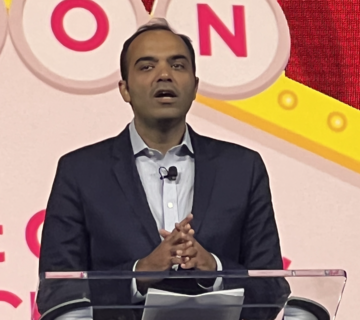
Rohit Chopra speaking to Money 20/20 meeting.
In practical terms, open banking and open finance allow consumers to more easily switch financial institutions and other types of providers, giving them control over how their data is used on a case-by-case basis.
The United States has trailed other parts of the world when it comes to open banking/open finance, but prior to Chopra’s remarks several speakers were already cautioning financial institutions and other providers in the U.S. to prepare for the trend to be more fully embraced in this country.
“A more decentralized and neutral consumer financial market structure has the potential to reshape how companies compete in the sphere,” Chopra said.
Process to Launch This Week
This week, Chopra said the CFPB is launching the process to activate a dormant authority under Section 1033 of the Consumer Financial Protection Act with a goal of accelerating the shift toward open banking.
‘The provisions provide for personal financial data rights for Americans, but would only have teeth after the CFPB defined the specifics through rules,” Chopra said. “While not explicitly an open banking or open finance rule, the rule will move us closer to it, by obligating financial institutions to share consumer data upon consumer request, empowering people to break up with banks that provide bad service, and unleashing more market competition.
“If successful, it will also reduce the ability for incumbents to build moats and for middlemen to serve as gatekeepers,” Chopra continued. “It will provide big advantages to those who provide the best products, service quality, and rates.”
Chopra told the meeting that regulation of the financial services industry has a bad name, “and rightfully so.”
He said financial regulators have “largely complied with what dominant incumbents desire by writing complicated rules to fit existing business models. Much of it involves financial institutions handing consumers a lot of fine print that they may not even read, like those financial privacy notices companies send. It’s a lot of busy work and paperwork.”
He said the CFPB is shifting away from that approach and looking to create “catalysts for more competition.” He added the Bureau is looking to create rules that will have “bright lines that require a minimal number of lawyers who bill by the hour.”
Goal for Market
According to Chopra, the proposed rules around open finance would seek to achieve several objectives, including:
Bargaining Leverage
Chopra said the proposed rules would give individuals and nascent firms more bargaining leverage.
“In today’s market, consumers can often permit access to their financial information through data brokers, sometimes referred to as data aggregators,” Chopra said. “But the broader overall regime is broken because consumer access is based on a set of unstable and inconsistent norms across market participants.
“For example, even when large institutions that share personal data with their customers use APIs, there is no guarantee those institutions don’t play games on availability, latency, and critical data points, like price. We expect that these games will become much more difficult for incumbents to play.”
He added the Bureau specifically expects consumers to have more leverage once data holding companies must share authorized consumer data with authorized third parties, as that will lead to more shopping by consumers.
“For instance, individuals who want to switch providers will be able to transfer their account history to a new company, so they don’t have to start over if they are unsatisfied with the service provided by an incumbent firm,” Chopra said. “Likewise, nascent firms would be able to use data permissioned by consumers to improve upon and customize, to provide greater access, and to develop products and services. Under the current regime, nascent firms often find themselves in the position of needing to curry favor with big market players.”
Improved Security
Chopra said the CFPB proposal will provide better security of personal financial data, saying the current ecosystem is “unstable” because many companies currently access consumer data through activities like screen scraping.
“If a firm is required to make a person’s financial information available to them, or to a third party acting on the consumer’s behalf, via a secure method, we will be able to mitigate some of the problems that exist today,” Chopra said. “For example, consumers who want to link their accounts with an app that helps them budget, make payments, or find a route to affordable credit would be able to do so without having to provide login credentials to third parties that are used in screen scraping.”
Switching & Incentives
Chopra said the Bureau’s planned proposal will lead to more account switching and incentives for better service.
“In an open and competitive market, it is easy for individuals to fire, or walk away from, their financial provider for whatever reason,” he said. “For example, for most consumers, changing a bank account is a huge pain. Direct deposits need to be reset, as do scheduled payments linked by ACH or debit card. And consumers need to take these actions, while managing day-to-day liquidity issues. Our rule will facilitate third party companies that offer services to make switching recurring payments easier.
“Importantly, a more open market will also make sure consumers won’t have to start from scratch,” he continued. “For example, Americans often use their deposit account history as a life ledger – it is a written record that keeps track of payments and deposits, which can be helpful for taxes, for disputes with merchants, or insurers, and for other purposes. By allowing consumers to transfer their ledger to a new institution, the rule could make switching institutions easier – you won’t need to maintain a relationship with your bank to maintain your written record.”
Unbundling Ahead
A competitive market would also lead to unbundling where companies compete on individual products, rather than relying on captive customers or “cross-selling scams,” according to Chopra. “When markets aren’t competitive, we feel that we need to buy additional services from a provider we already worked with. But with more seamless integration, this will give us all more choice.”
More Efforts to Win Loyalty
Chopra said the Bureau believes more switching will lead to greater efforts by firms to maintain or win customer loyalty.
“And, as for companies looking to draw in new customers – when consumers authorize transfers of their personal financial data, new providers will be able to treat them as if they have been long-time customers,” said Chopra. “Because of the authorized data, companies will immediately know the products and services that could best fit their new customers’ needs.
“Large incumbents will find their customers to be less sticky and easier to poach. They’ll also find it harder to impose junk fees and harvest personal financial data for their exclusive use.”
Reduced Bias
According to Chopra, open banking/open finance will reduce bias as financial companies find new ways to underwrite and score with less bias.
“Today, many companies are now exploring new underwriting models that return to core principles – assessing ability to repay without attempting to use outside information to model a consumer’s presumed ability to repay,” he said. “Transaction data will be especially useful for these purposes, and help bring an end to the current reliance on the three-digit social credit scores derived from credit reports that are cloaked in secrecy and rife with inaccuracies.
“Rather than rely on black-box models that people can’t make sense of, lending can move back to real-world data about someone’s ability to pay back a loan. This will eliminate bias and reliance on credit scores and other proxies.
The Rulemaking Ahead
Chopra said the first step the CFPB will be taking will be to propose requiring financial institutions offering deposit accounts, credit cards, digital wallets, prepaid cards, and other transaction accounts to set up secure methods, like APIs, for data sharing.
“While we expect to cover more products over time, we are starting with these ones,” Chopra said. “Through these transaction accounts, the rule will be able to facilitate new approaches to underwriting, payment services, personal financial management, income verification, account switching, and comparison shopping.
“Starting here will also mean that our jumping-off point is where industry infrastructure for consumer-authorized financial data sharing has already begun to take shape.”
The second step, he said, will involve looking at a number of ways to stop incumbent institutions from improperly restricting access when consumers seek to control and share their data.
“We are exploring ways to ensure that when consumers share their data for a specific use, that is the only use it will be used for,” Chopra said. “We know this will be a challenge, given how difficult it is to enforce restrictions, like purpose limitations and data deletion requirements.”
He said he is urging CFPB staff to explore alternatives to the so-called notice-and-opt out regime that has been the standard for financial data privacy.
“For example, the longstanding Gramm-Leach-Bliley Act privacy rules don’t give consumers meaningful control over how their data is being used,” Chopra said. “When a consumer permits their private data to be used by a company for a specific purpose, it is not a free pass for a firm to exploit the data for other uses, no matter what the legal mouse-print may say.”
Further, he said the Bureau will be exploring safeguards to prevent excessive control or monopolization by one, or even a handful of, firms.
Process and Timeline
As it is required to do bylaw, Chopra said before issuing a proposed rule, the CFPB will convene a panel of small businesses that represent their markets to provide input on our proposals.
In the first quarter of 2023, the Bureau will publish a report about the input it has received through that process, which will inform a proposed rule that we are planning to issue later in 2023. It then hopes to finalize the rule in 2024 and move to implementation, he said.