

WASHINGTON–The Consumer Financial Protection Bureau has issued an Advance Notice of Proposed Rulemaking (ANPR) seeking information relating to the expiration of the temporary qualified mortgage provision applicable to certain mortgage loans eligible for purchase or guarantee by the Government Sponsored Enterprises (GSEs), Fannie Mae and Freddie Mac, as part of the Bureau’s Ability to Repay/Qualified Mortgage (ATR/QM) Rule.
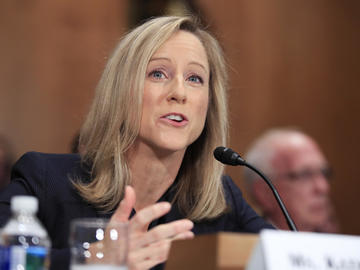
Kathy Kraninger
The provision, also known as the GSE patch, is scheduled to expire no later than Jan. 10, 2021.
The ANPR states that the Bureau currently plans to allow the GSE Patch to expire in January 2021 or after a short extension, if necessary, to “facilitate a smooth and orderly transition away from the GSE Patch.”
Comment Sought
The CFPB is now soliciting comments on possible amendments to the ATR/QM Rule, including whether to revise Regulation Z’s definition of a qualified mortgage in light of the GSE Patch’s scheduled expiration. The ANPR seeks information and comment on whether the definition of qualified mortgage should retain a direct measure of a consumer’s personal finances (for example, debt-to-income ratio), and whether the definition should include an alternative method for assessing financial capacity, the Bureau noted.
“Loans backed by Fannie Mae and Freddie Mac make up a large portion of the U.S. mortgage market,” said CFPB Director Kathleen L. Kraninger. “The national mortgage market readjusting away from the Patch can facilitate a more transparent, level playing field that ultimately benefits consumers through stronger consumer protection. We want to hear all perspectives on how to move beyond the GSE Patch, the impact on credit, the role of the private mortgage market, and possible modifications to the definition of qualified mortgages and the rules governing the documentation of debt and income. The Bureau is committed to ensuring a smooth and orderly mortgage market throughout its consideration of these issues and any resulting transition away from the GSE Patch.”
Expansion of Definition
The Dodd-Frank Wall Street Reform and Consumer Protection Act amended the Truth in Lending Act (TILA) to establish ability-to-repay (ATR) requirements for most residential mortgage loans. TILA identifies factors a creditor must consider in making a reasonable and good faith assessment of a consumer’s ATR. TILA also defines a category of loans called qualified mortgages for which creditors may presume compliance with the ATR requirements.
The CFPF said the GSE Patch, adopted in the Ability to Repay/Qualified Mortgage Rule, expanded the definition of qualified mortgage to include certain mortgage loans eligible for purchase or guarantee by the GSEs, and in most cases these loans are granted a safe harbor from legal liability in connection with the ATR requirements.
What’s Qualified
“These Temporary GSE QM loans generally qualify for that safe harbor from legal liability even if their debt-to-income ratio exceeds the 43% threshold otherwise generally required for loans to obtain qualified mortgage status,” the CFPB said.
Earlier this year, the Bureau released an assessment of its Ability to Repay/Qualified Mortgage Rule and found that GSE QM loans represent a “large and persistent” share of originations in the conforming mortgage market and that creditors generally offered a Temporary GSE QM loan even when a General QM loan could be originated.
The ANPR can be found here.
NAFCU Supports Expansive Definition
“NAFCU supports credit unions being able to provide provident credit to as many American consumers as possible,” said NAFCU EVP ofGovernment Affairs and General Counsel Carrie Hunt. “NAFCU has long supported a more expansive definition of what constitutes a qualified mortgage and will be providing our feedback to the CFPB. Under the current QM definition, the QM Patch has been a key factor in credit unions’ ability to lend to members of their communities, especially those of low- and moderate-income, to achieve homeownership. We will support a solution that allows credit unions to continue to lend to those communities.”