

WASHINGTON–The Consumer Financial Protection Bureau has issued a final rule concerning small dollar lending, and while the credit union trade groups embraced it, a number of consumer groups and one credit union leader wasted little time in blasting the agency for what is being called a “shameful” decision that will permit some lenders to make loans with APRs as high as 400%.
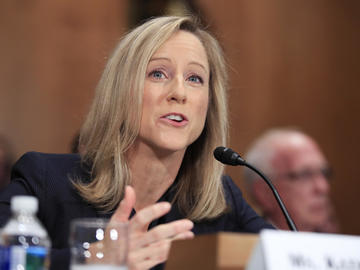
Kathy Kraninger
The CFPB said the final rule will “maintain consumer access to credit and competition in the marketplace.” The agency said it rescinded the mandatory underwriting provisions of the 2017 rule after “re-evaluating the legal and evidentiary bases for these provisions and finding them to be insufficient.” The final rule does not rescind or alter the payments provisions of the 2017 rule, the CFPB said.
“Consumers utilizing small dollar loans continue to have robust consumer protections in place under the prohibition on unfair, deceptive, and abusive acts or practices in the Dodd-Frank Act, the payments provisions of the 2017 rule, and other provisions of federal and state law,” the agency said in announcing the final rule. “Consumers also have increasingly innovative choices among competing small dollar products in the marketplace.
NAFCU Response
NAFCU President and CEO Dan Berger said the trade group welcomed the new rule.
“NAFCU supports the CFPB’s removal of problematic ability to repay underwriting requirements from its final small dollar loan rule. Still, more must be done to ensure consumers have access to affordable loan options,” said Berger. “We firmly believe that community lenders, such as credit unions, must be allowed to serve consumers while the predatory practices of certain payday lenders must be stopped. NAFCU will continue to urge the CFPB to exclude all future payday alternative loans made by credit unions from is rulemaking.”
CUNA Response
“We’re disappointed the CFPB declined to entirely exempt credit unions from its 2017 payday rule. The rescission will likely ensure consumers can continue to access small dollar credit from depository lenders that never should have been included within the scope of the rule in the first place,” said Elizabeth Eurgubian, CUNA’s deputy chief advocacy officer, in a statement. “We’ll continue to engage the Bureau on the impact of the payments provisions and expanding the rule’s payday alternative loan exemption.”
CU Leader Responds
Not everyone in credit unions supports the CFPB announcement. Hope Credit Union in Jackson, Miss., which serves the impoverished Mississippi Delta region, noted in 2017 when the CFPB finalized its earlier rule it was aimed at “a basic tenant of responsible lending: ensuring lenders assess a borrower’s ability to repay a loan without the need to re-borrow or default on other bills.”
Those 2017 rules, HOPE continued, followed five years of research, market assessment, and input from consumers and industry alike that included more than one-million public comments. HOPE Credit Union was part of a small business review panel that provided input into formulating the protections, and supported them in their final form, while its CEO, Bill Bynum, also chaired the Consumer Advisory Board when the rule was released.
“Across the Deep South, payday and car title lenders drain more than $1.6 billion a year in fees on loans carrying 300% APR or more,” said Bynum. “Daily, we see the devastation caused by these predatory lenders in our communities and on the lives of our most vulnerable residents who are elderly and low-income. It is incredibly disappointing that the agency charged with the mission of protecting consumers has chosen to favor high cost lenders over the people harmed most by their practices. To ensure people are not exploited by these practices, states and Congress should move to lower the cost of these loans to 36% APR or less, and states with strong laws already in place, such as Arkansas, must preserve these critical protections.”
CFPB Explanation

Bill Bynum
The CFPB offered different reasoning for the final rule.
“Rescinding the mandatory underwriting provisions of the 2017 rule ensures that consumers have access to credit and competition in states that have decided to allow their residents to use such products, subject to state-law limitations,” the CFPB stated. “Currently, 32 states allow small dollar lending. Many of these states set maximum interest rates for small dollar loans or impose other restrictions or limitations on their use. As noted above, the Bureau adopted today’s rule because of the insufficient legal and evidentiary bases for the 2017 rule’s mandatory underwriting provisions, but also notes that today’s action will help to ensure the continued availability of small dollar lending products for consumers who demand them, including those who may have a particular need for such products as a result of the current pandemic.”
The Bureau said it is “committed to ensuring that consumers can make the best-informed choices among the small dollar products available to them,’ and that it is undertaking research focusing on identifying information that could be disclosed to consumers during the small dollar lending process to allow them to make the most informed choices.
Consumers Are ‘Protected’
“A vibrant and well-functioning financial marketplace is important for consumers to access the financial products they need and ensure they are protected. Our actions today ensure that consumers have access to credit from a competitive marketplace, have the best information to make informed financial decisions, and retain key protections without hindering that access,” said CFPB Director Kathleen L. Kraninger in a statement. “The Bureau protects consumers from unfair, deceptive, or abusive practices and takes action against companies that break the law. We will continue to monitor the small dollar lending industry and enforce the law against bad actors.”
The Bureau said it received a petition to commence a rulemaking to exclude debit and prepaid cards from the payments provisions of the small dollar lending rule, but it has denied that petition. The Bureau also issued guidance clarifying the payments provisions’ scope and assisting lenders in complying with those provisions. In addition, the Bureau released a ratification of the payment provisions in light of the Supreme Court’s recent decision in Seila Law. Although the payments provisions are currently stayed by court order, the Bureau said it will seek to have them go into effect with a reasonable period for entities to come into compliance.
The final rule can be viewed here.
Consumer Groups Blast Rule
In response, a number of consumer groups were highly critical of the CFPB rule, with watchdog group Allied Progress calling on Kraninger to resign after selling out millions of vulnerable Americans to predatory lenders as the economy continues to slip further into recession, especially in communities of color.”
“In a complete and total abrogation of her responsibility to protect consumers, Director Kraninger issued a final payday and car-title lending rule today doing away with one of the strongest safeguards against the payday loan debt trap,” Allied Progress said. “Kraninger’s decision to permanently scrap the ability-to-repay standard established in 2017 by former director Richard Cordray – which even she herself admitted would save consumers over $7 billion in fees every year – has been the number-one priority of the payday loan industry that has handed Donald Trump millions of dollars for his campaign and personal business.”
The group pointed to a New York Times report that found former CFPB Acting Director Mick Mulvaney and other Trump political appointees “pressured the Bureau’s economists to use ‘inaccurate and inappropriate’ data’ in order to justify scrapping the requirement that payday lenders consider a borrowers’ ability to repay high-interest loans on time.”
Allied Progress called on Congress to immediately pass the “Veterans and Consumers Fair Credit Act,” bipartisan legislation backed by several veterans advocacy groups that expands the Military Lending Act’s 36% interest rate cap to all consumers nationwide.
“Director Kraninger just stamped an official seal of approval on one of the worst practices of payday lenders -- and now there’s nothing stopping the industry from ruining families with 400% interest rates in the middle of a recession. For the sake of all U.S. consumers, the Director needs to step aside,” said Jeremy Funk, spokesman for Allied Progress.
Protections are ‘Gutted’
Lauren Saunders, associate director with the National Consumer Law Center issued a statement saying, “At this moment of health and economic crisis, the CFPB has callously embraced an industry that charges up to 400% annual interest and deliberately makes loans that put people in a debt trap. The CFPB has no basis for gutting the heart of common sense protections that merely required payday lenders to do what responsible lenders already do: ensure that the borrower has the ability to repay. The evidence to support the debt trap of payday loans is overwhelming and the CFPB’s flimsy excuses for repealing protections do not stand up.
“It is truly shocking that the CFPB, an agency created to protect families from financial abuses, is bending over backwards to side with the most scurrilous lenders over the consumers it is supposed to protect. The CFPB has not only repealed critical protections against dangerous payday loans, but its May template for no action letters for banks that make small dollar loans, together with bank regulator guidance that could open the door to single-payment bank loans, could be used to encourage banks to get back into the bank payday loan business…”
A Cycle of Debt
The Pew Charitable Trusts expressed disappointment with the decision by the CFPB, saying the move could leave millions of Americans at high risk of becoming trapped in a cycle of debt.
“The 2017 rule was based on years of extensive research and was carefully designed to limit harmful lending practices while keeping credit available to consumers,” Pew Trusts said. “It put in place safeguards for single-payment loans and encouraged lenders to offer affordable small installment loans that—according to Pew’s research—could have saved millions of borrowers billions of dollars annually.
“The new rule the CFPB adopted today eliminates the 2017 rule’s central consumer protection measure, its ability-to-repay provision, which curbed unaffordable loan terms by requiring lenders to determine a borrower’s capacity for repaying loans all at once.”
Added Alex Horowitz, senior research officer with Pew’s consumer finance project, “By eliminating the ability-to-repay protections, the CFPB is making a grave error that leaves the 12 million Americans who use payday loans every year exposed to unaffordable payments at annual interest rates that average nearly 400%. The Bureau’s decision to rescind its 2017 rule ignores the foundational rationale for the rule and fails to refute or reinterpret the bulk of research underpinning it. The case the Bureau offers for overturning the rule and allowing loans that have a long track record of failing consumers is unsubstantiated.”
Predatory Lending to Increase
Vanita Gupta, president and CEO of The Leadership Conference on Civil and Human Rights, issued a statement saying, “How shameful that at a time when COVID-19 has killed at least 130,000 people in America and caused economic turmoil on a scale we have not seen since the Great Depression, the CFPB’s priority is filling the waters with loan sharks. The truly immoral decision to undo consumer protections at this time threatens to devastate communities of color that, as is typical in these crises, are already facing the worst fallout of the pandemic. To do so based on junk research is even worse. These communities need more, not fewer, CFPB protections now. If the courts do not promptly strike down this gift to predatory lenders, then Congress needs to step in and impose better protections.”