

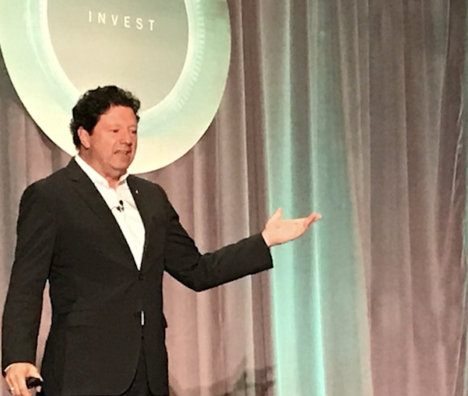
Peter Ricchiuti
ORLANDO–Credit union CFOs here were given a generally upbeat overview of where the economy is headed in the short term, although the same analyst raised a few red flags over some longer-term fundamentals.
Peter Ricchiuti, who teaches at Tulane University in New Orleans, kicked off the CUNA CFO Council annual meeting here by discussing everything from some myths around the current economy to immigration to tax evasion during his remarks.
First, several “Truth Decay” issues, according to Ricchiuti, who peppered his presentation with one-liners and jokes:
- Truth Decay #1: Unemployment rate is 42%. “That’s not true, that’s the workforce participation rate, which includes everyone over 16 years of age. The unemployment rate is really below 5%.”
- Truth Decay #2: The U.S. no longer manufactures much. “Actually, manufacturing output in the country is higher than ever. However, we’re doing it with a lot fewer people. We’ve lost five-million manufacturing jobs, and no political wand will change that. Eighty-seven percent of job losses in manufacturing are due to efficiencies in automation and robots. Bullying companies to keep jobs in the U.S. is good news for robots.”
- Truth Decay #3: The president inherited an awful financial mess. “Actually, the new president inherits the third-longest economic recovery on record.”
Ricchiuti said his exposure to students at Tulane University in New Orleans where he teaches has made him quite optimistic about what’s ahead, as opposed to so much of the pessimism about the next generation.
“The students I’m teaching now are the best students I’ve ever had,” he said. “They may be a little different in the way they go about work, but they are terrific. And they want to give back. This generation likes mandatory community service. I think they are better than my generation (Baby Boomers).”
New Generation
Demographically, he said CUs need to adjust to a new generation that is more urban and mobile, is starting families later, and one in which women often out-earn men.
“Their idea of pure hell is to live on a cul de sac and commute to work. They want to live downtown,” he said.
What is a concern, said Ricchiuti, is that over the next 30 years the population of working age people will steadily decrease in the U.S. (most of this comes from immigration). “If you ask an economist, the one most important metric on the health of an economy moving forward is growing population of working age people,” said Ricchiuti. He also expressed concern that the metric that results from the U.S. deficit figure divided by GDP will start rising again, especially if there are tax cuts and the U.S. simultaneously starts spending on infrastructure.
Another concern for Ricchiuti: the bond market.
“Wages are going to go up; that’s going to be the big surprise of the next 12-18 months,” he said, forecasting wage inflation of 3-4% over that period. Rising wages combined with increases in rates by the Fed will push bond prices down further he said, even as many people continue to invest in bonds.
“The way our economy is structured is 70% is driven by consumer spending. It’s the way it will always be,” said Ricchiuti. “The economic health of the middle class determines the strength of the U.S. economy. Since 1970, the U.S. economy has more than doubled in size. In 1970, the top 1% earned 10% of the nation’s income. Today, it’s 24% of the nation’s income, and that same group controls 50% of the country’s wealth. That cannot sustain. The only way the economy works is if people think they have an opportunity to move up.”
As an aside, Ricchiuti said tax evasion has added about $3 trillion to the national debt over the past decade, and that as a percentage of GDP, federal taxes are now about their lowest levels since 1950.
In terms of immigration, which is much in the news under the Trump Administration, Ricchiuti noted that 40% of Fortune 500 were stated immigrants or their children.
Warnings
Ricchiuti said he has heard some of the warnings from those who believe the economy is now showing signs of entering another recession. He doesn’t see those signs. For a recession, he said, the economy would need to show housing starts are high but falling (when current reality is they are low but rising); the average weekly hours worked would need to be high but falling (when reality is they are high and rising), and there would need to be an inverted yield curve (the reality is it remains steep).
“So, we’re not seeing signs of a recession,” said Ricchiuti.
But the economy is also not growing as quickly as many would like. And the reason, Ricchiuti said, is that the American middle class feels “very insecure.”
“They’ve never gotten over 2008-09,” he said. “The other side of this is corporate earnings have been terrific, but most of the money has gone toward stockpiling cash, M&A, and share buybacks. Very little has gone to investing in the country and into business expansion.”
“Things are getting better for most of us,” said Ricchiuti. “The average American today enjoys access to better transportation, entertainment, communications, and heathcare than did the robber barons. The U.S. has become a science-led economic juggernaut. There are massive improvements and breakthroughs due to life sciences.”
And if Ricchiuti’s largely optimistic message still wasn’t clear, he added, “The only two systems that work are democracy and capitalism. So, stick with it. We’re in great shape.”