WASHINGTON–A new survey has found low-income households are most likely to apply for credit in the next 12 months, yet these households generally know much less about credit scores than households with higher incomes.
The findings were released as part of the tenth annual credit score survey conducted by the Consumer Federation of America (CFA) and VantageScore Solutions.
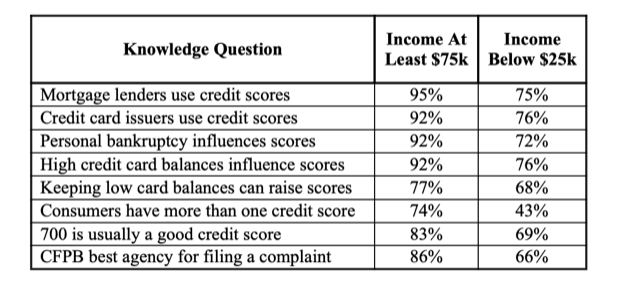
The phone survey of 1,001 representative Americans showed that 20% of households with incomes below $25,000, but only 13% of those with incomes of at least $75,000, intended to apply for credit in the next 12 months. At the same time, as the table below shows, these low-income consumers are far less likely than the high-income consumers to answer consumer knowledge questions correctly, the CFA said.
“At least one-quarter of low-income consumers lack the knowledge to help them raise low credit scores,” said Stephen Brobeck, a CFA senior fellow. “This lack of awareness could limit their access to credit or subject them to higher costs. Low income households can least afford to pay higher interest rates and fees associated with low credit scores,” he added.
The CFA noted low-income consumers are more likely than high-income consumers to consider their knowledge of credit scores to be fair or poor – 58% vs. 37%.
‘One Reason’
“Probably one reason for this perceived lack of knowledge, as well as less actual knowledge, is that low-income consumers are much less likely to have obtained or received any of their credit scores in the past 12 months – 32% vs. 59% for high-income consumers.
The CFA and VantageScore noted they developed and co-sponsor an interactive website, CreditScoreQuiz.org, that consumers can use to test their knowledge of credit scores. The website includes a 12-question quiz, available in both English and Spanish (http://www.cuestionarioparaelpuntajedecredito.org/)
Other Findings
While survey results indicated that low-income consumers had the least amount of knowledge about credit scores, a large number of all consumers still lack important basic knowledge, the CFA reported, including:
- Only 22% know that on a $20,000, 60-month auto loan, a borrower with a low credit score would likely pay more than $5,000 in interest than a borrower with a high score. Low scores may qualify borrowers for subprime auto loans only, with annual interest rates frequently exceeding 20%.
- Only 33% know that a credit score typically measures the risk of not repaying a loan—14% think that it measures knowledge or attitude toward consumer credit.
- Only 50% know that an electric company can use credit scores to determine the amount of deposit.
- Nearly half (48%) think that a person’s age is a factor used to calculate a credit score. However, only one’s use of credit actually influences their scores, the CFA noted.
- Over two-fifths (42%) think that credit repair companies are always or usually helpful in correcting any credit report errors or taking other measures to improve one’s credit score. “Experts agree, however, these companies tend to charge relatively high fees to do what consumers could do on their own for free,” the organization said.