

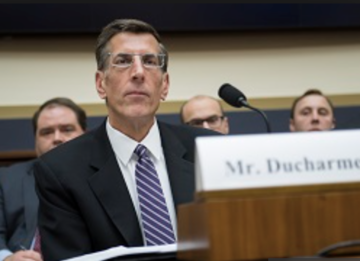
Brian Ducharme
WASHINGTON—During testimony before Congress, Brian Ducharme, CEO of MIT Federal Credit Union, urged members of a House Financial Services subcommittee to support legislation to stop the NCUA's risk-based capital rule (RBC) from taking effect on Jan. 1, 2019.
That legislation is scheduled for mark-up this week. Ducharme was testifying on behalf of NAFCU.
Ducharme said the rule will negatively impact the country's 110 million credit union members as it unnecessarily requires credit unions to set capital aside and thus "takes money out of the lending cycle," NAFCU reported.
The Common Sense Credit Union Capital Relief Act of 2017 (HR 4464), which would prevent the RBC rule from taking effect, was the focus of Ducharme's testimony before the House Financial Services Subcommittee on Financial Institutions and Consumer Credit. It is set for mark-up, along with a series of other bills, before the full House Financial Services Committee on Tuesday.
"NAFCU thanks members of the House Financial Services Committee for acknowledging the consequences of the NCUA's risk-based capital rule, and we are appreciative of Mr. Ducharme for relaying our concerns during Thursday's hearing," said NAFCU Vice President of Legislative Affairs Brad Thaler. "We encourage all credit unions to contact their representatives and let them know how the RBC rule will negatively affect the industry and to urge support for this legislation."
Ducharme testified that more than 400 credit unions will see declines in their capital cushions and roughly 40 credit unions, including Cambridge, Mass.-based MIT FCU, will see a downgrade in their capital levels. "NAFCU believes this rule is ill-conceived in its current form and will have a negative impact on the credit union industry if it is implemented without changes," Ducharme said.
In his submitted testimony, Ducharme noted studies on risk-based capital have found such requirements "are not appropriate for smaller banks and credit unions" because of their complexity, and "will likely impede economic growth without reductions in systemic risk," NAFCU reported.
Ducharme during the hearing also shared NAFCU's five tenets for a healthy and appropriate regulatory environment for credit unions and the ways in which many of the legislative proposals under review fall in line with the association's priorities.
When asked by Rep. Keith Rothfus (R-PA) about the impact "skyrocketing" regulations have had on MIT FCU, Ducharme said the impact has been "pretty significant," with increased compliance costs forcing the institution to allocate away resources that could have been spent on member services.
Ducharme, responding to a question from Rep. Scott Tipton, R-Colo., remarked that smaller credit unions that have closed in the past few years have done so "because of the excessive regulatory burden placed on them," NAFCU noted.
Ducharme's testimony also provided comments on other bills addressed by the subcommittee, including:
- The Business of Insurance Regulatory Reform Act of 2017 (HR 3746), which would help clarify the limits of the CFPB regulating insurance
- The Comprehensive Regulatory Review Act of 2017, which would amend the Economic Growth and Regulatory Paperwork Reduction Act of 1996 to include both the NCUA and CFPB as official participants and increase the review frequency from every 10 years to every five years.
Representatives from the Financial Services Roundtable, Mortgage Bankers Association and Americans for Financial Reform also testified during the hearing.