

NEW YORK--After more than a decade of rapid expansion, the Community Development Financial Institution (CDFI) industry has entered a modest pullback, with both the number of certified institutions and total assets declining since 2023, according to a new report from the Federal Reserve Bank of New York.
As of the second quarter of 2025, the CDFI sector included 1,378 certified institutions holding $446 billion in assets. That marks a 6% drop in certified entities and a 3% decline in total assets compared to mid-2023 levels, when the industry reached a recent peak.
For credit unions, the report underscores both dominance and vulnerability within the CDFI space. CDFI-certified credit unions hold approximately $277 billion in assets—roughly 62% of the industry total—making them the clear anchor of the sector. By comparison, certified banks hold $125 billion, or about 28%, while loan funds account for roughly $32 billion, or 7%.
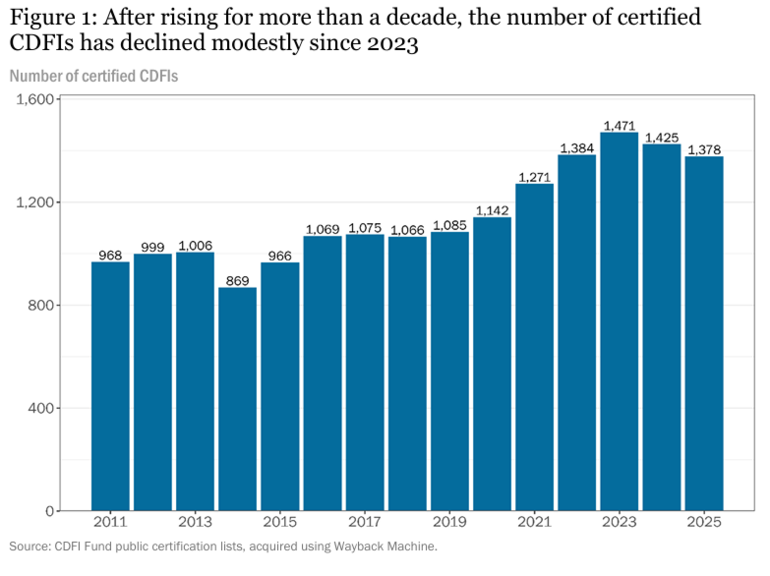
But the recent slowdown is being driven largely by credit unions, the report shows. The number of certified credit unions fell from 519 in 2023 to 445 in 2025, and assets held by CDFI credit unions declined by $18 billion over that same period. The contraction follows a period of extraordinary growth between 2019 and 2023, when federal programs and heightened industry outreach—particularly in Puerto Rico—helped drive certification and asset expansion.
Despite the recent dip, the longer-term trajectory remains striking. CDFI assets grew nearly tenfold between 2011 and 2024 before leveling off. Average CDFI assets now stand at $396 million, nearly five times the 2011 level, while median assets have climbed to $82 million—almost seven times larger than in 2011. Among credit unions specifically, median assets reached $181 million in 2025, representing more than tenfold growth over the period.
Credit unions also dominate the top tier of the industry. Nine of the ten largest CDFIs by assets are credit unions, with Suncoast Credit Union leading at $18.9 billion. Only one bank—BankPlus—appears in the top ten. That concentration reflects the increasingly central role of depository institutions, which now hold more than 90% of total CDFI industry assets, according to the report.
The report also highlights a structural difference between depository CDFIs and loan funds. While credit unions’ total assets are nearly nine times those of loan funds, their net worth is only about three times larger. Loan funds operate with significantly lower leverage, maintaining net asset ratios above 30%, compared to 10%–12% for depositories. That suggests loan funds rely less on borrowed capital, while credit unions continue to leverage deposits to scale impact.
Geographically, CDFIs are broadly distributed in line with population, but there is a notable concentration in the Mississippi River Delta region, particularly among certified banks. Credit unions remain more evenly distributed, with Puerto Rico accounting for a significant share of certified cooperativas following the certification surge of the past several years, the report shows.