

SAN ANTONIO–The first misconception a prize-linked savings program needs to overcome: it’s not “gambling.”
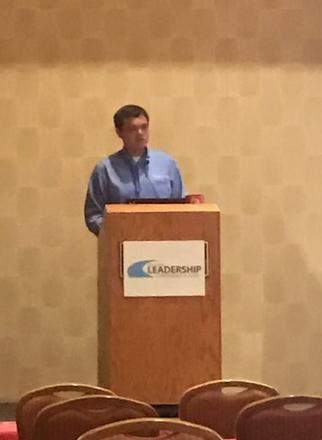
Nathan Behncke addresses meeting
Nathan Behncke, regulatory compliance advisor with the cornerstone CU League, said it’s a fundamental tenet that needs to be understood by the credit union itself, members and elected officials.
“We do not want to give the governments of any our states that we are involved in any sort of gambling,” he told the CCUL’s Leadership Conference here.
Instead, prize-linked savings are meant to promote a basic foundation of credit unions, thrift, by encouraging members to save. Such programs do so by holding quarterly and annual drawings for prizes for members who are participating.
Terrible Savers
By and large, people are absolutely terrible savers, observed Behncke, pointing out that in addition to the income levels that prevent many people from savings, it’s also just not a priority for many others.
Among the worst generations at savings are Baby Boomers, he said, with the demographic savings just 5% of their incomes. Generation X (35054) saves approximately 8% of income, while Millennials are actually the best savers at about 10% on average.
“It makes it difficult for the average person to weather even temporary hardships,” said Behncke.
Low interest rates on savings have also discouraged many people from saving funds in insured accounts and instead have looked to other vehicles, such as the stock market, he added.
The Genesis
Prize Linked Savings Accounts got their launch in 2006 as part of a Filene i3 program following research by Dr. Peter Tufano. That led to a 2009 pilot in Michigan that was “generally successful,” observed Behncke. The Michigan league’s CU Solutions Group has since created a PLS program that it offers to other states called “Save-to-Win.” CU Resources offers the program in Texas. In Minnesota, the program is known as “Win-centive.”
Follow-up research from Harvard Business School showed that increased savings in persons considered non-savers before the program by 56%, he noted.
As of 2018, 28 states have authorized prize-linked savings, including Arkansas and Texas (with enabling legislation passed in 2017). The product remains illegal in Oklahoma. Arizona, Louisiana, North Carolina and Rhode Island allow prize-linked savings for credit unions only. There are no restrictions at the federal level.
Behncke noted that initially there was slow adoption of PLS programs in part over the related costs and uncertainty over whether members really want it.
Be Careful
After reviewing some of the legalities and rules such as Truth-in-Savings around prize-linked savings programs, including the fact that a different interest rate can be offered at least in at least some states, Behncke again stressed that when marketing the product a CU must really focus on the savings and stay away from suggesting it is any sort of gambling substitute. Marketing must avoid images such as poker chips or other related activities, he said.
“Members need to know this is intended to entice them into savings more money than they are currently using,” Behncke said.