ALEXANDRIA, Va.–NCUA is proposing to turn its CAMEL rating system into a “CAMELS” rating system, with the new “S” representing sensitivity to market risk, and specifically, interest rate risk.

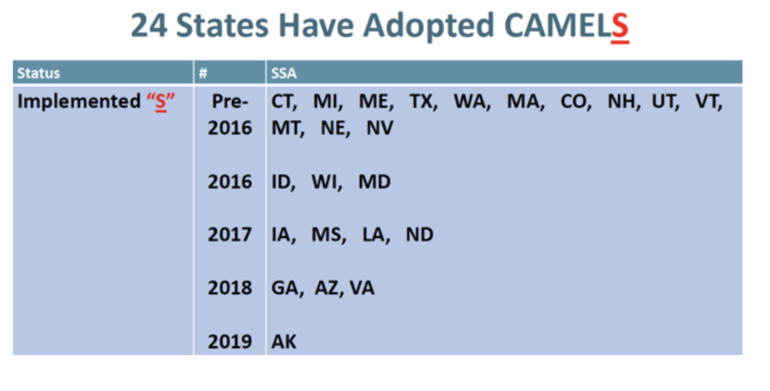
The proposal also calls for redefining the “L” for liquidity component. Many credit unions are already accustomed to a CAMELS rating system, with 24 state regulators already having such a measure in place (see chart, below).
The proposal was approved for 60-day comment by a 3-0 vote.
The CAMEL rating system, for Capital adequacy, Asset quality, Management, Earnings and Liquidity, was first developed in 1979, with NCUA adopting it in 1987 (prior to which it used the “Early Warning System”).
Since 1987, NCUA updated CAMEL 10 times, the latest of which was issued in 2007.
“Since then we have seen a significant increase in the total assets in the industry and an increase in concentrations in products such as fixed-rate real estate loans and investments,” said NCUA staff.
Staff told the board that adding the S component for sensitivity to market risk and redefining the L component to evaluate credit risk will provide enhanced clarity and transparency to credit unions and will improve communication by examiners.
Staff said from a functional examinational perspective, a couple of foundational elements are already in place, and NCUA’s MERIT also includes the foundation to add the S component.
If the proposal is approved, NCUA said it would require approximately one year to add the S. and create CAMELS rating. The transition will likely require all of 2021 in order to implement as early as Q1 2022, staff said.
Strong Support from Chairman
NCUA chairman Rodney Hood called the proposal “opportune and appropriate.”
“I certainly believe in updating to CAMELS it will help credit unions to fully understanding examiners’ assessment of interest rate and liquidity risk by citing a separate S and a separate L component rating,” Hood said. “This has long been an issue identified by our Office of Inspector General. The adoption of CAMELS will not change examination processes for interest rate and liquidity risk assessments. Adopting CAMELS will strengthen our supervision and the transparency of our examination efforts.”
In response to a question from Hood, NCUA staff said it expects the adoption of CAMELS will not adversely affect the composite CAMEL(S) rating, and will only work to improve transparency, saying it provides greater clarity for each risk assessment that the blended component does not.
A ‘Long Time in Coming’
NCUA Board Member Todd Harper said the rule is a “long time in coming.”
“Not only have our fellow federal and state regulators seen the wisdom in assessing liquidity risk separate from interest rate risk, but also the NCUA Inspector General called for the agency to take similar action more than five years ago,” said Harper. “In separating out liquidity risk from interest rate risk, we will ensure that the risk assessments for each of these components are clear and that one component can no longer mask the other component, leading to a false sense of security about a credit union’s risk potential. I am pleased we are finally implementing the Inspector General’s recommendation.”
Harper said in 1997, just 19% of a credit union’s balance sheet was in mortgage-related assets, a figure that has risen to 42% today.
“Longer duration mortgage assets typically increase an institution’s sensitivity to changes in interest rates and require a greater focus on liquidity risk management,” said Harper. “By adding a market risk sensitivity component to the existing CAMEL rating system and redefining the liquidity risk component to conform to the standards used by other safety-and-soundness regulators, we will better protect consumers, credit unions, the Share Insurance Fund, and taxpayers.”
NASCUS Response
In response, Lucy Ito, president of the National Association of State Credit Union Supervisors (NASCUS), said, "The state system praises the NCUA Board for moving forward on expansion of the rating system to include the 'S' component, matching the standard already used by 24 states (and long advocated by NASCUS for NCUA). We’re almost at the finish line – but we are willing and able to keep working with the agency to complete the process, and see this change made in time to be effective in 2022. The state system is driving toward this goal out of a desire to have consistent standards set across the credit union system, and to reduce risk. For some time, state examiners have observed that the extended low-yield environment may encourage greater risk taking by financial institutions. We urge the agency to finalize this proposal as soon as possible following the comment period and as soon as practicable following necessary technical re-programming."
NASCUS also included the chart, below, with its statement.