

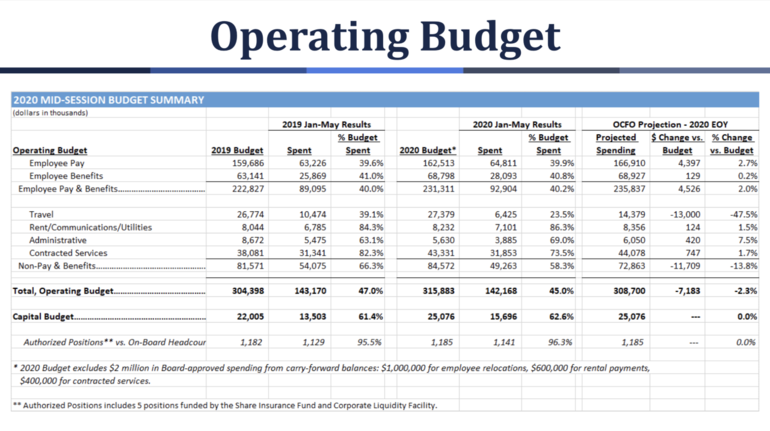
ALEXANDRIA, Va.–NCUA has released new mid-year spending estimates showing all those examiners working from home has led to savings of approximately $7.2 million in its 2020 budget, with a few other areas showing minor increases.
The figures were shared during the agency’s July board meeting.
In a letter to the agency ahead of its board meeting, NAFCU urged NCUA to continue to carry forward the cost savings it is realizing by moving full time to a virtual examination environment.
The 2020 operational budget was $315.9 million, including 1,185 positions, with a capital budget of $25.1 million and a Share Insurance Fund administrative budget of $6.5 million, including five positions. But travel costs are nearly 50% below what had been projected. Non-pay and benefits expenses at mid-year are 13.8% under budget.
NCUA’s CFO said the agency is still projecting there will be some travel taking place later this year.
The agency has seen some small expense increases as a result of the coronavirus pandemic, according to its CFO, including licensing and software costs related to remote work, reimbursement of work-from-home related expenses, and increased costs related to cleaning.
According to the agency:
- Overall staffing trends show a modest decline in the vacancy rate through May 2020, as compared to the same period of the prior year.
- Projected benefits costs are on target to the December 2019 published budget.
- The midsession compensation projections reflect the liquidation of a portion of NCUA’s liabilities associated with disbursements to employees for leave earned in 2020, reducing the anticipated end-of-year balance.
The Specifics
Specifically, NCUA said:
- Due to the restrictions placed on employee travel due to COVID-19 precautions and the shift to remote examinations, travel is forecast to be about 48% lower than in the 2020 budget. “This conservative estimate assumes that some level of examinations-related travel resumes later in this calendar year, but a resumption depends on NCUA’s on-site plans later in 2020,” NCUA said.
- The remaining other expense categories are projected to be slightly higher than originally budgeted, also as a result of the shift to off-site work resulting from COVID-19. “This is anticipated to include increased expenses for items such as remote communications and supply reimbursements due to required off-site, licensing and supporting technology equipment, cleaning supplies, and facility cleaning and maintenance,” NCUA said.
The Capital Budget
For its capital budget, NCUA said:
- No budgetary changes are required for the NCUA’s 2020 capital projects, for which the board approved $25.1 million in 2020.
- NCUA said project spending estimates and project timelines generally remain consistent with the project details and descriptions the agency published as part of the 2020 budget.
- Amounts provided by the NCUA board through the budget process for a capital project are generally available for that project for multiple years.
The Share Insurance Fund
- No changes are required to the SIF administrative budget.
- Similarly, state examiner travel for 2020 is lower than budgeted because of COVID-related travel restrictions.
In their comments following the staff presentation, Board Members J. Mark McWatters and Todd Harper both expressed support for resources to be provided in the area of consumer protection.
Additional information on the NCUA budget can be found here.
NAFCU Input
Ahead of the meeting, NAFCU CEO Dan Berger sent a letter to the agency calling on it to "carefully evaluate how it plans to utilize its remaining resources in 2020 and revisit its 2021 draft budget, which proposed another 3.8% increase over 2020."
Berger said NAFCU has consistently cautioned against annual budget increases and in testimony on the 2020 and 2021 proposed budgets reiterated its call for prudent management of funds by improving accountability.
Berger thanked the board for "quickly pivot[ing] to investing in technology and the resources necessary to assist credit unions during this uncertain time," noting the agency's efforts to promptly provide credit unions with relief and issue interim final rules to implement changes made by coronavirus relief packages.
"Unfortunately, more remains to be done," Berger wrote. "NAFCU urges the agency to consistently seek feedback from credit unions to find opportunities for further relief measures as institutions continue to combat the impacts of the COVID-19 pandemic. These temporary relief measures have a limited footprint on the agency’s budget, do not sacrifice safety and soundness, and could, in fact, lead to cost-savings in the supervision process while providing critical assistance to credit unions.
"The agency can ensure cost-savings in the future by utilizing available resources now to perfect its virtual examination procedures. NAFCU is encouraged by the NCUA’s deployment of a fully virtual examination process during the COVID-19 pandemic and has heard positive feedback from members," Berger continued. "Now is the time to document lessons learned and brainstorm more ways to further improve the examination process to begin transitioning to a predominately virtual examination process going forward."
In addition, Berger offered recommendations related to the NCUA's efforts to serve vulnerable communities with support for minority depository institutions (MDIs) and Community Development Financial Institutions (CDFIs).