

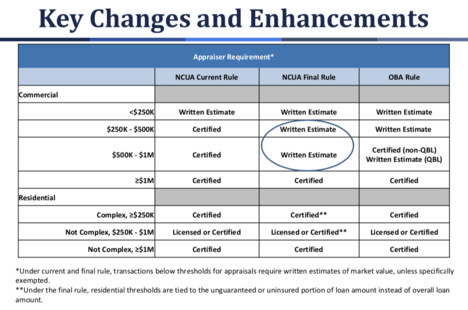
ALEXANDRIA, Va.–The NCUA Board voted 2-1 to amend its rules around real estate appraisals, including increasing the threshold below which appraisals are not required for commercial real estate transactions from $250,000 to $1,000,000. NCUA Board Member Todd Harper cast the dissenting vote.
The rule passed by the board also has been restructured to enhance clarity, includes an exemption from the rule certain federally related transactions involving real estate in a rural area, and makes conforming amendments to the definitions section. With the change, the NCUA Appraisal Threshold of $1 million is now double that of other banking regulators when it comes to non-qualifying business loans (non-QBLs), where the threshold is $500,000.
Four Objectives
In comments to the board prior to the vote on Final Rule Part 722, Larry Fazio, director of the Office of Examination & Insurance, said there are four objectives in updating a rule last updated in 2002:
- To match banks standards and provide some measure of relief for CUs and borrowers in rural areas where may be shortage of appraisers
- To restructure sections to make it easier for the reader when it comes to written estimates
- To incorporate the rule exemption into the regulation itself so it is all in one place
- To make minor conforming adjustments.
The key changes and enhancements to the rule can be seen in the slide at right.
Agency staff told the board they are recommending credit unions get appraisals even when not required based on safety and soundness and transaction risks; that many CUs have a successful history of commercial real estate lending and expertise comparable to community banks involved in CRE lending; that non-QBLs are not necessarily riskier than QBLs, and that credit unions currently have limited CRE exposure.
Harper’s Dissent
In casting his vote against the increase Board Member Harper recalled his days as a staff member on the House Financial Services Committee at the time of the real estate meltdown more than a decade ago. He said he was unable to support the proposal for three reasons:
- The magnitude of threshold increase is too large
- There is a lack of consistency with other financial regulators that could lead to “regulatory arbitrage”
- There is risk from the potential impact that could be had on “important safeguards for certain small business owners, particularly those who are unsophisticated”
“There is an old adage you should walk before you run, and with this rule we are running before we walk,” said Harper. “We are actually leapfrogging other financial regulators.”
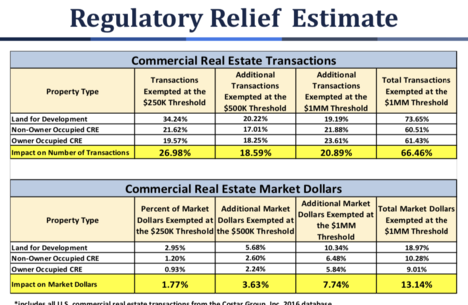
Harper said NCUA staff estimates the percentage of exempted real estate transactions will more than double to 66% from 27% as a result of the rule change.
“To be fair, there is a much larger percentage at banks and thrifts, but we don’t know that will always be the case,” said Harper. “Banks have larger staff and more expertise. They are already walking not running. Half of all credit unions not subject to the member loan cap and this may increase their risk appetites and the system’s exposure to commercial real estate losses. It would have been, in my view, more prudent to move in a smaller incremental step.”
Realtors’ Objections Cited
Harper added that among those that sent a comment letter opposed to the increase was the National Association of Realtors. “I expected the trade associations to support the increase” but the NAR is a group that benefits from the increase and it still opposed the change, as did three-quarters of the comment letters filed, said Harper.
He drew a final comparison to what happens when unsophisticated borrowers, such as those who took out taxi medallion loans, get in “over their heads.”
McWatters’ View
NCUA Board Member J. Mark McWatters disagreed, saying that the rule is narrow and the change appropriate.
“Since I’ve been at NCUA I’ve had a regulatory philosophy that regulations should be tailored to the actual risk presented,” said McWatters. “I ask myself is this tailored and targeted? And is it a safety and soundness issue? It only affects commercial real estate between a certain dollar amount. I think it is pretty targeted and tailored.”
McWatters said commercial real estate loans represent just 4% of credit union assets, while they represent 35% of assets at community banks.
“Sometimes people glom on to this term appraisal like it’s a guarantee. It’s not. It’s an estimate,” he said.
NAFCU Response
Following the vote, NAFCU's director of regulatory affairs, Ann Kossachev, said, "NAFCU supports the NCUA’s decision regarding commercial real estate appraisals, as it better aligns credit unions' standards with those contemplated by the other banking regulators and provides meaningful relief for rural areas."
NASCUS Response
NASCUS CEO Lucy Ito issued a statement saying, “NASCUS commends the NCUA Board for modernizing the agency’s appraisal rule by increasing the threshold for which appraisals would be required for commercial real estate transactions, incorporating S. 2155’s relief for rural communities, and restructuring the regulation to make it easier to determine what is required. We will continue to examine the rule in consultation with our members and look forward to providing the state system perspective to NCUA as it updates its exam procedures and guidance, National Supervision Policy Manual and examiner training to reflect the final rule.”