

ALEXANDRIA, Va.–The NCUA board has voted 2-1 in favor of again delaying implementation of its risk-based capital rules, this time to Jan. 1, 2022, back from what would have been a Jan. 1, 2020 deadline.
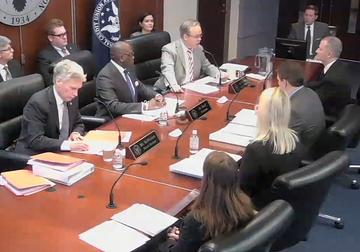
The rule would apply to credit unions of more than $500-million in assets.
NCUA Board Member Todd Harper cast the dissenting vote, arguing NCUA has repeatedly delayed the rule and now trails other regulators by more than a decade in implementing risk-based capital rules, even though the changes as proposed would affect just four credit unions, and even those four would be considered adequately capitalized under PCA under the new rules, according to NCUA staff.
NCUA staff told the board prior to the vote the delay would allow the agency time to develop and implement improved capital standards, specifically to allow for subordinated debt, to allow complex CUs additional options for compliance, and to allow for a three-year phase-in of the effects on capital ratios related to CECL.
NCUA Chairman Rodney Hood said the overall high net worth ratios of credit unions at 11.4% and the fact 99% of credit unions would not be affected means there is plenty of time to make the improvements.
Harper: No Need for More Delays
Harper pressed NCUA staff with questions around when other federal regulators had updated their risk-based capital rules, with staff responding it was more than five years ago,
“It is often said to those who forget the past are condemned to repeat it,” said Harper, saying the ongoing delays in the risk-based capital rules mean the NCUA board is “forgetting the past just like the characters in Groundhog Day. In my view the time has long since come for NCUA to implement this tailored, common sense standard.”
Harper said he had previously voted against such a delay because in his view credit unions “should hold capital equal to the risks held on their balance sheets.
“Putting risk based capital standards in place before the next recession is sound public policy. We don’t know when a recession is coming, but we know it is coming at some point, that is why we should fix the roof before it rains by implementing this starting in 2020,” Harper said.
McWatters: Proposal Violates FCU Act
McWatters followed by saying he hasn’t forgotten the past, including that he had voted against the rule previously because it’s his view based on three decades of legal experience that the risk-based capital plan violates the Federal Credit Union Act.
That had been the view at the agency until “suddenly and shockingly” NCUA changed its position, he said.
“I am not going to vote to have a rule go into effect that in my opinion as a lawyer violates the law,” said McWatters.
McWatters said he also favors delay because NCUA is now considering an expanded suite of rules that would include subordinated debt options, and in his view, “more capital is better than less capital.”
Trades Comment On Delay
NAFCU is asking the agency to look closely at its RBC rules.
“Today, the credit union industry remains well-capitalized, manages risk well, and has proved resilient in light of the bank-led financial crisis of 2008,” said NAFCU President and CEO Dan Berger. “We appreciate NCUA Chairman Rodney Hood's and Board Member J. Mark McWatters’ commitment to ensuring credit unions benefit from an appropriate, modern capital regime by providing further review of the agency's risk-based capital rule. While the NCUA reviews its rulemaking, NAFCU strongly urges the agency to consider its rulemaking anew and assess risk based upon a credit union's specific business practices as opposed to an arbitrary asset threshold.”
NASCUS said that while it understands the need for time to develop a comprehensive capital framework, it is disappointed that the RBC rule will be delayed for two additional years.
"The economy is stable now and it appears it will be stable in 2020," said NASCU President and CEO Lucy Ito. "However, that may not be the case in 2021 or 2022. Capital reform should be in place ahead of the next economic downturn to help credit unions buffer the impact of higher unemployment, decreases in house values, etc. That said, we are encouraged that the board shared its intended timeline for releasing proposals for a subordinated debt rule (January 2020) and a credit union alternative to the community bank leverage ratio (February 2020). Perhaps if NCUA resolves the related capital issues, it will be in a position to reconsider implementing the RBC rule prior to the current January 1, 2022 effective date.”