

NEW YORK–The billions of dollars in government stimulus money paid out during the pandemic—funds that sent CU savings balances surging—are dwindling for many Americans and have been depleted by many others, according to a new analysis.
According to Moody’s Analytics, the stimulus funds that went to many working- and middle-class households could be exhausted as soon as early next year, which will not only reduce their financial cushions but also potentially affect the economy, since consumer spending is such a large share of activity, according to the company.
The New York Times noted that in April 2020, after the pandemic’s outset, the nation’s personal saving rate jumped fourfold from its February 2020 level to 34%. Some of that spike in savings resulted from government checks of up to $1,200 sent to most Americans; some simply stemmed from reduced spending by firmly middle-class or affluent households during lockdowns, the Times noted. The rate peaked again at 26% this past spring after another round of direct federal payments.
For credit unions, regardless of the source, it marked a big inflow that affected just about every CU’s liquidity ratio.
“But the personal saving rate doesn’t account for how those savings are distributed. Wealthy households, for instance, have saved the most,” the Times added.
What New Research Reveals
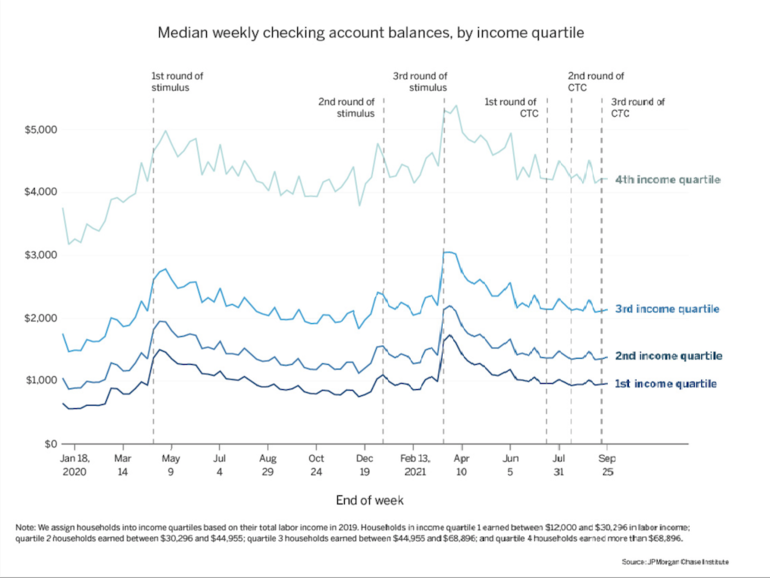
New research by the JPMorgan Chase Institute, which assesses the bank accounts of 1.6 million families, found that low-income families experienced the “greatest percent gains” during each round of stimulus, yet also exhausted their balances faster, according to the Times. That’s in part because those households went into the crisis with the thinnest financial buffers.
The same research found the median balance among higher-income families (defined as those earning more than $68,896) was roughly 40% higher in September than two years earlier. The typical low-income family (those earning less than $30,296) experienced a much larger increase in relative terms — 70%— but that represented a total cash balance of only about $1,000.
And households making $30,296 to $44,955 also made significant gains compared with 2019, yet typically had less than about $1,300 in cash on hand, according to the JPMorgan Chase Institute.
One ‘Silver Lining’
The Times noted that in a “silver lining,” the report found the cash balances of families with children appear to have been helped by the three rounds of monthly child tax credit payments that began in July, which provided up to $300 per child under six and up to $250 per child 6 to 17.
“I’ve been trying to ask myself this question: Is this a lot or is this a little?” Fiona Greig, a co-president of the JPMorgan Chase Institute, told the Times, adding that when reviewing the data, she was torn between hope — when seeing that “families had a doubling of balances in some cases when they received their stimulus checks” — and disappointment knowing “there are some families for whom this is really all they have.”
By October, the U.S. personal saving rate, which had peaked above 30%, had reverted to its December 2019 level of 7.3%.
Unintended Consequences
“Technically, most households are financially better off now than before the crisis by several measures, an anomaly after a recession,” the Times stated. “Still, the fading impact of pandemic aid is quickly being felt. In July, one in three Americans reported having less money to fall back on in an emergency than before the pandemic, according to a Bankrate survey.
The report added, “There has been wide agreement among business leaders and economists that after decades of wage and income stagnation, the burst in savings has eased poverty while giving employees and job seekers more leverage. But there is less agreement about whether this development has had unintended, negative consequences.”