

DURHAM, N.C.–What makes a financial institution “good?” And why are so many government debt-collection efforts so bad? One person here had answers for both questions.
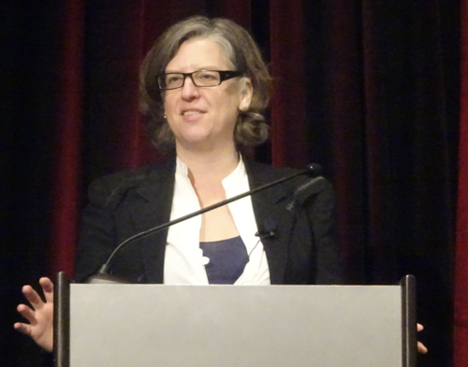
Virginia Eubanks speaks during big. bright. minds. meeting
Virginia Eubanks, associate professor of political science at the University of Albany-SUNY, shared with Filene’s big.bright.minds meeting here remarks around the title of her book, “Automating Inequality: How High-Tech Tools Profile, Police and Punish the Poor,” and further offered her view on how credit unions can play a positive role.
Eubanks recalled when she first joined the faculty at the University of Albany she was actually already living in the area as a resident of Troy, N.Y. During a faculty orientation, other new faculty members from outside the area had numerous day-to-day life questions, and as part of that Eubanks extolled the benefits of belonging to her credit union, State Employees FCU (SEFCU).
A Challenging Question
In response, one of the newbies asked her what made for a good financial institution. It was a question she said she had to ponder, before finally concluding it is in part “a lack of predatory products.”
“Maybe that is a really low bar,” she said, laughing, before adding, “Simply don’t victimize vulnerable people. Or maybe it’s a line in the sand that credit unions promise to hold.”
Eubanks’ work and research have made her an expert in how vulnerable people are victimized, especially by government programs that often, ironically, are meant to help.
Three Themes
Eubanks touched on three themes addressed in her book, including:
- Automating Austerity. “Despite good intentions, these tools in public services assume austerity, that there isn’t enough for everyone and hard choice needs to be made over who gets to access tools,” she said. “But these tools actually end up diverting people away from public resources and create extraordinary hardship for families. We actually end up spending more money to share fewer public resources than we did before.”
- Poverty Profiling. Although many government debt-collection tools are rationalized as means to combat bias, what they tend to do “is create feedback loops of injustice.” What a safe and healthy family should look like gets built into models, observed Eubanks, and families feel it creates “poverty profiling.”
- Empathy Override. At their worst, the tools create “empathy override,” where the biggest challenges the nation faces get outsourced to a purportedly neutral computer program instead of having people just care for each other, she said.
The Digital Poorhouse
Eubanks said an invisible institution of surveillance and containment has been created that attempts to predict the future in social services. “It’s all around money and extraction. It not only controls people in their day-to-day lives, it also creates a regime of extraction,” said Eubanks.
It isn’t just an issue in the United States. Eubanks pointed to the “Not My Debt” campaign in Australia launched in response to what she called a “robo-debt scandal.” About one-million people received automated notices from the Australian government saying they were overpaid benefits in the past and need to prove they don’t need to pay reimbursement. About three-quarters of those contacted by the government were shown to be incorrect, and the government has been forced to freeze collection on some of the alleged debts.
After traveling to Australia and witnessing the robo-debt scandal, Eubanks returned to do research and file a FOIA in the United States and found the same thing is happening in the U.S. and elsewhere over what she called “government zombie debt collection.” One Illinois agency sends 29,000 collection notices per year. Iowa sent 20,000 similar letters over two months.
No Appeal
In those cases she said, digital tools are being used to go further and further back through records to ID inconsistencies, which are then ID’d as debt.
“Families across the country are receiving these notices over supposed over-payments, often over benefits they don’t remember even getting, going back as far as 30 years,” said Eubanks. “Often, the debts are so old that neither the state nor the family has any records of these payments. For many of the families I spoke with, the debt was never legitimate to begin with.”
To frustrate people even further, in many cases the window to appeal the claims of debt closed years before they were ever informed of the supposed overpayment and debt. In Maryland and Illinois, the government has gone after children of people who are no longer alive but who allegedly were overpaid, Eubanks said.
Deeply Unethical
Eubanks called much of what she has seen “deeply unethical” collection practices, saying the government is able to take actions that would never be allowed in private markets. She suggested the state should carry the burden of proving debt, rather than having those notified of debt having to prove they don’t owe the funds. And finally, there should be a statute of limitations on such debts, she said.
“The big picture here is really about being aware that each system we produce for the intentional purpose of lowering barriers to receiving public benefits or financial services can also be used to open up families to predations,” said Eubanks. “We really need to get a sense of how many of these letters are going out every month in the United States. We have no idea, and I suspect it’s in the hundreds of thousands.
“This combination of data systems that can reach deeply into the past with government systems that can reach deeply into your pockets—even if untrue—creates a legalized extortion I call the shakedown state,” Eubanks continued.
What Can CUs Do?
Eubanks said there is a role to be played by credit unions in the broader picture.
The ideal institution, she said, treats people “with dignity. It steps into provide resources that keep a one-time emergency from becoming a life-altering, permanent catastrophe. And it protects communities from financial predation. I think that’s the line credit unions can hold.”
Additional Resources
For more information, Filene recommended two of its deep dive reports:
- #493: Fairness and Accountability for Algorithms in Financial Services: Addressing Bias and Discrimination to Prevent Digital Redlining
- 462: Ethical and Legal Concerns of Using Artificial Intelligence