

RALEIGH-DURHAM, N.C.–The changing demographics of the United States are having real implications on members and their ability to save.
For credit unions, it will mean introducing reforms in both products and approaches, according to one person.
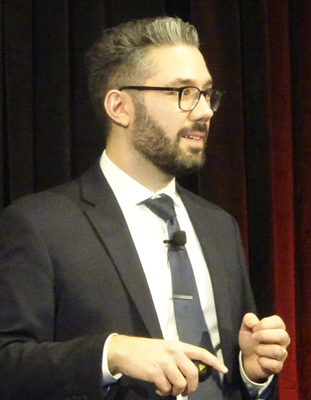
Lowell Ricketts addresses the meeting
Speaking to Filene’s big.bright.minds meeting here on the issue of retirement and housing insecurity, Lowell Ricketts, lead analyst with the Federal Reserve Bank of St. Louis’ Center for Household Financial Stability, said those changing U.S. demographics are affecting retirement savings crisis, innovations and reforms, homeownership inequities, and access to home equity.
The Demographics, They Are A-Changin’
First, said Ricketts, what can’t be overlooked is how the “dependent population” is growing in ways that will affect everyone. Ricketts defined dependents as individuals younger than 20 and older than 65 are expected to rapidly rise as a share of the population in the next few decades.
“This will have important implications for the population and the economy. The economy is going to become much more top-heavy,” he said. “The surge in dependency ratio will primarily be driven by greater share of population reaching the retirement age, hitting an inflection point around 2047. In addition, the U.S. fertility rate has been declining slightly as the average life span has increased dramatically during the 20th century. Life expectancy is expected to increase further and the rate of that increase has surpassed earlier forecasts.”
Ricketts said around the mid-2030s the U.S. will see Social Security Trust Fund depleted, all of which, he added, means, is the “stool is a bit wobbly.”
How Prepared are Americans for Retirement
According to 2018 findings in the Fed’s Survey of Household Economics and Decisionmaking (SHED):
- 36% of non-retired adults think their retirement savings plan is on track
- 25% of non-retired individuals have no retirement savings or pension
- Among those with retirement savings, just 22% have money in defined benefit pensions
- Of those 60 and older, 13% have no retirement savings or pension; 45% think their savings are on track
More specifically, ownership of defined contribution plans has long differed between white and nonwhite families, and had expanded to 29.5 percentage points in 2016, said Ricketts.
He also offered a caution to keep in mind around retirement data. “If we take the share of those households that have any amount of money in retirement accounts, they are going to be attributed to having accounts by this measure,” he observed. “Two-thirds of white households are covered in some way. Just one third of nonwhite households have these accounts.”
Long Term, Short Term
To talk about long-term savings it’s also necessary to first talk about short-term savings, according to Ricketts.
“You can’t talk about long-term stability without talking about short-term stability,” said Ricketts, before citing (and noting everyone cites it) that in 2018 39% of adults couldn’t cover a $400 expense without borrowing or selling something. Fortunately, this statistic has gone down significantly, he said, as the economy has recovered.
Innovations & Reforms
Steps that should be taken to improve Americans’ savings rates and recommended by Ricketts include:
- Strengthening the 401(k). “Build on what works.”
- Making plans more portable and simplify rollovers.
- Create a sustainable future for the Social Security trusts.
- State-run IRA plans to close coverage gap.
- Sidecar accounts to address expense volatility, preserve retirement funds.
What Can Be Done About Social Security?
With the Social Security Administration forecasting the Old Age and Survivors Insurance Fund will run out of cash by 2035, Ricketts said the options are:
- Raise tax rate paid by employer and employee
- Raise or remove earnings cap
- Change benefits formula by raising retirement age and changing COLA
- Find new revenue streams
The American Homeownership Society
Meanwhile, is homeownership still the pathway to financial security for Americans? It’s a good question, said Ricketts.
Again, he noted homeownership varies strongly by race/ethnicity, with large gaps between various groups, especially black and Hispanic families that have a homeownership rate approximately 27 percentage points below that of whites. He added the trend is true across all generations. Hispanic Millennial home ownership, however, is much higher than had been expected, said Ricketts.
“Sustainable homeownership has long been out of reach for many black and Hispanic families,” said Ricketts. “The historical legacy of explicit housing discrimination hampers black and Hispanic homeownership and home equity today. Predatory financial products continue to be a concern in the low-to-moderate income segment of the housing market. A lot of households think they have traditional mortgage products,” but do not.
For more info: Filene’s George Hofheimer pointed attendees to two reports available at filene.org on savings that Filene has conducted that offer more information, including:
- Research Project 491: Are You Prepared? Get Your CU and Members Ready for Recession
- Research Project 459: The Credit Union of the Twenty-First Century