

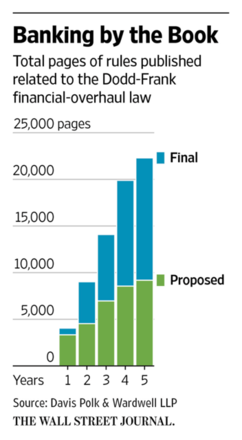
NEW YORK–The effect of Dodd-Frank on banks, and by default, credit unions, was profiled in detail by the Wall Street Journal, which summed up the feeling of many by pointing to one person’s joke that TRID doesn’t stand for the TILA-Respa Integrated Disclosure rule, but instead for “The reason I drink.”
The Journal interviewed the nation’s largest banks regarding the costs of complying with Dodd-Frank, which was passed in 2010 and is currently at 22,200 pages.
“Those rules and others have spawned a regulatory apparatus that is the fastest-growing component of the financial sector, with banks hiring tens of thousands of new staff whose job it is to keep their employers right with the new regime,” the Journal reported. “Federal agencies have dispatched thousands of their own minders to set watch at banks.”
The Wall Street Journal cited ABA data that show the heightened regulatory environment led 46% of banks to pare back their offerings for loan accounts, deposit accounts or other services.
It further cited data showing the six largest U.S. banks by assets in 2013 together spent at least $70.2 billion that year on regulatory compliance, up from $34.7 billion in 2007, according to the most recent study by policy-analysis firm Federal Financial Analytics Inc., which said costs have continued to mount since then.
The Journal noted that big banks regularly see teams of regulators from not just the Fed and the FDIC, but the OCC and another dozen agencies.
“The dynamic can be maddening for all sides, with regulators, internal compliance executives and employees operating like rival tribes, according to interviews with more than three dozen current and former employees who have worked on these issues inside the country’s banks and regulatory agencies,” the Journal reported.
And in comments that will resonate with many credit unions, many banks, large and small, noted how many compliance-related employees they now employ. At J.P. Morgan, the nation’s largest bank by assets, the head count associated with what it calls “controls,” which includes many compliance-related staff, has grown to 43,000 in 2015 from 24,000 in 2011, the Journal reported.