

By Ray Birch
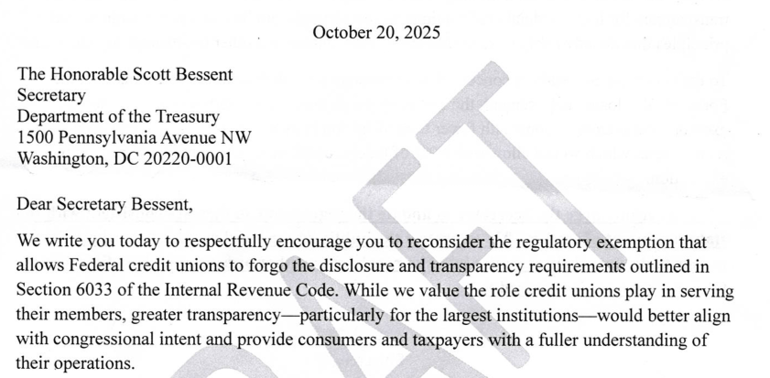
WASHINGTON—Bankers have reportedly intensified their campaign to weaken credit unions’ standing on Capitol Hill, circulating a draft letter that urges Treasury Secretary Scott Bessent to impose new reporting requirements on large federal credit unions, according to a document obtained by CUToday.info.
The unsigned draft letter calls on Treasury to roll back a 54-year-old exemption that allows federal credit unions to forgo filing Form 990—an annual disclosure required of nearly all other tax-exempt organizations. Its circulation, apparently, marks the latest step in a coordinated, yearlong effort by segments of the banking industry to paint big credit unions as indistinguishable from banks and ultimately position them for taxation. That campaign escalated sharply in 2025 when the Independent Community Bankers of America (ICBA) proposed taxing all credit unions over $1 billion in assets.
Sources on Capitol Hill informed CUToday.info that Republicans Pete Sessions (TX) and Troy Downing (MT), both members of the House Financial Services Committee, support the letter. CUToday.info reached out to both lawmakers Friday morning for comment, and also contacted the ICBA and the American Bankers Association for their responses.
The draft letter argues that the exemption created in 1971 “no longer reflects modern reality,” noting that some federal credit unions “now operate at a scale comparable to large financial institutions and engage in similar commercial activities, such as broad advertising campaigns or sponsorships.”
While the letter acknowledges that credit unions “play an important role in serving their members,” it frames the growth of large federal charters as grounds for imposing additional scrutiny—echoing talking points that have surfaced repeatedly in bankers’ tax campaigns this year.
Letter Cites 6033 Requirements, Calls For New Disclosures
Section 6033 of the Internal Revenue Code requires most tax-exempt organizations to file a Form 990 detailing finances, governance, compensation, and compliance. The letter notes that nearly all nonprofits—including state-chartered credit unions—must file the form, arguing that federal credit unions should be held to the same standard.
“Currently federal credit unions are not required to make certain disclosures that apply to nearly all other tax-exempt entities, including small community charities,” the letter states.
In what appears to be an attempt to make the proposal more palatable, the letter recommends carving out federal credit unions with under $1 billion in assets—a threshold that would exempt more than 90% of federally chartered credit unions, according to the document.
The letter tells Bessent that Treasury could “exercise his authority to continue to exempt federal credit unions with fewer than $1 billion in assets,” while requiring the largest institutions to begin public disclosure.
The letter concludes by urging Bessent to “update the regulations so they are consistent with the statutory intent of Section 6033” and to “require federal credit unions to disclose their activities just like nearly every other organization benefiting from tax-exempt status.”

Jason Stverak
Letter Follows Strong Support From CUs During Shutdown
The Defense Credit Union Council pointed out that when the federal shutdown hit, credit unions across the country sprang into action—offering no-interest relief loans, waiving fees, and helping service members and furloughed government employees access emergency funds.
“Instead of applauding that work, the banking lobby responded by pushing to force credit unions to file the IRS Form 990—a detailed nonprofit disclosure form—as a kind of retaliatory penalty,” said DCUC Chief Advocacy Officer Jason Stverak.
Stverak noted banks claim this filing requirement is about “transparency.”
“But the facts underline a very different story,” Stverak told CUToday.info. “Federal credit unions already submit quarterly 10-Q-like reports to NCUA covering roughly 3,400 data fields on loans, investments, deposits, income, expenses, and more. The Form 990 mandate would duplicate that oversight, impose unnecessary burdens—especially on small and mid-sized credit unions—and divert resources away from serving members.”
Credit unions aren’t asking for leniency—they’re asking for fairness, Stverak said.
“We ask lawmakers to recognize that this push by the banking industry is not about transparency, but about undermining cooperatives that serve their communities with trust and purpose,” he said. “Credit unions have earned their tax-exempt cooperative status by putting people ahead of profits—even during crises—and now it’s time for policy to stand with us, not saddle us with needless red tape.
Stverak said the truth is simple.
“Credit unions have earned that trust by putting people first,” concluded Stverak. “Defense credit unions, in particular, show up for military families in ways banks simply don’t. We advance pay during shutdowns, deploy emergency programs, and serve young, enlisted families who are too often overlooked by traditional banks. We don’t answer to shareholders. We answer to our members. And that difference shows in everything we do.
“So, if the banks want to keep taking shots at us, they can. But it won’t change the reality on the ground. Credit unions remain one of the strongest, most reliable financial partners for hardworking Americans and the men and women who serve our nation. We’ll keep doing what we’ve always done—serve with integrity, compassion, and commitment—while the banks continue trying to distract from their own failures to serve the underserved. Our communities know the truth, and that’s why credit unions continue to grow and thrive.”