

WASHINGTON—The Independent Community Bankers of America (ICBA) today launched a nationwide campaign calling on policymakers and the public to “Wake Up” to the “risky practices, costly tax subsidies, and irresponsibly lax oversight of the nation’s credit unions.” Both credit union trade groups have responded, with CUNA clarifying the reason for the credit union tax exemption and issuing a statement citing the more than a quarter-trillion dollars paid by banks in fines over the last decade, and NAFCU saying the real issue is big banks "eating community banks' lunch."
The ICBA said the Wake Up campaign will encourage policymakers to “open their eyes to the growing threats posed by these financial firms’ abandonment of their founding mission facilitated by their captive federal regulator,” the National Credit Union Administration.
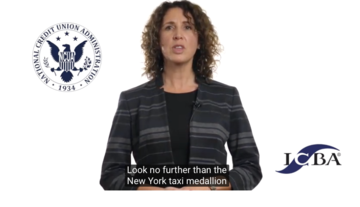
ICBA CEO Rebeca Romero Rainey appears in video.
“ICBA and the nation’s community banks are calling on Washington to stop pressing the snooze button and wake up to the risks of aggressive, growth-obsessed credit unions and the costs of their taxpayer-funded subsidies,” ICBA President and CEO Rebeca Romero Rainey said. “With credit unions abandoning their founding mission in the name of expansion and risky lending, it is long past time for Congress to level the playing field between community banks and credit unions while reining in the National Credit Union Administration’s expand-at-all-costs agenda.”
What Campaign Includes
According to the ICBA, the Wake Up campaign will feature legislative and regulatory proposals, comprehensive research, grassroots advocacy campaigns, and customizable resources to help community banks nationwide continue the call for policymakers to review credit unions’ $2 billion taxpayer-funded annual subsidy.
The group noted the initiative follows its formation of the ICBA Credit Union Task Force to take on the “disturbing trend of large credit unions using their tax subsidy to buy smaller, taxpaying community banks—a trend that is worsening industry consolidation, reducing tax revenues for local communities, and furthering credit unions’ unbridled encroachment into full-service banking.”
‘Unwarranted Subsidy’
The ICBA reminded that it and community banks have long opposed the credit union industry’s “unwarranted” federal tax subsidy and the “NCUA’s attempts to drastically increase the powers of tax-exempt credit unions beyond their statutory limits.”
With the help of a federal agency that has shown repeated lapses in regulatory oversight while cheerleading the industry it is charged with regulating, credit unions have abandoned their founding tax-exempt mission of serving people of modest means with a common bond, the trade group added.
“On the heels of the NCUA’s failure to prevent irresponsible credit union lending abuses in the New York taxi medallion scandal, which led to financial ruin for thousands of families, now is the time for policymakers to finally re-examine the credit union industry’s tax and regulatory subsidies,” said ICBA Chairman Preston L. Kennedy, president and CEO of Zachary Bancshares Inc. in Zachary, La. “With credit unions posing so many risks to their members, the financial system and taxpayers nationwide, Washington needs to wake up and address the credit union industry gone rogue.”
A video the ICBA has created can be found here.

Ryan Donovan
CUNA Response
In response to the ICBA announcement, CUNA's chief advocacy officer, Ryan Donovan, said, "Banking groups consistently devote valuable resources toward unwarranted attacks on a movement that prides itself on providing value and financial benefit to American consumers. This is not the first and it won’t be the last time the credit union mission and structure is brought into question. Credit unions continue to be the only financial institution that returns profits, upward of $16.4 billion, back to average consumers through direct & indirect financial benefits including higher yields on deposits, lower interest rates on loans, lower fees and better service. Historically, credit union lending and service practices have not been abusive in nature. Credit unions have always to provided members with safe and affordable financial products."
CUNA's statement also resonded to some of the other allegations made by the ICBA, including:
Abandonment of founding mission: "Credit union tax status arises from not-for-profit structure and member (depositor) ownership – unchanged since their inception early in the 20th century. Credit union tax status has nothing to do with growth, service offerings, or field of membership restrictions," CUNA said. "The credit union mission & mission fulfillment has not changed."
Risky Behaviors: "Widespread bank anti-consumer behaviors include saddling millions of consumers with toxic mortgages they couldn’t afford – precipitating the global financial crisis and the Great Recession. In fact, there have been a recorded $260 billion in bank fines since 2009."
Obsessive Growth-Obsessed CUs "Banks have a near-monopoly presence in the market with a 92.5% market share of total financial institution assets at year-end 2018. Additionally, bank assets have grown by $3.6 trillion in the past five years – 2.5 times more than credit unions have grown since beginning operations in the U.S. roughly 100 years ago," CUNA said. "It’s important to note that, three U.S. banks (JP Morgan Chase, BOA, Wells Fargo) individually control more assets than the total assets in all 5,400 U.S. credit unions."

Dan Berger
NAFCU Response
Also in response to the ICBA campaign, NAFCU President and CEO Dan Berger said, “This ‘campaign’ from ICBA is strangely misaligned and not pointed at their real problem – the big banks are eating the community banking industry’s lunch. The only mission abandoned by anyone in the financial services industry has been by banks – including community banks – who have chosen to put profit over people when they should have prioritized giving their customers good, honest service. Credit unions are not-for-profit cooperatives that exist to serve Americans of all means. The only thing community banks are really upset about is that their customers are beginning to notice that it’s better to bank without bankers. With so much at stake here in Washington, D.C., ICBA and its members would better benefit from looking at their own bank peers and industry malpractices as the reason for their challenges.”