

NEW YORK– New research examining how bank fees and interest have impacted consumers’ and banks’ bottom lines in the past decade has found that 2011 and 2020, deposit account bank fees outweighed interest by about 1.2 times, but consumers also paid less in bank fees last year than in any other year in the past 10 (although that could be due to the coronavirus).
The research, conducted by Magnify Money, was launched in the wake of the surge in deposits at commercial banks in the U.S., which rose to $16.1 trillion from $13.2 trillion during 2020 alone.
“For more than 10 years, deposit rates have generally been very low,” DepositAccounts founder Ken Tumin said. “The average consumer has been paying out much more in bank fees than they receive in interest on their savings.”
Key Findings
Among the key findings of the research, according to Magnify Money:
- Americans have paid far more in bank fees in the past decade than they’ve collected in interest. Between 2011 and 2020, consumers paid $345.1 billion in bank fees while collecting $231 billion in interest. That represents a deficit of $114.1 billion, or $198.40 per account, the analysis found.
- Bank account holders paid less in fees in 2020 than any other year dating to 2011. Americans last year paid $32.2 billion in bank fees, or an average of $53.79 per account.
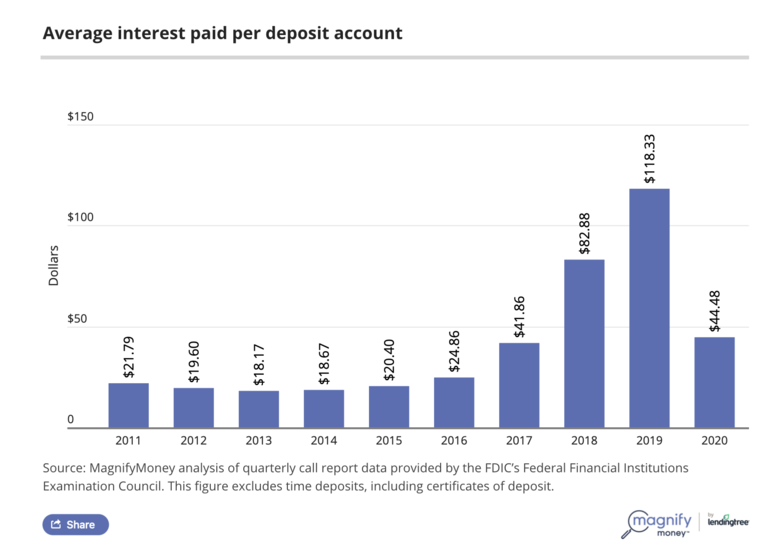
- The amount of interest per account paid out by banks plummeted in 2020. Banks paid out $26.6 billion, or $44.48 per account, in interest last year, down $73.85 from a record-breaking $118.33 per account the year prior.
- Banks more than doubled what they collected per account in 2020. For each dollar paid out in interest to deposit accounts in 2020, banks collected $1.21 — a jump from 55 cents in 2019, but a far cry from what institutions were netting earlier in the decade, according to the company.
Looking specifically at the decline in bank fees, Tumin said the coronavirus crisis could be the catalyst for the 2020 drop in fees. When the pandemic started in early 2020, many banks provided temporary fee waivers to assist impacted customers, the company noted.
In addition, the federal economic stimulus payments likely led to fewer overdraft fees — which Tumin said make up a large percentage of the total fees that banks receive — being collected.
Tumin also cites consumers spending less money due to pandemic-related restrictions as another reason for the drop in overdraft fees.
A Look at the Numbers
Magnify Money said average bank fees in 2020 were $53.79 per account, which is significantly lower than $64.84 per account in 2019. Bank fees per account peaked in 2017 at an average of $66.66. On average since 2011, banks have charged $60.75 yearly in fees per deposit account.
In 2019, banks paid out $66.1 billion in interest, but that amount plummeted to $26.6 billion in 2020, or about 2.5 times less. Since 2011, banks have collected $231 billion in interest — or an average of $23.1 billion yearly, the analysis added.
Magnify Money also said it is notable that banks paid out more interest in 2018 and 2019 than they collected in fees. Banks paid out $45 billion in 2018 and $66.1 billion in 2019, far above any year in the past decade — and the only two years that total interest exceeded bank fees in this period.
For info, go here.