

DALLAS–Key issues facing emerging women leaders were discussed during a session titled “Backwards in High Heels: Navigating the Pathway to Leadership.”
The session was part of the Women’s Leadership Conference hosted by the Cornerstone Credit Union League here. It was named after an observation made by Ginger Rogers, who when asked about dancing with Fred Astaire, responded that she did everything he did, but backwards and in high heels.
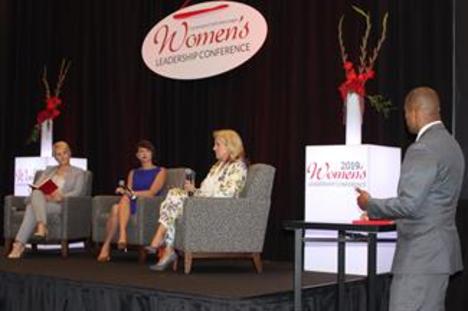
Featured as panelists during the session were Teresa Freeborn, CEO of California-based Xceed Financial Credit Union; Jill Nowicki, former CEO of the Credit Union League of Connecticut; and Rachel Pross, chief risk officer with Oregon-based Maps Credit Union. The session was moderated by James Pogue, an expert on diversity and inclusion.
According to the Cornerstone CU League, Pogue opened the session by talking about the benefits of gender diversity, including more innovation, higher productivity, and more empowered teams. He illustrated some of the challenges, citing statistics that show 70% of all credit union employees are women and 50% of credit union CEOs are women, but that for larger credit unions—those at $500 million or more—only one out of eight women are CEOs, the league reported.
‘Imposter Syndrome’
In response to a question from Pogue on how women might navigate a lack of confidence, Nowacki responded by noting many women feel “imposter syndrome,” observing, “Even when someone tells us we’re qualified, we still feel like we have to do more to prove ourselves.”
During the discussion, Pross noted she was faced with taking on an interim CEO position and felt unsure, sharing she called her father, who encouraged her and that she was just as capable as a man, but also said she would need to work twice as hard. His advice: “fake it until you make it.” Pross told the meeting she took the position and said it was the best decision she ever made, according to the Cornerstone League.
The CCUL quoted Freeborn as saying that when she was unsure of a decision or about asking for a raise, she would do research and have her facts and figures ready, which would reinforce her confidence. “I say yes all the time. Research trumps confidence issues any day.”
Knowing the Difference
When asked “how do know when your job is a great challenge or when it’s not a great fit,” Freeborn responded, “Make sure it’s not just about you. Take on tough assignments, and if there’s no chance for advancement, go talk to the boss. If that’s the case, find another job. Some companies respect women who ask for what they want. Make sure your network is working.”
Pross added, “If you don’t feel you can use your talent and get fulfillment and growth, it’s okay to walk away, especially if you’ve been there awhile,” the CCUL reported.
Pogue asked the group if they had a professional or personal advisory board. Pross said she had lots of support and access to an executive coach she works with regularly, adding, “He is a good person to bring up challenges of attack and plan, asking about minefields. Often the best person to ask is your boss. If you’re not sponsored by your company, I highly recommend a coach. It doesn’t have to be expensive.”
‘Just Ask’
According to the CCUL, Freeborn said she has gone back to mentors—primarily men—but her biggest “go to” are women in her network. She said to “just ask. Women like to talk and buoy you up.”
Nowacki added that she likes to run things by as many people as possible. “The best way for women to get promoted is to be mentored by men. It’s the best way to learn skills that men use successfully and network,” Nowacki said.
Finally, Pogue asked the panelists to share some of the mistakes they’ve made and what they’ve learned. Freeborn talked about a bad hiring decision, which she said she handled by being upfront with her board. “Be very transparent. Just admit, ‘I made a mistake.’ We all make mistakes.”
One Mistake
Pross related how she played it safe with a job, the CCUL said. “I moved my family, took my kids out of school, and by end of first week, I knew it was a mistake. I had to admit the mistake to myself and my husband. Less than a year later, I moved into the job I am in now. When you make a mistake, don’t stick it out – fail fast. I’m so much happier now.”
Nowacki recounted a time when she compromised who she was to please others, saying she felt like she was not serving as a good role model for other women. “It felt like assimilation was really important, but me compromising who I was wasn’t making me a better executive,” the CCUL quoted her as saying.