

NEW YORK–Average yields for interest checking accounts tied a record low of 0.04% APY, while the average monthly fee for this type of account and the balance requirement to avoid paying the fee are both at record highs, coming in at $15.50 and $7,550 respectively, according to Bankrate’s 2020 checking account and ATM fee study.
When it comes to non-interest accounts, however, average monthly fees hit a six-year low of $5.27 and 47% of these types of accounts are free, Bankrate reported.
In addition, Bankrate found the average fee for non-sufficient funds (NSF) rose 0.3% to $33.47, an increase of 11 cents compared to last year and the highest it’s been in the 23-year history of the company’s annual study.
Meanwhile, the total average cost of using out-of-network ATMs decreased slightly, down eight cents to $4.64, the lowest it’s been since 2016, Bankrate said.
Bankrate’s findings are based on a survey of 10 banks and thrifts in 25 large U.S. markets.
The Key Findings
- Both the average monthly service fee ($15.50) and the average balance required to avoid a fee ($7,550) hit record highs for interest checking accounts.
- Nearly half (47%) of non-interest checking accounts are free accounts, the highest percentage since 2010. Monthly fees for non-interest checking accounts that charge them decreased by an average of 34 cents.
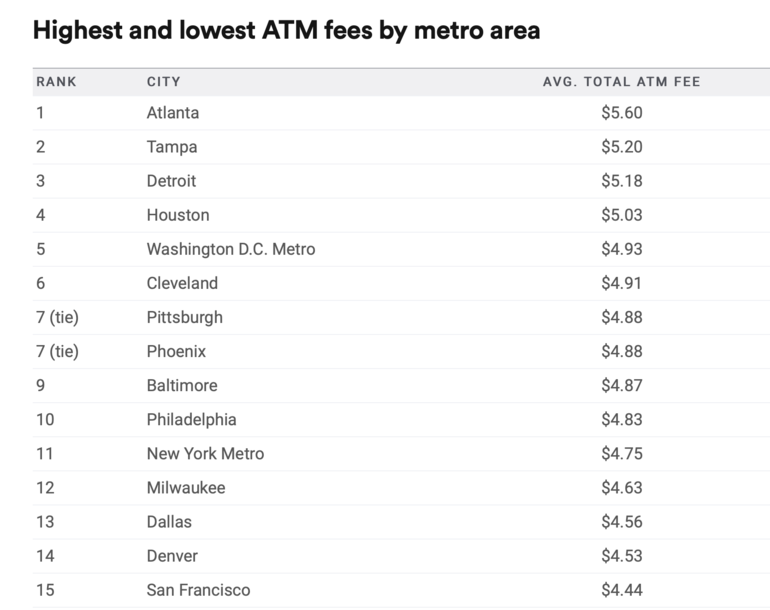
- Average combined ATM fees decreased by 8 cents, to $4.64. Atlanta had the highest fees at $5.60 and Chicago had the lowest at $4.11.
- Average overdraft fees hit a record high of $33.47.
Diving Deeper
Bankrate said the new record $7,550 needed to avoid paying a monthly maintenance fee on an interest checking account is up 6% from 2019. The average monthly service fee on interest-bearing accounts increased by nearly 3% since last year’s survey, Bankrate said.
Almost three-quarters of interest accounts (70%) require consumers to keep that balance in either a checking account or at the FI in order to avoid the fee.
“But direct deposit is a way to waive this fee on 21% of these accounts. That’s up from 19% last year and 16% in 2018,” Bankrate said.
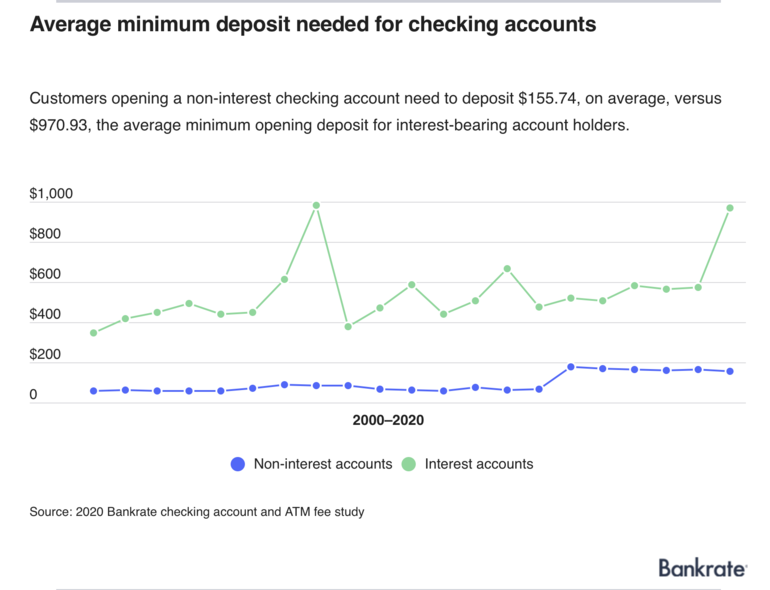
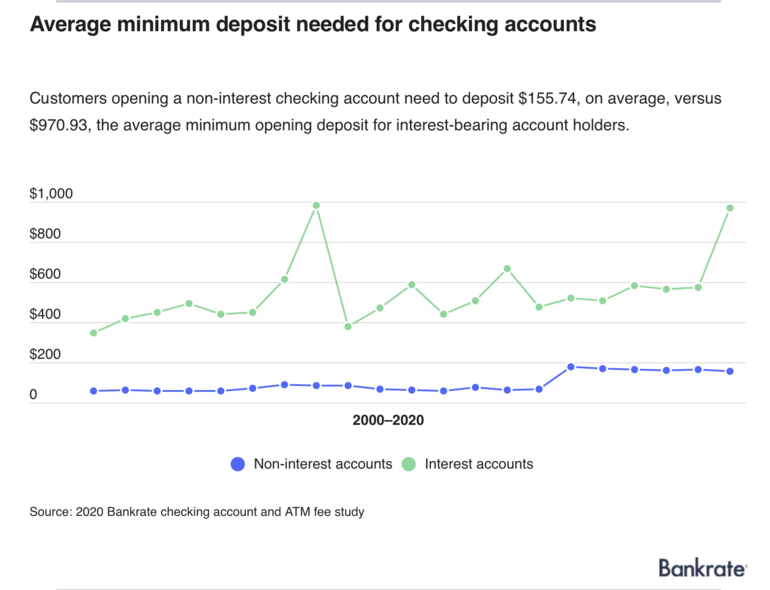
“Minimum opening balances are also climbing,” the Bankrate analysis continued. “The average amount needed to open an interest-bearing checking account skyrocketed since last year — going from around $575 to near $971 in this year’s survey. That’s only about $15 away from the record-high of $986, set in 2007.”
Other Findings
When it comes to non-interest checking, Bankrate reported its survey found the highest percentage of free accounts since 2010. Among non-interest checking accounts, about half (47%) are considered free, up 5% from last year and the highest percentage since 2010.
Of those accounts with monthly fees, the average fee has fallen to a six-year low of $5.27. This is significantly lower than the $15.50 average for interest checking accounts, Bankrate reported.
“In addition, customers only need to keep about one-thirteenth of the minimum balance in their account (about $594, on average) compared to interest checking accounts in order to have the fee waived,” Bankrate said. “Direct deposit will waive this fee for 41% of these accounts.”
The survey found consumers don’t need as much to open a non-interest checking account, with the average minimum opening balance decreasing by around $7 in the past year to a six-year low of $156.
A Dichotomy
There’s long been this dichotomy between interest and non-interest accounts, according Greg McBride, Bankrate chief financial analyst.
“And it is even more apparent this year with fees and balance requirements on interest accounts hitting new record highs at the same time that among non-interest accounts we’re seeing the most free accounts that we’ve seen in a decade,” McBride says. “And we’ve seen a shift toward lower fees and balance requirements among non-interest accounts.”
ATM Fees
According to Bankrate’s data, the total cost of the average out-of-network ATM withdrawal is $4.64, which is the lowest it’s been since 2016 and a decrease of eight cents in the past year.
ATM surcharges, on average, cost non-customers $3.08, down a penny since last year’s record high, Bankrate reported, saying it’s only the second time in the survey’s history the average ATM surcharge has decreased — with the last coming in 2004.
But the average ATM surcharge is still at the second highest amount in the history of Bankrate’s survey.
Banks still charge customers around an average of $1.56 to use another institution’s ATM, which actually fell for the third straight year and is the lowest since 2013, Bankrate found.
ATM fees are largely affected by location, however, with Bankrate noting cities like Atlanta, Tampa and Detroit pay significantly more on average for using out-of-network ATMs than those in Chicago, Los Angeles and Seattle. There’s around a 36% difference between the $5.60 average total ATM withdrawal fee in Atlanta compared with the average of $4.11 in Chicago, Bankrate found.
Overdraft Charges
The Bankrate Survey found the cost of overdrawing a checking account hit a new record high in 2020, increasing to an average of $33.47. The average overdraft NSF fee is 11 cents higher than last year and rose for the twentieth time in the past 22 years, the company reported.
Like ATM fees, Bankrate noted overdraft fees vary across the country. For instance, Philadelphia ($35.70), Houston ($35.18) and Baltimore ($35.05) all have average overdraft fees above $35. Meanwhile, Cincinnati ($30.42), San Francisco ($31.44) and St. Louis ($31.60) have the lowest overdraft fees.
The full survey can be found here.