MADISON, Wis.—Credit union loan balances rose 1.1% in May, driven largely by continuing strong auto loan growth, according to CUNA Mutual Group’s latest Trends Report.
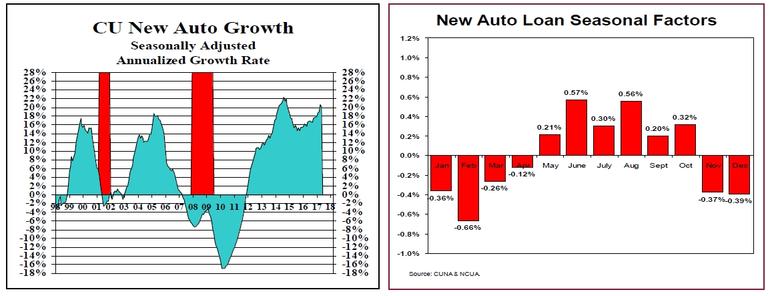
New-auto loan balances grew at a 20.1% seasonally adjusted, annualized growth rate in May, a strong acceleration from the 16.6% pace set in May 2016.
Total Credit Union Lending
Every loan category reported solid growth in May, led by used-auto lending, which increased 1.7%. This pushed year-over-year loan growth to 10.9%, the fastest pace since September 2005.
Meanwhile credit union savings balances grew 7.6% over the last year, above the 6.0% 10-year average growth rate, due to members’ accumulating their low-gas-price windfall. But with loans growing faster than savings, the credit union average loan-to-savings ratio reached 79.9% in May, above the 77.5% reported one year earlier. “We are still below the high-water mark for the loan-to-share ratio set back in September 2008, when credit unions were 84.1% loaned out,” CUNA Mutual said.
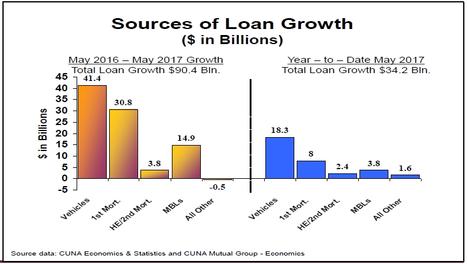
Vehicle lending has made up the lion’s share of loan growth over the last year. Since May of 2016, credit union auto loan balances increased a record $41.4 billion, followed by first mortgage loan balances rising $30.8 billion.
Credit Union Consumer Installment Credit (CUCIC)
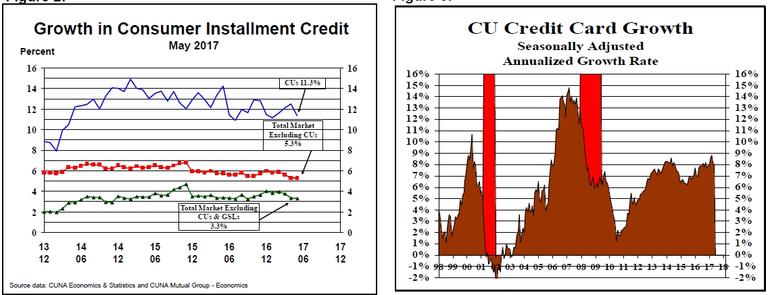
Credit union consumer installment credit loan balances (auto, credit card and other unsecured loans) rose 11.3% during the 12 months ending in May, which is more than twice the 5.3% pace of the total market, excluding credit unions, and significantly faster than the 3.3% growth rate of the total market, excluding credit unions and government student loans, the Trends Report shows. Credit union credit card loan balances grew at a strong 8% seasonally-adjusted, annualized growth rate in May as consumer financial conditions continue to improve; additional jobs, rising wages, higher stock and home values, and improving confidence.
Vehicle Loans
Credit union new-auto loan balances grew at a 20.1% seasonally-adjusted, annualized growth rate in May, a strong acceleration from the 16.6% pace set in May 2016. Credit union new-auto lending is the fastest growing loan category for the first five months of 2017 and throughout the last year. Used-auto lending is the second fastest growing loan category, increasing 13% during the last year, less than new-auto loan growth of 18%. On a month-over-month basis, new-auto loan balances increased 1.3% in May, faster than the 1.2% reported in May 2016. May’s seasonal factors usually add 0.21 percentage points to the underlying trend growth rate,and June’s seasonal factors are typically the largest of the year. May through October is considered the new-auto buying and lending season, CUNA Mutual explained.
Vehicle sales fell in May to a 16.7 million unit seasonally-adjusted annualized sales rate, which is down from the 16.9 million units reported in April, and 3% below the pace set one year ago. This sales decline occurred despite record-high incentive spending of close to $4,000 per vehicle as automakers attempt to clear record-breaking levels of inventory. New-auto sales headwinds include lenders tightening credit standards, a surplus of used cars, and falling pent-up demand.
Real Estate Secured Lending – 1st Mortgages and Other Real Estate
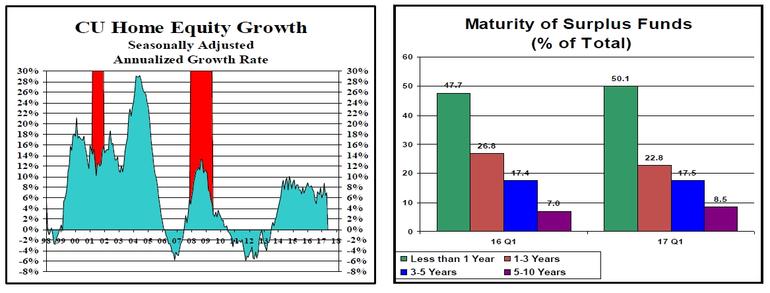
Credit union home equity loan balances grew at a 7% seasonally-adjusted, annualized growth rate in May due to rising home prices and improving consumer confidence. “The demand for home equity credit will remain strong due to rising home prices, the improving job market, rising consumer confidence, consumers releasing pent-up demand for durable goods, and low interest rates,” CUNA Mutual said. Credit union fixed-rate, first mortgage loan balances rose only 0.4% in May, down from the 1.1% in May 2016, and have shown only 2.2% growth so far this year.
Existing home sales increased to a 5.62 million annual pace in May, according to the National Association of Realtors, above the five million considered to be a healthy level. Their existing single-family median home price index rose 5.9% over the last year. “Generally speaking, this means most homeowners no longer need to fear a capital loss if they sell their homes. This will increase the supply of homes on the market and reduce the rate of price appreciation during the next few years,” the report stated.
The contract interest rate on a 30-year fixed-rate conventional home mortgage fell to 4.01% in May, down slightly from 4.05% in April, and below 3.6% in May 2016. The Fed will likely raise short-term interest rates one additional time in 2017 and 0.75% in 2018, CUNA Mutual said, adding that refinance applications will fall as interest rates begin their ascent in earnest.
Home prices rose 1.2% in May, according to the CoreLogic Home Price Index, and 6.6% year-over-year. The index is now 47% above the low point in March 2011 and only 1% below the peak set in April 2006. A strong labor market over the next few months will lead to a surge in home sales as household formation increases and existing households experience improving balance sheets and decide to exchange their old homes in for newer ones. However, without first-time homebuyers, the market is just shuffling homes among current homeowners and not generating new demand. First-time homebuyer purchases made up 33% of all sales in May, greater than the 30% reported in May 2016. But renting, rather than owning, continues to be popular with Millennials due to a lack of funds for a down payment, the report stated.
Surplus Funds (Cash + Investments)
Credit union surplus funds as a percentage of assets fell to 28.3% in May, down from 30.4% in May 2016, due to credit union assets growing faster than surplus funds—7.6% versus 0.1%, respectively. Credit union yield-on-asset ratios rose 3 basis points over the last year to reach 3.41% in the first quarter of 2017. The “mix effect,” the shift in the mix of credit union assets from low-yielding investments to higher-yielding loans, added 6 basis points to credit union yield-on-asset ratios. However, the “rate effect” shaved 3 basis points off yield-on-asset ratios due to the yield on loans falling from 4.59% in the first quarter of 2016 to 4.49% in the first quarter of 2017. Credit union cost of funds rose 1 basis point to reach 0.52% throughout the last year, so net interest margins rose only 2 basis points.
Surplus funds with a maturity of less than one year rose to 50.1% of all surplus funds in the first quarter, which is up from 47.7% in the same period a year ago. Longer term investments as a percent of surplus funds fell during the last year; one-to-three year investments fell to 22.8% of surplus funds from 26.8% a year earlier. “Credit unions are repositioning their investment portfolios due to expectations that the Federal Reserve may continue raising interest rates in the 4th quarter of this year. By reducing the concentration of long-term investments, credit unions reduce their interest rate risk exposure that accompany rising interest rates,” CINA Mutual said.
Savings and Assets
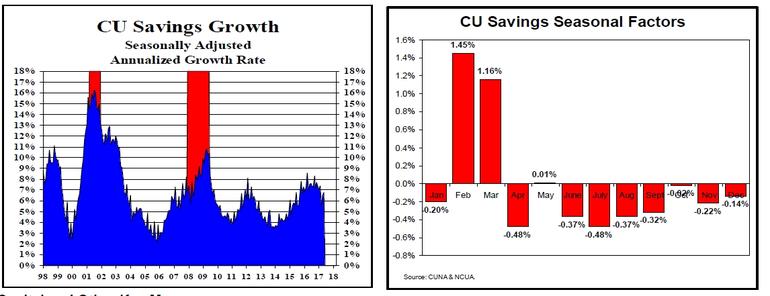
Credit union savings balances grew at a 6.8% seasonally-adjusted, annualized growth rate in May, a slight deceleration when compared to the last few months. “However, growth is faster now than the last couple of years because of low gas prices, rising household incomes, strong job growth, and faster membership growth. May’s seasonal factors (tax refunds) typically add a small 0.01 percentage point to the underlying savings trend growth. Seasonal factors turn negative for the remainder of the year,” the report shared.
Contributing to the overall growth in savings balances was the 2.7% growth in share certificate balances during the first five months of 2017 as credit unions slowly increased deposit interest rates to help fund the surge in loan balances. Credit union wholesale borrowings are up 10.1% from a year ago to boost year-over-year asset growth to 7.6%. Total credit union assets should breach the $1.4 trillion mark by the end of the third quarter.
Credit Unions and Members
As of May 2017, CUNA estimates 5,922 credit unions were in operation, four fewer than April and 211 less than May 2016. During the first five months of 2017, approximately 100 credit unions ceased to exist because of mergers, purchase and assumptions, or liquidation. “This rate is slower than the 103 reported during the similar time period in 2016. Most of the recent mergers were either an acquisition merger (where the assets of the merged credit union were 10- 50% of the acquirer credit union) or an absorption merger (where the assets of the merged credit union were less than 10% of the acquirer credit union). Our 2017 forecast estimates an average annual decline of 250 credit unions through 2021, bringing the total number of credit unions below 5,000 by the end of 2021,” CUNA Mutual said. “During the last 11 years, approximately 47% of the annual decline in the number of credit unions takes place in the first half of the year, so we should expect acceleration in mergers as we enter the third and fourth quarters.”
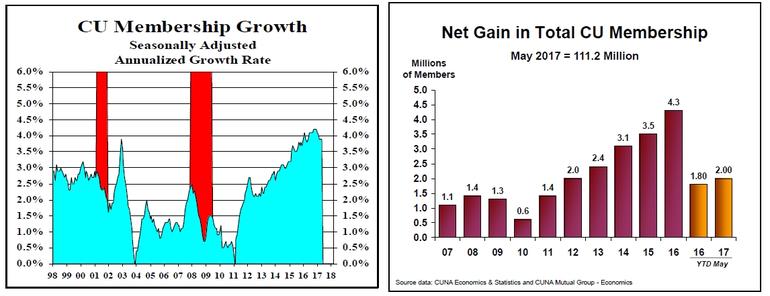
Credit union memberships grew a strong 408,000 in May, or 0.37%, up from May 2016 when the movement added 401,000 memberships, an increase of 0.38%. The membership gain was helped along by 152,000 new jobs created in May, according to the Bureau of Labor Statistics. Employment is typically one factor that drives credit union membership growth.
Credit union memberships grew at a 3.9% seasonally-adjusted, annualized growth rate in May, below the record-setting pace of the last few months. “However, the rapid membership gain began with Bank Transfer Day on November 5, 2011 is being maintained by the strong pace of new job creation over the last few years and the tremendous growth in credit union auto lending. During the first five months of 2017, credit unions added a record 2.0 million new credit union memberships, which has outpaced the previous record set back in 2016,” CUNA Mutual said.