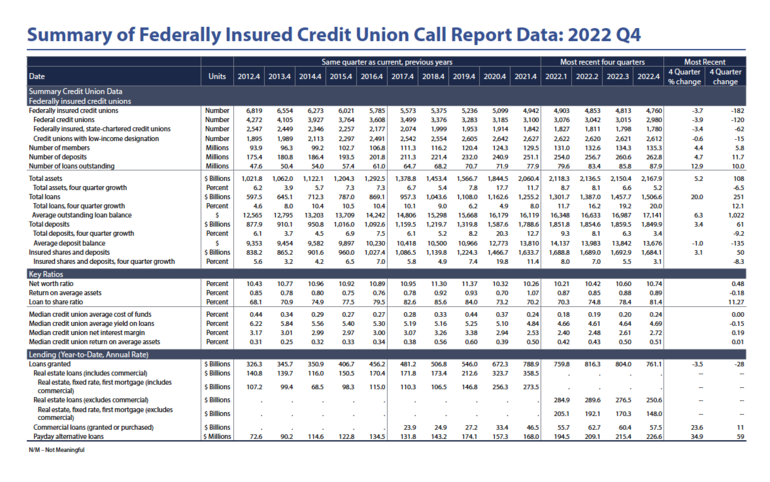
ALEXANDRIA, Va.–Total assets in federally insured credit unions rose by $108 billion (5.2%) to $2.17 trillion at year-end 2022, with lending so strong last year that loans increased at CUs in all asset size categories after years of declining among most CUs under $500 million in assets, according to NCUA.
The agency’s chief economist noted that among the most “striking features” in the data is the growth in second liens at CUs.
But there are reasons for concern, according to NCUA, with its chairman and its chief economist flagging concerns around the pace of growth in delinquencies on credit card and auto loans. And while CUs of all sizes reported stronger loan portfolios—which can be seen in the 10-point increase in the industry’s average loan-to-share ratio, overall, credit unions with assets below $500 million saw decreases in their memberships.
Total CU membership in the U.S. surpassed 135 million as of year-end 2022.
The full report can be found under the white papers tab in CUToday.info’s The Vault here.
On Solid Footing
“In terms of overall performance, federally insured credit unions remained on a solid footing last year. Total loans, assets, and insured shares increased, and capital levels remained strong,” Chairman Todd M. Harper said in a statement. “Economic activity, however, has begun to cool. As rates increase in the current economic environment, so does the associated risk that makes short-term liquidity events possible. The potential for sudden changes in either inflation, the rate environment, or the economy means that credit unions must remain nimble in the months ahead.”
The data was released as part of NCUA’s Quarterly Data Summary Report for the fourth quarter of 2022.
The Overall Performance
According to the agency, highlights from its year-end report include:
- The credit union system’s net worth increased by $21.4 billion, or 10.1%, over the year to $232.9 billion.
- The aggregate net worth ratio — net worth as a percentage of assets — stood at 10.74% in the fourth quarter of 2022, up from 10.26% one year earlier.
- Total shares and deposits rose by $61.3 billion, or 3.4%, over the year to $1.85 trillion in the fourth quarter of 2022.
- The return on average assets for federally insured credit unions was 89 basis points in 2022, down from 107 basis points in 2021. The median return on average assets across all federally insured credit unions was 51 basis points, up one basis point from 2021.
- Total loans outstanding increased $251 billion, or 20%, over the year to $1.51 trillion.
- The average outstanding loan balance in the fourth quarter of 2022 was $17,141, up $1,022, or 6.3%, from one year earlier.
- The delinquency rate at federally insured credit unions was 61 basis points in the fourth quarter of 2022, up 12 basis points from one year earlier.
- The net charge-off ratio was 34 basis points, up eight basis points compared with the fourth quarter of 2021.
- The number of federally insured credit unions declined to 4,760 in the fourth quarter of 2022, from 4,942 in the fourth quarter of 2021. In the fourth quarter of 2022, there were 2,980 federal credit unions and 1,780 federally insured, state-chartered credit unions. “The year-over-year decline is consistent with long-running industry consolidation trends,” the agency said.
- Federally insured credit unions added 5.8 million members over the year, and credit union membership in these institutions reached 135.3 million in the fourth quarter of 2022.
Worth Watching
During a call with the media held in conjunction with the release of the new data, NCUA Chairman Todd Harper said the numbers are strong, but he did flag the “notable” increase in delinquencies, especially in credit cards and auto loans.
“In the event of an economic slowdown, the ability to repay outstanding debt could be severely constrained, exposing credit unions to greater levels of credit risk,” said Harper, adding that elevated levels of liquidity risk and cyber security risk, in addition to rising interest rates, are also issues that have the agency’s attention.
“With rising interest rate risk, credit unions must be diligent in managing safety and soundness, and be prepared to face sudden changes in inflation, the interest rate environment and the economy.”
NCUA’s chief economist, Andrew Leventis, said some of the positives in the report include that net interest margins at credit unions grew during the year to 2.86% from 2.59%. He said capital also remains strong at small CUs.
Catching the Attention
Leventis said the data also reveal something else that has caught his attention.
“To me the most striking feature of last couple of quarterly releases is the growth in second liens,” he said. “This is consistent with the overall market, but if you look at the data summary, credit unions now have more than $100 billion in outstanding junior liens and that is up tremendously from last year. Auto loans have also gained market share. We saw 20% loan growth in outstanding loans over last year. So, credit unions have definitely gained marketshare in various segments over the last year. And you can see that in the increase in the loan to share ratio.”
As for the ongoing decline in the number of credit unions, Harper said it’s a long-term trend over the last three decades that is “hard to push back against.” He said NCUA continues to work with smaller CUs on their viability, including its proposal that succession plans be put in place. He added it has also worked to streamline the application process for de novo CUs and it is exploring the idea of "provisional charters” as a means of encouraging people and organizations to provide capital to start-up CUs earlier in the process.
The Balance Sheet Details
Here are the balance sheet details from the year-end report on credit unions from NCUA:
Assets
- Total assets in federally insured credit unions rose by $107.5 billion, or 5.2%, over the year to $2.17 trillion in the fourth quarter of 2022.
- Cash declined $124.7 billion, or 48.9%, to $130.3 billion. NCUA said CUs should note that the 2022Q1 Call Report redefined cash to exclude cash equivalents (investments with original maturities of three months or less). Cash now represents cash on hand and cash on deposit.
- Total investments fell $21.8 billion, or 4.8%, to $435.6 billion. The agency said CUs should note that the 2022Q1 Call Report introduced a new definition for total investments on the investment maturity schedule. Investments with maturities less than or equal to one year declined $8.8 billion, or 9.0%, to $89.3 billion.
- Investments with maturities of one to three years declined $0.4 billion, or 0.4%, to $115.4 billion.
- Investments with maturities of three to five years fell $33.7 billion, or 26.4%, to $93.7 billion.
- Investments with maturities of five to 10 years rose $18.3 billion, or 18.7%, to $116.2 billion.
- Investments with maturities greater than 10 years increased $2.8 billion, or 15.4%, to $21.1 billion.
Lending
According to NCUA:
- Total loans outstanding increased $251.4 billion, or 20.0%, over the year, to $1.51 trillion. NCUA said CUs should note that the loans variable was redefined to include loans to natural person credit unions, which were previously reported as investments.
- Credit union loan balances rose in all major categories, compared with the fourth quarter of 2021. Loans secured by 1- to 4-family residential properties increased $108.7 billion, or 19.7%, to $659.6 billion in the fourth quarter of 2022.
- Auto loans increased $81.1 billion, or 20%, to $485.6 billion. Used auto loans rose $49.6 billion, or 18.9%, to $312.1 billion, and new auto loans rose $31.5 billion, or 22.2%, to $173.5 billion.
- Credit card balances rose $10.0 billion, or 15.6%, to $74.2 billion.
- Non-federally guaranteed student loans increased $0.9 billion, or 14.3%, to $7.5 billion.
- Commercial loans, excluding unfunded commitments, increased $27.3 billion, or 24.5%, over the year to $139.1 billion in the fourth quarter of 2022.
Delinquencies & Charge-Offs
According to NCUA:
- The delinquency rate at federally insured credit unions was 61 basis points in the fourth quarter of 2022, up 12 basis points compared with the fourth quarter of 2021.
- The delinquency rate on non-commercial real estate loans was 43 basis points in the fourth quarter of 2022. NCUA noted this is a new variable added in 2022Q1; data for previous quarters are not available.
- The credit card delinquency rate rose to 148 basis points from 96 basis points one year earlier.
- The auto loan delinquency rate increased 25 basis points over the year to 67 basis points in the fourth quarter of 2022.
- The delinquency rate for commercial loans, excluding unfunded commitments, was 33 basis points in the fourth quarter of 2022, compared with 44 basis points in the fourth quarter of 2021.
- The net charge-off ratio for all federally insured credit unions was 34 basis points in the fourth quarter of 2022, up 8 basis points compared with the fourth quarter of 2021.
Liabilities and Net Worth
NCUA reported:
- Total shares and deposits rose by $61.3 billion, or 3.4%, over the year to $1.85 trillion in the fourth quarter of 2022.
- Regular shares increased $1.2 billion, or 0.2%, to $657.0 billion. Other deposits increased $45.1 billion, or 5.9%, to $810.8 billion, led by share certificate accounts, which grew $49.2 billion, or 19.9%, over the year.
- The credit union system’s net worth increased by $21.4 billion, or 10.1%, over the year to $232.9 billion. The aggregate net worth ratio — net worth as a percentage of assets — stood at 10.74% in the fourth quarter of 2022, up from 10.26% one year earlier.
Income Statement Details
The new NCUA report shows:
- Net income for federally insured credit unions totaled $18.9 billion in 2022, down $2.0 billion, or 9.5%, from 2021.
- Interest income rose $12.5 billion, or 21.2%, over the year to $71.5 billion.
- Non-interest income fell $2.8 billion, or 10.5%, to $23.8 billion, largely due to a drop in other income, NCUA said.
- Interest expense totaled $10.9 billion in 2022, up $2.5 billion, or 29.9%, from one year earlier. Non-interest expenses grew $5.1 billion, or 9.2%, over the year to $60.2 billion in 2022.
- Rising employee compensation and benefits, which were up $2.5 billion, or 8.6%, accounted for about half of the increase in non-interest expenses, the agency said.
- The aggregate net interest margin widened by $10.0 billion, or 19.8%, over the year to $60.6 billion in 2022.
- The credit union system’s provision for loan and lease losses or credit loss expense increased $4.1 billion, or 336.7%, to $5.3 billion in 2022.
Performance by Asset Category
As CUToday.info has reported, and as the new quarterly report again confirms, “Consistent with long-running trends, credit unions with assets of at least $1 billion reported the strongest growth in loans, membership, and net worth over the year ending in the fourth quarter of 2022.”
According to NCUA:
- The number of federally insured credit unions with assets of at least $1 billion increased to 421 in the fourth quarter of 2022 from 404 in the fourth quarter of 2021. These 421 credit unions held $1.6 trillion in assets, or 75% of total system assets. Credit unions in this category reported loan growth of 22.9% over the year. Membership rose 7.6%. Net worth increased 12.2%.
- The number of federally insured credit unions with assets of at least $500 million but less than $1 billion rose to 288 in the fourth quarter of 2022 from 287 in the fourth quarter of 2021. These 288 credit unions held $207.9 billion in total assets, or 10% of total system assets. Credit unions in this category reported 14.0% growth in total loans outstanding over the year. Membership was unchanged, while net worth increased 6.9%.
- The number of federally insured credit unions with at least $100 million but less than $500 million in assets declined to 1,070 in the fourth quarter of 2022 from 1,082 in the fourth quarter of 2021. These 1,070 credit unions held $243.0 billion in total assets, or 11% of total system assets. Credit unions in this category reported a 10.5% increase in total loans outstanding over the year. Membership fell 3.1%. Net worth rose 4.0%.
- The number of federally insured credit unions with at least $50 million but less than $100 million in assets declined to 657 in the fourth quarter of 2022 from 683 one year earlier. These 657 credit unions held $47.9 billion in total assets, or 2% of total system assets. Credit unions in this category reported a 6.2% increase in total loans over the year. Membership fell 5.2%. Net worth rose 1.1%.
- The number of federally insured credit unions with assets of at least $10 million but less than $50 million declined to 1,357 in the fourth quarter of 2022 from 1,446 in the fourth quarter of 2021. These credit unions held $35.8 billion in assets, or 2% of total system assets. Credit unions in this category reported a 5.9% increase in loans over the year. Membership declined 5.9%. Net worth fell 1.5%.
- The number of federally insured credit unions with less than $10 million in assets declined to 967 in the fourth quarter of 2022 from 1,040 in the fourth quarter of 2021. These credit unions held $4.1 billion in assets, or 0.2% of total system assets. Credit unions in this category reported a 4.1% increase in loans over the year. Membership fell 7.4%. Net worth declined 1.5%.
Data Available
The agency said it makes credit union system performance data available in the Credit Union Analysis section of NCUA.gov. The analysis section includes quarterly data summaries and detailed financial information, a graphics package illustrating financial trends in federally insured credit unions, and a spreadsheet listing all federally insured credit unions that filed a call report as of Dec. 31, 2022, including key metrics, NCUA said.