

TROY, Mich.—As inflation strains household budgets and more Americans slip into financial vulnerability, consumers are increasingly turning to artificial intelligence for financial guidance—a shift that signals both a warning and an opportunity for banks and credit unions, according to new data from J.D. Power.
“As these struggling consumers increasingly seek guidance on a wide range of financial topics from budgeting to investing, many are turning to artificial intelligence (AI) tools for help,” the company said.
Financial Health Shows Strain
After June showed the best financial health metrics in over a year, the proportion of consumers who are financially vulnerable rose to 40% in July. That increase brings the total share of financially unhealthy consumers, defined as vulnerable, overextended or stressed, to 64%.
“The persistently high price of consumer goods is at the center of this trend. Overall, 71% of consumers say the price of goods is increasing faster than their income in July, up from 66% in June. Vulnerable (82%) and stressed (85%) consumers have notably higher levels of concern regarding inflation,” J.D. Power said.
AI Emerges as Consumer Financial Advice Tool
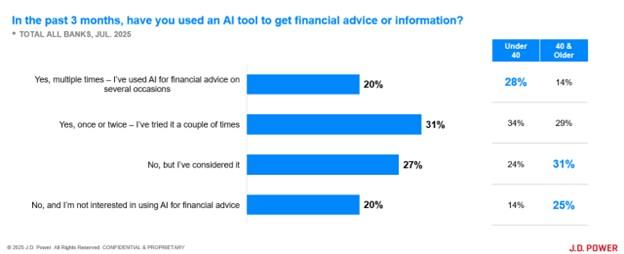
As consumers’ concerns about inflation persist, more than half (51%) say they are using AI to get financial advice or information.
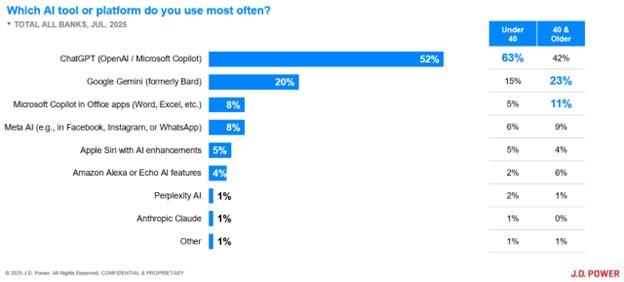
When asked about which AI tools or platforms they use, more than half (52%) say ChatGPT. That number gets even bigger for respondents under age 40 (63%). Google Gemini is also popular with consumers over age 40 (23% vs. 15% of those under age 40), J.D. Power said.
When asked what they are using these tools for, 13% of consumers say they use AI for banking and financial services on a daily basis. That is the highest percentage of daily users among all other AI use cases. However, 27% of respondents say they never use AI tools for banking and financial services, which suggests that consumer AI adoption rates vary considerably.
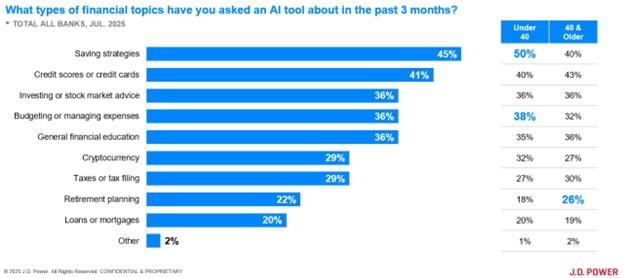
Consumers most frequently ask AI about saving strategies (45%) and credit scores or credit cards (41%). Investing in the stock market (36%), budgeting or managing expenses (36%), and general financial education (36%) were also among the most sought-after financial topics when using AI.
What Role Should Banks Play in this Evolution?
“As consumers continue to grapple with market headwinds and economic volatility, and popular culture news stories continue to extol the virtues of AI as a tool to hack everything from a to-do list to a stock portfolio, consumers will undoubtedly experiment with AI-driven banking and financial advice solutions. While this analysis did not track the use of bank-branded AI tools, it establishes an important baseline of consumer interest in technology that should be noteworthy to retail banks,” J.D. Power said.
In times of economic uncertainty, consumers often turn to banks in the hopes of guiding them to solid ground, the company said.
“The current daily utilization of AI for banking and financial services tasks shows that consumers see value in these solutions. As banks hope to build better relationships with consumers, leveraging new technology and effectively building awareness behind it could be a key cog in building trust and might even help some consumers get a better handle on their financial health,” J.D. Power concluded.