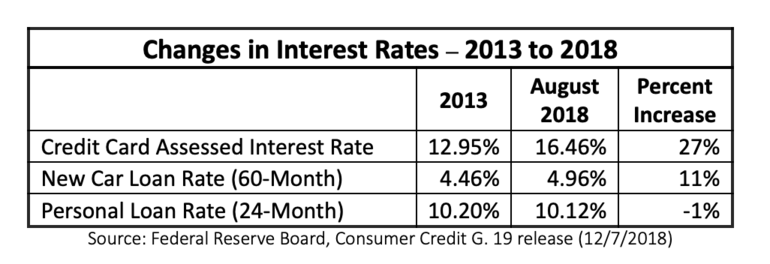
WASHINGTON–The Consumer Federation of America is cautioning consumers that rising credit card rates will mean larger debts for holiday purchases financed by plastics, and calling on financial institutions to explain to consumers their card rates have risen.
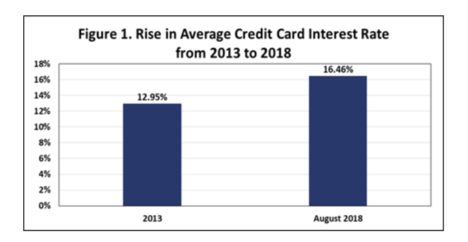
The CFA said consumer debt has risen by several billion dollars in recent years as card APRs have risen, noting the assessed interest rate on credit card accounts rose fairly steadily from 12.95% in 2013 to 16.46% in August 2018, an increase of 2%. The recent credit card interest rate is the highest in this century, the CFA said.
“Consumers with high credit card debt levels should be particularly cautious about increasing their debt during the holiday season,” said Steve Brobeck, a senior fellow at the CFA.
The CFA cited Federal Reserve data showing outstanding revolving credit rose from $855.6 billion in 2013 to $1.041 trillion in August 2018, an increase of 22%. While consumers are not paying interest on a portion of this debt, since it includes new balances that are paid off at the end of the month and a small portion of the outstanding credit represents debt from overdraft loans, the CFA noted that nevertheless, in 2018, consumers will still be paying tens of billions of dollars more in credit card interest than they did in 2013.
Wants FIs To Provide Explanations
The Consumer Federation said issuers should explain why credit card rates have risen much more rapidly than other consumer loan rates.
“The increase in the prime rate by two percentage points in the same period does not explain all of the 3.5 percentage point hike in card rates,” said Brobeck, adding many credit card rates are variable and linked to the prime rate.
According to the CFA, there are recent signs that some consumers are having greater difficulty making credit card payments, although credit card delinquency and default rates remain low relative to these rates since the 1990s. For the largest 100 banks, these rates are well below peak rates during the Great Recession – for delinquency rates, 2.48% this past August compared to 6.64% in the second quarter of 2009, and for charge-off rates, 3.72% in August compared to 10.68% in the fourth quarter of 2009, the CFA said.
But, the CFA added, for all other banks, the rates were at Great Recession levels – for delinquency rates, 6.14% in August compared to 5.61% in the fourth quarter of 2008, and for charge-off rates, 7.57% in August compared to 8.36% in the first quarter of 2010.
“The relatively high credit card debt and interest rate levels may not be affordable for many consumers in the event of an economic downturn,” said Brobeck.