

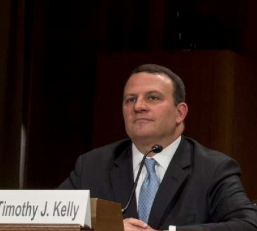
Timothy Kelly
WASHINGTON—Judge Timothy Kelly heard arguments here as part a preliminary injunction request from the CFPB’s Leandra English that challenges President Trump's appointment of Mick Mulvaney to serve as interim director of the Consumer Financial Protection Bureau.
As CUToday.info reported here, a vacancy was created at the CFPB when Director Richard Cordray resigned with the intention of English being elevated from deputy director to the top spot. President Trump, however, named Mulvaney, who is also director of the Office of Management and Budget, to the position.
English responded with a lawsuit and appeal of her own arguing the Dodd-Frank Act, which created the CFPB, is clear in how succession should work at the CFPB. The Trump Administration disagreed, citing the Federal Vacancies Reform Act for the authority to appoint Mulvaney.
During last week’s hearing, the Department of Justice (DoJ) argued that the Federal Vacancies Reform Act (FVRA), which explicitly to vacancies and resignations is the traditional statutory authority for addressing Executive Branch vacancies, and contains limited exceptions expressly articulated in the statute itself (none of which apply to the CFPB). It also argued that Section 5491 of the Dodd-Frank Act does not clearly apply to a vacancy and does not include a clear statement displacing the FVRA’s preexisting procedures. During the hearing. in addition to counsel for DoJ, the CFPB’s General Counsel sat on the Defendants side. Previously, the CFPB general counsel issued a memo siding with the DoJ, reported CUNA, which is participating as an amici in this litigation.
Plaintiff’s counsel Deepak Guptam argued that the Dodd-Frank Act provides a mandatory succession plan for CFPB leadership that should displace the FVRA. In terms of standing, Gupta argued that English is harmed because she cannot engage in her statutory right to function as the CFPB director.
Throughout the arguments several points from CUNA’s amicus brief were raised in the hearing, CUNA noted. The constitutional question CUNA raised argues that were the plaintiff to prevail, the president would be deprived of any right of control over the CFPB, including even the right to appoint an acting director in the event of a resignation entirely beyond the president’s control.
It was also noted, as highlighted in CUNA’s brief, that the D.C. Circuit currently has before it, en banc, a petition by PHH Corp. to declare that Dodd-Frank unconstitutionally deprives the president of the right to discharge the CFPB director without cause. PHH had earlier filed suit after the CFPB took action against it. In this case, the plaintiffs claim goes even a step further to the other extreme by arguing the court should not only allow a director to only be removed “for cause” but also have the ability to appoint their own non-Senate confirmed successor, who would also be removable only for cause, CUNA reported.
This prompted a discussion at the hearing of whether English’s argument conflicts with the Take Care Clause, which says the President must “take care that the laws be faithfully executed.” Kelly appeared to agree that this was a concerning Constitutional question and added an additional concern that English could arguably serve indefinitely having never been selected by a President or confirmed by the Senate if he ruled in her favor, which is essentially unprecedented, CUNA said in its analysis.
Kelly also questioned Gupta about how granting the injunction would create more certainty for consumers and the marketplace. Gupta argued that finding for English would be in the public interest and that she might very well perform her duties differently than Director Mulvaney, and that all actions taken by Mulvaney will have to be undone if the court rules in favor. The DoJ pointed out that naming a third director in one month would likely not provide the public with certainty, and the judge also questioned how financial markets would be better served if English were to take over and create uncertainty about the CFPB’s ongoing work, CUNA said.
In closing Gupta asked for a written opinion for the injunction, which would be significant if there is an appeal. It is expected that either side will likely appeal a loss, CUNA said.