ST. LOUIS– Are college degrees worth it? And which offer the best ROI? The two questions are critical to credit unions and their members as both lenders and borrowers, and a new analysis offers some lessons.
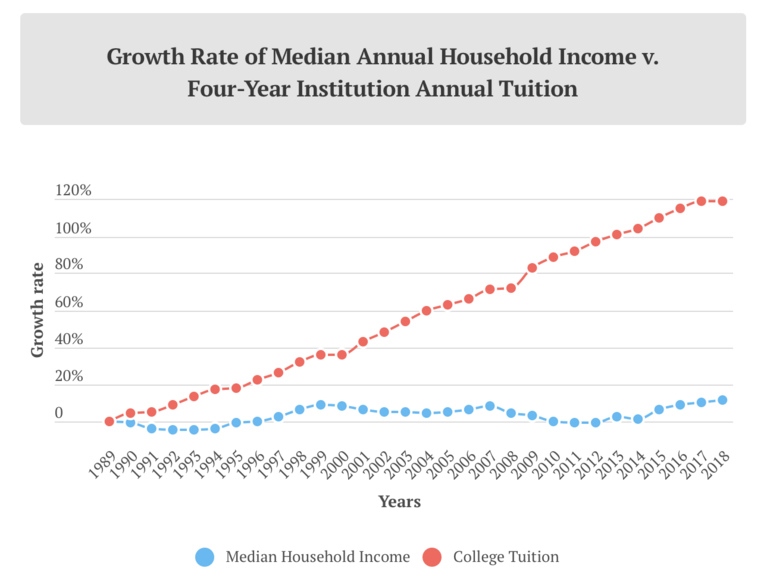
The numbers were crunched by Clever Real Estate which noted the discrepancy between income and tuition growth over the past two decades means that more household income is going towards college, and now more than half of families have to borrow to cover those costs.
“Slow income growth compounded with student loan repayment and accruing interest could mean that graduates won't recoup those costs very quickly,” said Clever. “The high cost of education begs the question: Are college degrees worth it? In general, it seems like they are: people with a college education earn more money over their lifetime than people who never attended college, and it's easier to get a job with a degree.”
But while an undergraduate degree pays for itself, many graduate degrees aren’t such a sure thing, Clever added.
To explore variations within degree types, specifically bachelor's degrees, Clever said it created a ranking system to determine the best majors based on return on investment (ROI), job opportunity, and job meaningfulness using data from PayScale, the Bureau of Labor Statistics, and College Scorecard.
The Findings
Among the findings:
- People with a bachelor's degree earn $2.7 million more in their lifetime than high school graduates
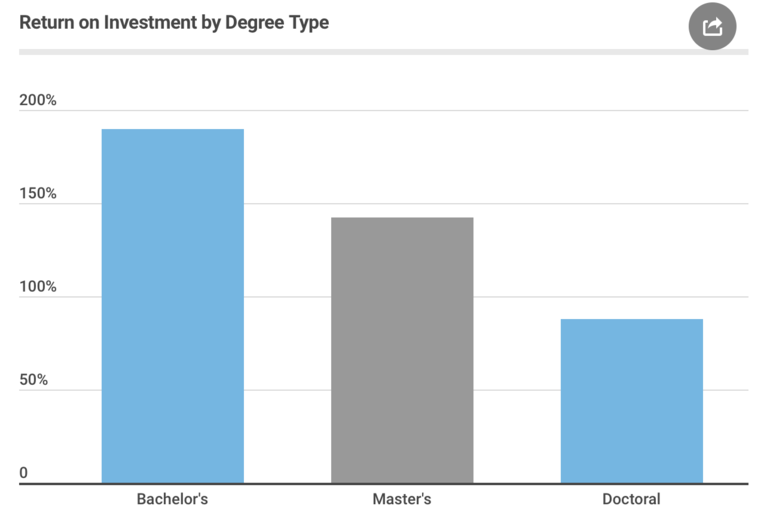
- Spending more time in school doesn't always pay off: the ROI of bachelor's degrees (190%) is higher than that of master's (142%) and doctoral degrees (88%)
- The typical student spends $29,955 on student loans and interest for a bachelor's degree, $62,146 for a master's degree, and $100,166 for a doctorate
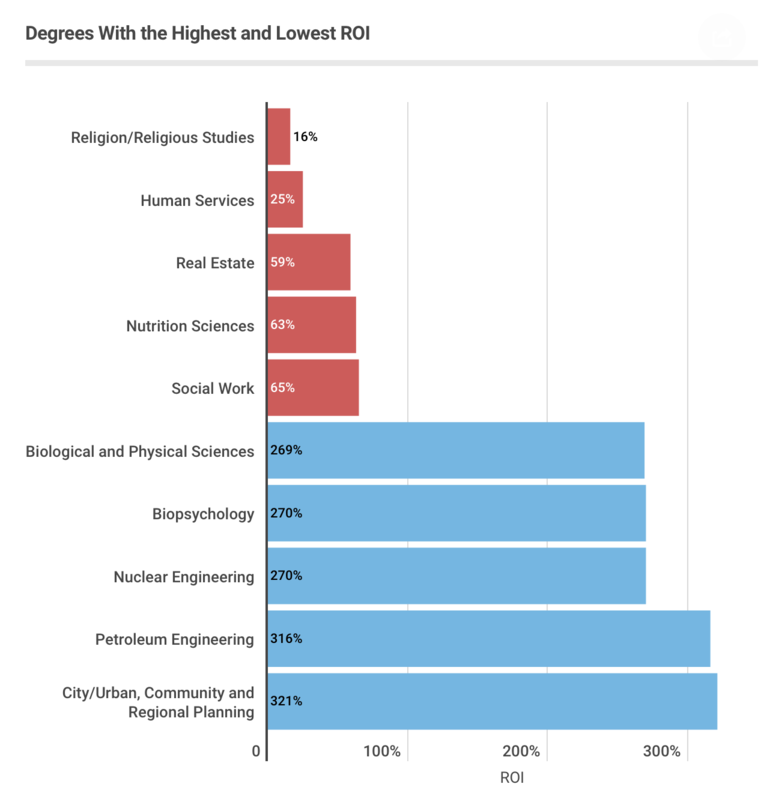
- High ROI doesn't always equate to job satisfaction: People who major in gerontology, social work, religion/religious studies, and human services find their careers most meaningful but have low ROI, Clever said
- Careers related to plastics engineering, information sciences, industrial engineering, natural sciences, and operations research have high ROIs but degree holders don't find these jobs as meaningful
- Engineering majors (ocean, architectural, systems, chemical, nuclear, and petroleum) were among the highest ROIs, but all are expected to experience slower-than-average job growth through 2028
Best and Worst Majors
- Best bachelor’s degrees: operations research, petroleum engineering, biological and physical sciences, biopsychology, and gerontology, according to Clever
- Worst bachelor’s degrees: interior architecture; polymer / plastics engineering; real estate; English language and literature; and communication, journalism, and related programs
- Best master's degrees: social work, computer science, behavioral sciences, information sciences, psychology
- Worst master's degrees: urban studies, international / global studies, anthropology, archeology, and business
- Best doctorates: psychology, business, social work, education, and religion / religious studies
- Worst doctorates: sociology, anthropology, computer science, English language and literature, and information sciences
Other Considerations
“A major's return on investment isn't the only characteristic people should consider when deciding upon a major, though. The ability to get and keep a job in a related field after graduation could reduce financial and emotional stress in the future,” Clever stated. “The #1 major on our list also has the most job growth projected through 2028 at 18%. Many engineering majors - which typically result in a high monetary payoff after graduation - have low projected growth.
“Gerontology has a relatively low ROI - especially compared to the rest of our top five majors - but landed the #5 spot on our list because nearly 80% of people in jobs related to gerontology find their work very meaningful,” Clever added.
Diminishing Returns of Graduate Degrees
In its analysis Clever said getting a degree leads to higher lifetime earnings than no college education, but graduate degrees diminish returns.
“There are two major factors driving the drop in ROI with more education: earnings and debt. Both are related to the amount of time people spend in school either missing out on earnings or spending more money to complete their degrees,” said Clever. “Counterintuitively, people with a bachelor's degree actually earn more in their lifetime on average than those with graduate degrees. Therefore, even though graduate degrees are more profitable than a high school diploma, spending an additional 2-8 years in college doesn't usually pay off financially.”
For more information, go here.