ALEXANDRIA, Va.–Although one board member expressed strong concerns, the NCUA board has voted 3-0 to put out for comment a proposal to raise to $400,000 from $250,000 the home value threshold required for an appraisal when a CU is making a mortgage loan.
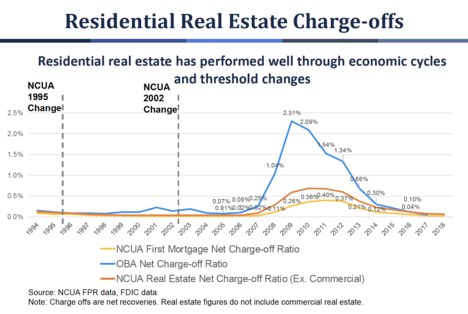
In presenting the proposal, agency staff said it will provide both regulatory burden relief and keep up with inflation. The threshold was last raised in 2002. Staff told the board the increase is not a threat to safety and soundness and restores exemptions on par with previous threshold increases.
The change will also allow for additional mortgages to be made in rural areas, according to NCUA staff, and does not preclude a CU from requiring appraisals.
Mortgages on homes valued under $400,000 will still require a written estimate, which was a point of concern to Board Member Todd Harper, who expressed worries over risks similar to that which occurred in the run-up to the housing meltdown more than a decade ago.
Risks in Downturn?
“Because we will eventually experience an economic downturn, and probably sooner rather than later, I have apprehensions we are loosening standards at the wrong time in the economic cycle,” said Harper. “Other actions we could take would be more meaningful.”
Harper called appraisals a “key part" of the mortgage process, verifying a property’s value for the buyer, seller, investor and others.
“The statute says appraisers must be unbiased arbiters,” he said, referring to rules included in the Dodd-Frank Act in the wake of the mortgage crisis that were aimed at firming up how property valuations are arrived at. “I’m concerned the rule will negatively affect progress made in these areas.”
Specifically, said Harper, he is concerned over the requirement that written estimates are all that’s needed on properties worth $400,000 or below, as an “imprudent lender” inside a CU may take risky steps to increase volume during a downturn.
In response to a question from Harper, agency staff said rules are in place that can be enforced to ensure those preparing the estimates are qualified, competent and independent of loan production.
Automated Valuation Models
Harper said he also has concerns around the use and effectiveness of AVMs, or automated valuation models, that are used in creating estimates of market value. He pointed to his own experience in recently buying a home in Arlington, Va., where one company using AVM software indicated the property had increased in value by 10% in just 30 days.
“The market may be hot, but it’s not that hot,” said Harper.
Harper said it’s been nine years since Dodd-Frank and that he is hopeful the proposal will put momentum behind efforts around rulemaking on AVMs. In addition, he also called for support for “appraisal portability,” allowing one appraisal to be used by multiple lenders in order to provide “substantial savings” for consumers.
46,000 Mortgages Would Be Exempt
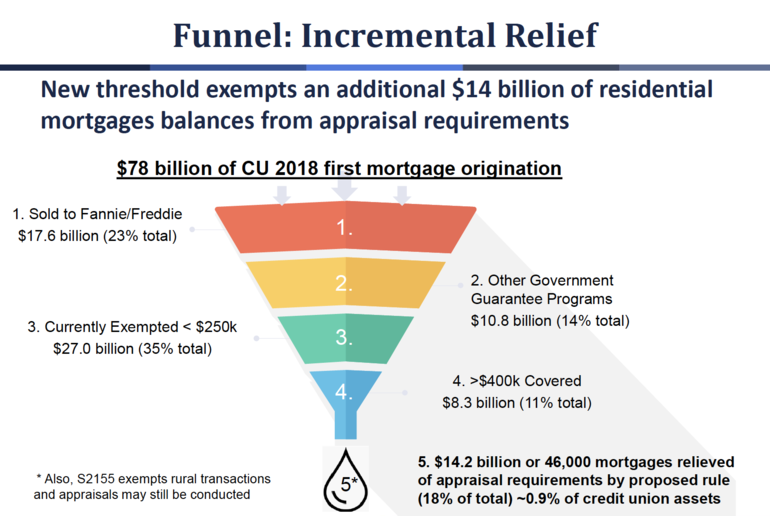
According to NCUA staff, the proposed increase would exempt approximately 95% of transactions at credit unions, or an additional $14 billion in loans (46,000 residential mortgages).
In 1990, the initial threshold set by NCUA on home values was $50,000. That was increased to $100,000 in 1995, and to $250,000 in 2002.
CUNA Response
Following the vote,CUNA's deputy chief advocacy officer, Elizabeth Eurgubian, said, "We thank the NCUA board for responding quickly to our request and issuing a proposal we believe will significantly benefit credit union members seeking to obtain mortgage credit. Not only will this proposal reduce the significant time and expenses for homebuyers associated with residential appraisals, it will address a competitive disadvantage credit unions have faced since federal banking regulators raised the threshold to $400,000 in September 2019.”