WASHINGTON– Likely driven by anticipation rates will rise, existing-home sales rose in January, making a “notable move upward following a previous month where sales declined,” according to the National Association of Realtors.
In addition, the average price for a home in January was 15% higher than one year earlier, with some regions of the country seeing even bigger price increases.
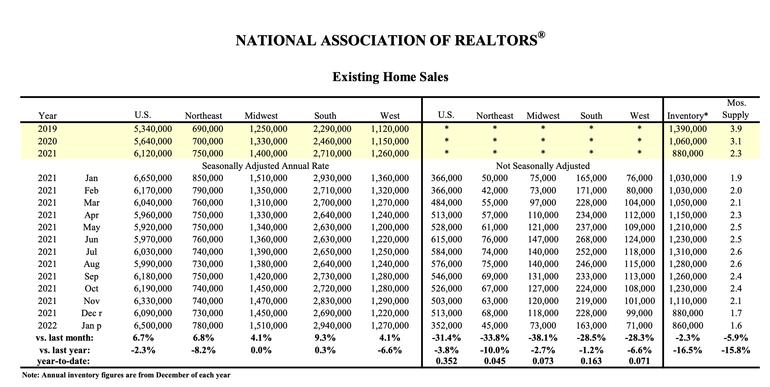
On a month-over-month basis, each of the four major U.S. regions experienced an increase in sales in January, according to the NAR, but year-over-year, activity was mixed as two regions reported sagging sales, another watched sales increase and a fourth region remained flat.
"Existing home sales jumped in January to its highest point in a year, further depleting inventory,” said Curt Long, chief economist and vice president of research with NAFCU. “Homes for sale at the end of the period dropped to an all-time low of 860,000.
The share of sales going to first-time homebuyers was just 27%, which is down six percentage points from a year prior," added Long. "NAFCU expects home sales to continue to rise gradually in 2022.”
Total existing-home sales––completed transactions that include single-family homes, townhomes, condominiums and co-ops––climbed 6.7% from December to a seasonally adjusted annual rate of 6.50 million in January. Year-over-year, sales fell 2.3% (6.65 million in January 2021), the NAR said.
Anticipating Increases
"Buyers were likely anticipating further rate increases and locking-in at the low rates, and investors added to overall demand with all-cash offers," said Lawrence Yun, NAR's chief economist, in a statement. "Consequently, housing prices continue to move solidly higher."
The NAR reported that total housing inventory at the end of January amounted to 860,000 units, down 2.3% from December and down 16.5% from one year ago (1.03 million). Unsold inventory sits at a 1.6-month supply at the current sales pace, down from 1.7 months in December and from 1.9 months in January 2021, the organization added.
"The inventory of homes on the market remains woefully depleted, and in fact is currently at an all-time low," Yun said.
According to Yun, homes priced at $500,000 and below are disappearing, while supply has risen at the higher price range. He noted that such increases will continue to shift the mix of buyers toward high-income consumers.
"There are more listings at the upper end – homes priced above $500,000 – compared to a year ago, which should lead to less hurried decisions by some buyers," Yun added. "Clearly, more supply is needed at the lower-end of the market in order to achieve more equitable distribution of housing wealth."
The Data Points
Other data points in the latest NAR data:
- The median existing-home price for all housing types in January was $350,300, up 15.4% from January 2021 ($303,600), as prices rose in each region. This marks 119 consecutive months of year-over-year increases, the longest-running streak on record.
- Properties typically remained on the market for 19 days in January, equal to days on market for December, and down from 21 days in January 2021. Seventy-nine percent of homes sold in January 2022 were on the market for less than a month, the NAR said.
- First-time buyers were responsible for 27% of sales in January, down from 30% in December and down from 33% in January 2021. NAR's 2021 Profile of Home Buyers and Sellers – released in late 2021– reported that the annual share of first-time buyers was 34%.
- Individual investors or second-home buyers, who make up many cash sales, purchased 22% of homes in January, up from 17% in December and from 15% in January 2021. All-cash sales accounted for 27% of transactions in January, up from 23% in December and from 19% in January 2021.
- According to Freddie Mac, the average commitment rate for a 30-year, conventional, fixed-rate mortgage was 3.45% in January, up from 3.10% in December. The average commitment rate across all of 2021 was 2.96%.
- Single-family home sales jumped to a seasonally adjusted annual rate of 5.76 million in January, up 6.5% from 5.41 million in December and down 2.4% from one year ago. The median existing single-family home price was $357,100 in January, up 15.9% from January 2021.
- Existing condominium and co-op sales were recorded at a seasonally adjusted annual rate of 740,000 units in January, up 8.8% from 680,000 in December and down 1.3% from one year ago. The median existing condo price was $297,800 in January, an annual increase of 10.8%, the NAR said.
Regional Breakdown
According to the NAR, existing-home sales in the Northeast grew 6.8% in January, posting an annual rate of 780,000, an 8.2% decline from January 2021. The median price in the Northeast was $382,800, up 6.0% from one year ago.
Existing-home sales in the Midwest rose 4.1% from the prior month to an annual rate of 1,510,000 in January, equal to the level seen from a year ago. The median price in the Midwest was $245,900, a 7.8% rise from January 2021, the NAR said.
Existing-home sales in the South jumped 9.3% in January from the prior month, reporting an annual rate of 2,940,000, a gain of 0.3% from one year ago, according to the NAR. The median price in the South was $312,400, an 18.7% surge from one year prior. For the fifth straight month, the South witnessed the highest pace of appreciation.
Existing-home sales in the West increased 4.1% from the previous month, registering an annual rate of 1,270,000 in January, down 6.6% from one year ago. The median price in the West was $505,800, up 8.8% from January 2021.