

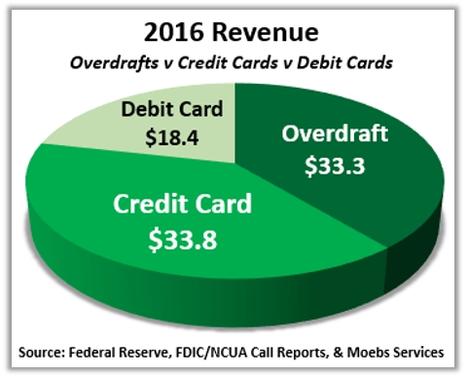
LAKE FOREST, Ill—Overdrafts have always collected the most revenue for all related service charges. Now, for the first time, credit card interchange has exceeded overdraft revenue to become the top money maker among all service charges, reports Moebs $ervices.
At 2016 yearend, overdraft revenue was $33.3 billion, while credit card revenue was slightly higher at $33.8 billion.
“This is a major shift in how depositories have collected fees for decades,” said Michael Moebs, economist and CEO of Moebs Services. “In 2006, a year of consumer economic prosperity, overdraft revenue was 53.2% of all service charge revenue. Credit card revenue comprised only about half of the total overdraft revenue.”
The average credit card transaction fee, or interchange fee, is a few pennies shy of a dollar. The interchange price of a debit card transaction is about $0.43 for depositories with assets less than $10 billion and about $0.25 for depositories with assets greater than $10 billion, explained Moebs.
“Debit cards average $0.30 for all debit card transactions. Based on interchange fees and revenue, it is easy to see why a depository would prefer to promote credit cards,” Moebs told CUToday.info. “Debit cards create 76% more volume than credit cards. Yet, the credit card is more appealing due to its interchange fee being 250% greater. The higher credit card fee results in higher revenue making up for the lower volume.”
Moebs said that credit cards are the big banks “domain.”
“The big bank strategy is to heavily promote rewards programs, which come at a lower cost to them,” said Moebs. “Many credit unions and community banks attempt to duplicate the big bank rewards programs. These main street depositories face low account and transaction volumes, which increases the costs significantly and diminishes overall profitability when compared to the big banks.”
Why Now?
Why is credit card revenue now exceeding overdraft revenue?
The national median price for an overdraft is currently $30 per item, according to Moebs study of 3,817 depositories. Credit card volume is over 30 times overdraft volume.
“The interchange price, or fee, multiplied by the high volume of credit cards transactions over the number of ODs equals a credit card equivalent OD price of $30.76,” said Moebs. “This is why credit card revenue exceeds OD revenue – higher equivalent price from higher volume.”
Since 2010 the price of overdrafts has increased, creating a reduction in volume and consequently a reduction in revenue, explained Moebs.
“Many depositories are beginning to realize a higher OD price doesn’t translate into more revenue and have lowered their prices. As a result of a lower price, they are experiencing an increase in overall overdraft revenue,” said Moebs.
Other Contributing Factors
Several factors, according to Moebs have led to the reason why OD revenue is no longer king.

Michael Moebs, Moebs $ervices
“First, the price gap of credit card over debit card prices creates more incentive for selling the credit card instead of a debit card. Secondly, the overdraft price is no longer inelastic, which is why volume has begun to slow, and as a result OD revenue is falling,” he said.
Moebs Payment Study predicts depositories that have less than $10 billion in assets will be the clear winners as debit card volume increases. With the normal debt card price restricted by the Durbin Amendment for large depositories, community banks and credit unions can increase fee revenue with increasing debit card volume and interchange.
Big banks use very low-cost reward programs to stimulate credit card volume, which is something community banks and credit unions cannot afford to duplicate, asserted Moebs. However, the Main Street depositories can offer an attractive reward programs with debit cards where they hold a price advantage over the big banks, said Moebs.
“Credit card Interchange will lead the way, unless the legislation on debit card interchange can be redone, but overdraft revenue will soon fall to number three by 2020,” predicted Moebs.