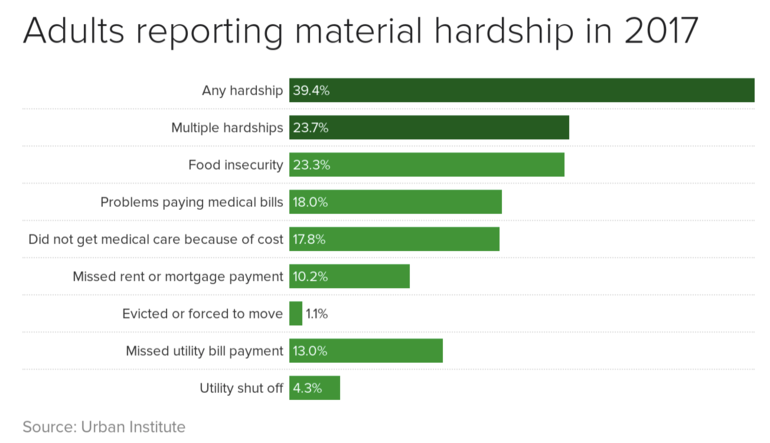
WASHINGTON–Four in 10 Americans are struggling to pay for their basic needs such as groceries or housing, a problem that is confounding even middle-class households, according to a new study.
In its study the Urban Institute said it found despite the U.S. economy being near full employment, 39.4% of adults between 18 and 64 years old said they experienced at least one type of material hardship in 2017. The study is based on a survey of more than 7,500 adults about whether they had trouble paying for housing, utilities, food or health care.
The study is consistent with others featured in CUToday.info, including those that have found many Americans lack even $400 for an emergency.
The Urban Institute said it was surprised to find the high levels of hardship among so many middle-class families. Middle class income "is no guarantee" of protection from hardship, said Michael Karpman, research associate at the Urban Institute's Health Policy Center and a co-author of the report.
One difference is middle class households tend to struggle with paying their healthcare bills rather than utilities.
"A lot of people are looking at the fact that wages aren't keeping up with household costs as one reason families are having difficulty making ends meet," Karpman said in a statement. "Even for families with health insurance, they may be facing high deductibles that leave them facing high costs."
The Findings
Among the findings, according to the Urban Institute:
- Low-income households reported the highest share of hardship. For instance, more than 40% of poor and near-poor adults, or those below and slightly above the federal poverty level, experienced food insecurity, compared with about 23% across all income groups.
- Holding a job also doesn't provide immunity to hardship, the study found. One of three families with at least one working adult said they had trouble meeting at least one basic need, such as paying for food or utilities.
- Minorities report higher rates of hardship than whites, while women are almost seven percentage points more likely to struggle to meet their basic needs than men. White households tend to earn more money than minority families, while men out-earn women due to the gender wage gap and occupational segregation, meaning men hold a larger share of higher-paying jobs.
- Almost 60% of Americans with multiple chronic medical conditions experienced material hardship in 2017, compared with about 33% of adults without any chronic illnesses, they found.
- Educational attainment was also tied to hardship. The researchers found that 56% of Americans with less than a high school degree struggled to meet their basic needs. By comparison, just 24% of college grads experienced hardship.