

WASHINGTON–A new analyses of government data show the Small Business Administration’s Paycheck Protection Program allowed many of the earliest funds to go to parts of the country that were not as hard hit by the coronavirus, as well as to a small number of companies seeking millions in assistance.
The analysis, by a group of University of Chicago and MIT economists, also revealed that while some critics said it was the largest banks whose customers were getting the funds, during the first of the PPP’s two rounds, community banks and regional institutions did most of the lending. The biggest banks have since gained ground, however.
“That contributed to a disproportionately large share of loans going to areas that were not as hard-hit by the virus,” reported the New York Times.
According to a Times analysis, businesses in Iowa, Nebraska and North Dakota were among the biggest beneficiaries of the early aid when accounting for the number of people working for small businesses in each state. All three states are below the national media for cases of the virus per capita, and none impose statewide lockdowns as a result of the outbreak, according to the report.
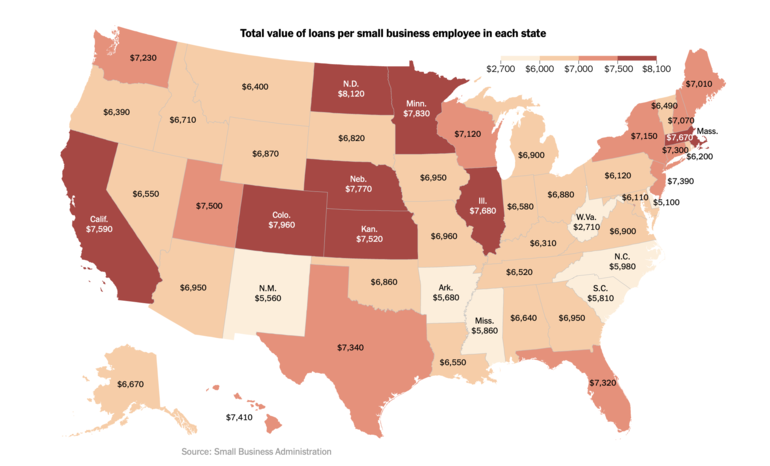
Big Banks Gain Speed
“One reason for the uneven distribution is because big banks were slow to lend when the program first began, in part because of bureaucratic delays, and they imposed rules that blocked many people seeking help,” the Times reported. “The 20 largest banks accounted for 41% of small-business lending throughout the country before the pandemic, but issued only 20% of the first-round loans, the Chicago and M.I.T. economists found. Since then, big banks made vastly more loans. Businesses in harder-hit states like California and New York have claimed a larger share of the money so far in the second round, which started in late April after Congress approved a fresh round of funds when money quickly ran out during the initial wave.”
Other Findings
Among the other findings, according to the Times:
- Loans of more than $1 million made up just 5% of those approved in the first round, but they accounted for roughly half of the overall money. That favored large companies seeking greater sums.
- Many of those companies already had deep relationships with their banks, which helped them get to the front of the line.
- More than 300 public companies have disclosed receiving funds, although a few have returned the money.
- In the first round if PPP loans, the average loan size was $206,000. After one week of the second round, it was $79,000.
“Many of the most devastated businesses — like restaurants and service providers — have already laid off workers and are uncertain when their sales will return,” said the Times in its analysis. “Because the program’s rules require companies to maintain their head count at pre-pandemic levels (those that cut positions have a brief window to rehire) if they want their loans forgiven, those businesses have a much harder time taking advantage of the program than companies that still have their full workforce intact.
“In effect, the Chicago and M.I.T. economists argued, the early stages of the program ‘functioned less as social insurance to support the hardest hit areas’ and more as a cash infusion ‘for less affected firms,’” the report stated.