NEW YORK–Credit unions with outstanding loans and lines of credit to retailers and retail shopping plazas should expect to see increasing bankruptcy filings and even anticipate many retailers will close and never reopen, according to a new report.
The report, from commercial real estate analysis firm Trepp, said the closings of retail outlets as the result of the coronavirus has begun to show financial impact in the CMBS market, as retailers including Urban Outfitters, Calvin Klein and others have stopped making rent payments.
“Before the outbreak, large retail chains across the board were already facing distress as notable names such as Neiman Marcus, Pier 1 Imports, Sears, and Macy’s announced closings in droves,” Trepp stated. “Given the uncertainty regarding the retail market and the inevitable financial distress which has yet to occur, we’ve analyzed the state of the retail market, its historical performance relative to other property sectors, and key players in the retail market that will likely be hit the hardest.”
The ‘Worst Performance’
According to Trepp data, retail loans account for over 25% of the outstanding mortgage debt in the CMBS universe – the second largest property type by outstanding balance (the largest being office loans, which represent 27% of the pie).
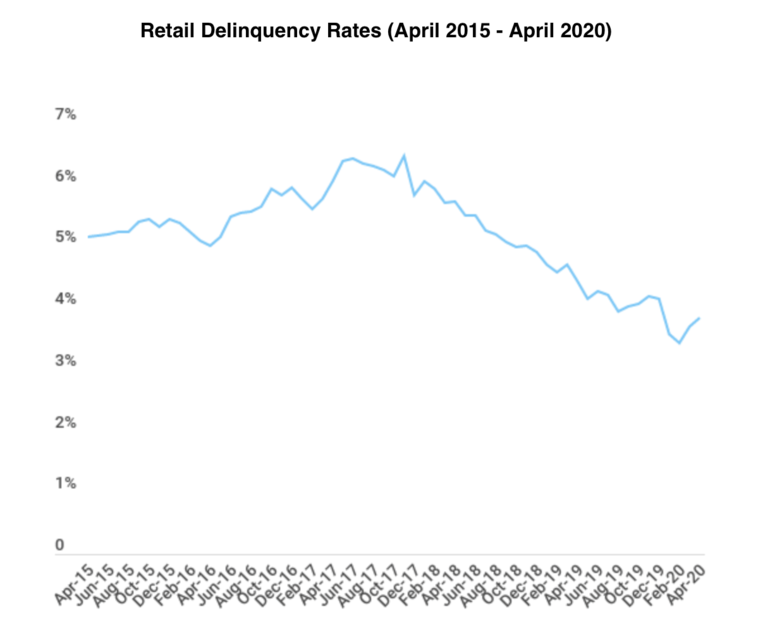
Trepp noted its March Delinquency Report showed retail logged the worst performance of all major property types, with a delinquency rate of 3.89% (overall rate was 2.07%). This was twice the delinquency rate of the next worst-performing sector, office.
“April’s numbers indicate that the retail delinquency rate is now at 3.83%, down six basis points from the previous month,” Trepp said. “However, this reflects the April data which has been released to date, and with several large retailers indicating that they will not be making rent payments, the rate will likely continue to increase in the coming months.”
Increase in Late and Missed Payments
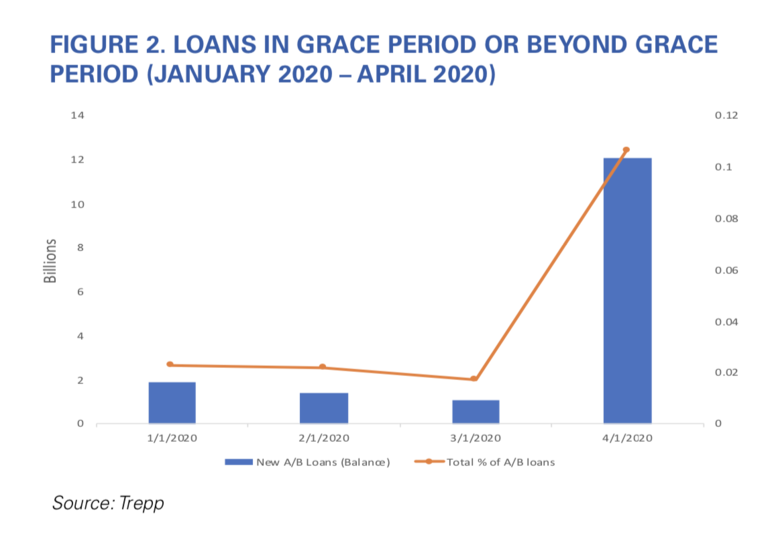
With retailers across the board experiencing financial distress due to the pandemic, a large number have missed their April 1 rent payment, according to Trepp. These loans currently have a loan status - ‘A’ or ‘B’, which indicates that the borrower is “in grace period” (A) or “beyond grace period” (B) on its payment. It also serves as an early indicator of the future delinquencies, the analysis added.
“In the past, less than 2% of retail CMBS loans were placed in this category. However, this number has considerably increased in the month of April,” Trepp reported. “Based on approximately 98% of the remittance data, 600 retail loans totaling $12.0 billion were reported in the A/B category. As a percentage of the total balance of retail loans, those in the A/B category increased from 1.7% last month to 10.6% in April. The following shows the trend in the last four months.”
State and Regional Analysis
Trepp said its analysis of the data shows Vermont, South Dakota and West Virginia posted the highest delinquency rates in the retail sector with rates of 73.37%, 45.59%, and 24.51%, respectively, for the month of April. These three states posted proportionally high overall state delinquency rates of 49.26%, 40.55% and 15.31% as well. Overall, 21 states posted a delinquency rate higher than the average 3.83%.
By MSA, the NewYork MSA recorded the highest delinquent retail loan balance of $460 million. However, this is likely to change in the coming months given the number of retailers headquartered in the MSA, Trepp said.