

NEW YORK–The economic disruption caused by COVID-19 and the efforts to contain it will trigger a new cycle of rising defaults and losses in the commercial real estate lending sector, according to a new report.
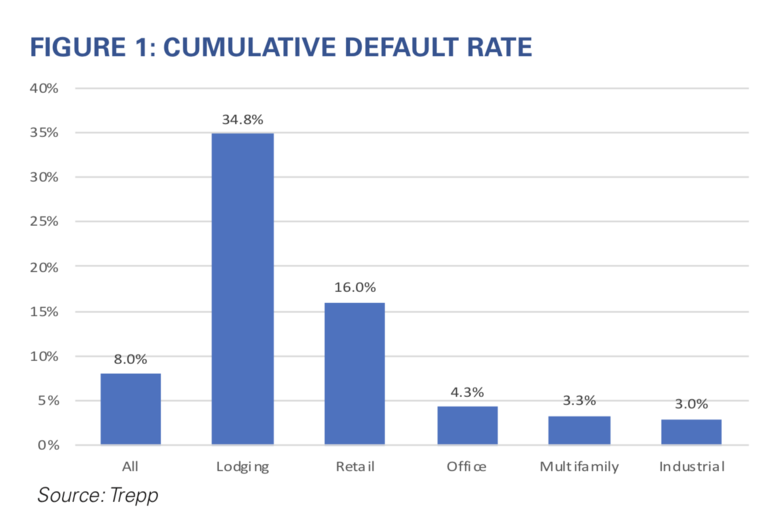
In one scenario created by Trepp, which provides analysis of commercial real estate among other services, the cumulative default rate across commercial mortgages overall will rise to 8%, up significantly from the current 0.4% default rate. The impact will be most immediate and severe in the lodging sector, with a cumulative default rate approaching 35%, Trepp said.
The retail sector will also experience elevated defaults, with an estimated cumulative default rate of 16% in this scenario. Other major real estate sectors analyzed – office, multifamily, and industrial – will experience more measured increases in distress, according to the company.
To gauge the impacts of the COVID-19 disruption, Trepp said it has applied an economic and real estate forecast scenario to a portfolio of 12,500 commercial real estate loans. The loans are from Trepp’s T-ALLR data set, which is comprised of balance sheet loans held by commercial banks, the company said, with the loans used for the analysis commercial mortgage loans, spanning a broad range of size, geography, and property type.
Loan Data Summary Highlights:
• Credit metrics across the different property types are generally similar, with median current LTVs between 37.0 and 41.9 and median current DSCRs between 1.79 and 2.12.
• Most of the loans were originated in the last five years. Nearly 80% of the current outstanding balance is from the 2015 to 2019 vintages.
• The more recent vintages have higher LTVs and lower DSCRs than the older vintages. While the loans show similar LTVs at origination, the older vintages have benefited from more seasoning: values have increased due to appreciation and amortization has reduced the outstanding loan balances. As a result, the current LTVs are lower and the DSCRs are higher for the older vintages, Trepp said.
“It is difficult to know which economic and real estate forecast scenario to use. It is possible that the severe disruptions that have been impacting nearly every aspect of daily life will be over as suddenly as they hit, but it is also possible that they will last longer and have a deeper impact on the economy,” said Trepp. “Even if the disruptions do pass relatively quickly, the linkages within the economy mean that the economic fallout will be with us for some time.”
To gauge the impact on commercial real estate mortgages, Trepp said it used the Severely Adverse scenario that regulators
have created for large bank stress testing. This scenario assumes that GDP falls precipitously, the unemployment rate rises (peaking at 10%), interest rates plunge, and asset prices fall. Commercial real estate prices fall 35% over the first two years of that scenario.
The Findings
Among the findings in the forecast:
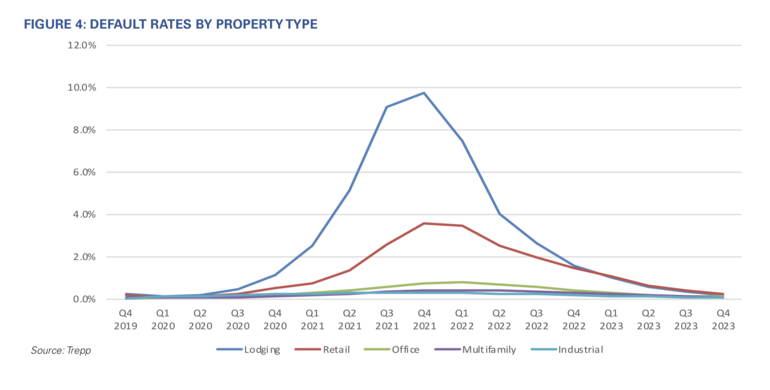
• The default rate for Lodging loans will soar, reaching a peak of nearly 10% by the end of 2021
• Retail defaults will also rise sharply, peaking at 3.6% in late 2021 / early 2022
• Office default rates will rise, though not as severely. The peak default rate for office loans in this scenario would be 0.8%
• Industrial and multifamily mortgages will experience smaller increases in default rates, peaking at about 0.5%. For both property types, the expected declines in prices and NOI mean that LTV and DSCR ratios will hold up better, compared to lodging and retail.
The impacts of these higher periodic default rates over the five-year forecast horizon will mean much higher cumulative default and loss rates for all types of loans, particularly lodging and retail loans.
• The cumulative default rate for all CRE loans is 8.0%, and with an expected loss severity of 31.7%, the cumulative loss rate will be 2.5%.
• For lodging loans, the cumulative default rate is expected to be 34.8%, translating into cumulative losses of 13.1%.
• The cumulative default rate for retail is expected to be 16.0% and cumulative losses will total 5.3%.
• The other sectors analyzed – office, multifamily and industrial – will fare comparatively better, with cumulative default rates in the 3.0% to 4.3% range and cumulative losses in the 0.8% to 1.2% range.