

LAKE FOREST, Ill.—A new report reveals that banks and thrifts are run more efficiently than credit unions, and that the benefits of scale really begin at $500 million in assets.
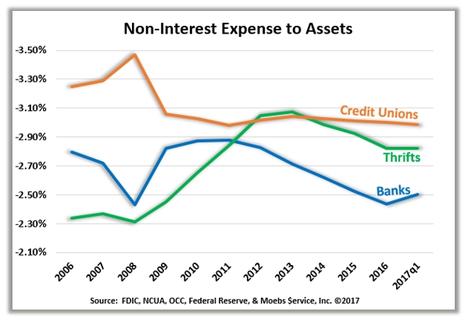
“Banks and thrifts have an incentive to keep expenses low to pay for taxes,” said Michael Moebs, economist and CEO of Moebs Services. “Interestingly credit unions, which are not taxed, lack a similar incentive to keep expenses low and operate about 20% higher than banks.”
Moebs explained that economy of scale (EOS) includes items from both the income statement and balance sheet causing the average cost of a service to fall as volume increases.
“The first thing we have found in our EOS studies is that efficiency is essential in resource use,” said Moebs. “As shown in the graph (right) of non-interest expense to assets, there have been good economic growth as well as extreme economic downfall. Without taxes, the result shows banks being most successful in controlling expenses. Reducing resource use is essential to start to achieve scale.”
While controlling expenses, a depository’s mission is to grow rapidly as much as capital formation allows, said Moebs.
“Most EOS start as a depository approaches about $500 million in assets. At this point leadership of the financial institution needs to switch from growth as a prime directive to efficiency,” asserted Moebs. “When the average cost of services begins to fall as volume increases, efficiency starts to take over, followed by a reduction of services driven by service profitability.”
The larger a depository becomes the more complex it becomes, creating greater risk for a diseconomy of scale, Moebs emphasized.
“The complexity invites more inefficient costs, which offsets the savings gained from greater scale. A recent example is Wells Fargo, whose sales function nearly brought down the bank by creating fake accounts to achieve their goal,” said Moebs, who added that scale complexity leads to more staff on payroll than work available.
The EOS is best shown through a historical perspective, including both good and bad economic conditions, said Moebs.
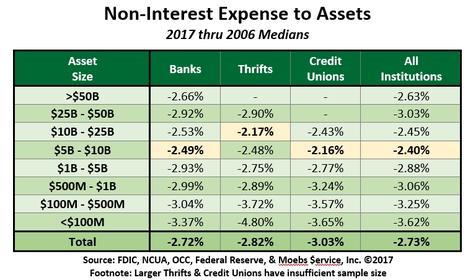
“The table (right) shows the median non-interest expenses to assets over a 16-year period for each type and size of depository,” he said. “The highlighted areas of the table show the EOS for the three different depositories groups. Overall the economy of scale is achieved when expenses reach 2.40% of assets.”
Moebs said the question then becomes how to attain and maintain the economy of scale.
“A depository must have good control of their expenses to reach a 2.40% expense-to-asset ratio. Once the expense goal is reached, grow, as much as appropriate, capital levels until the economy of scale is realized,” said Moebs. “Most important, a depository must reassess their services and shed the unprofitable services as quickly as possible.”
Moebs emphasized that the economy of scale is far more complex than the use of non-interest-expense-to-asset ratios.
“Yet, it allows a depository to gauge its expense position and manage the process to avoid the dark side of the diseconomy of scale,” said Moebs. “The result is much more value, benefits over cost, for members, employees and stakeholders in general.”