OAK BROOK, Ill.–Just how do parents decide the amount the Tooth Fairy will be paying for lost teeth? And how good an indicator is the amount paid of the direction of the national economy? Important new research offers some answers.
According to the latest “The Original Tooth Fairy Poll” sponsored by Delta Dental, the number-one guiding factor is how much spare cash the Tooth Fairy has on hand (46%).
So, what other key considerations may influence the Tooth Fairy's generosity? According to the survey:
- 31% use children's ages to set the value of a lost tooth.
- 29% said the Tooth Fairy remembers historical payouts and then determines comparable amounts to what children's parents received when they were young (29%).
- 20% said the Tooth Fairy is mindful of kids' recent behaviors.
- 18% said the Tooth Fairy keeps a tally of lost teeth and that is their top factor in deciding monetary rewards.
Inflation/Deflation
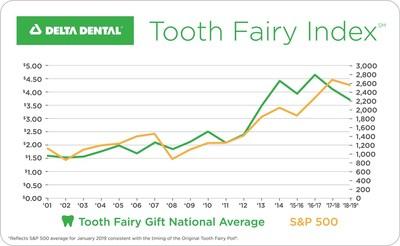
Separately, as the Fed keeps an eye on the inflation rate, the Original Tooth Fairy Poll has found children’s teeth are a rapidly depreciating asset—but not in all instances. According to the survey, the Tooth Fairy's average cash gift declined to $3.70 for a lost tooth, which is down by 43 cents from a year ago.
“Not all parents say the Tooth Fairy is following the national average,” the survey found. “In homes that the Tooth Fairy visits, close to two-in-five parents (37%) share that their children receive at least $5 or more. Also, a first lost tooth continues to impress. The Tooth Fairy appears to recognize that this is a monumental tooth as indicated by kids' receiving an average gift of $4.96, representing $1.26 above the $3.70 average for subsequent lost teeth.”
What’s Changed in 2 Decades
Delta Dental, which has been conducting the survey for two decades, reported that in 1998, the average paid by Tooth Fairies nationally was $1.30, which equates to about $2.00 today with inflation.
“The Original Tooth Fairy Poll has typically served as a good indicator of the economy's overall direction, tracking with the movement of Standard & Poor's 500 Index (S&P 500) for 14 of the past 17 years,” Delta Dental reported. “A year ago, a single lost tooth was valued at $4.13 and dropped to $3.70 in this year's survey, down 10%. Over the same time period, the S&P 500 also saw a decline and decreased by 3%.”