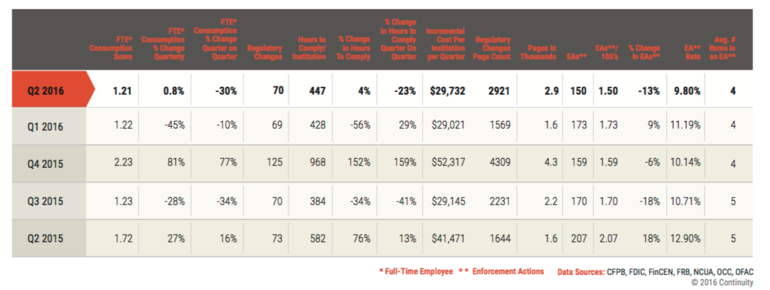
NEW HAVEN, Conn. – After levying record numbers of enforcement actions against financial institutions (FIs) in recent quarters, regulators eased enforcement activity slightly in 2016’s second quarter, according to The Banking Compliance Index (BCI).
The BCI is compiled by Continuity’s Regulatory Operations Center (ROC) to measure and analyze the volume of regulatory change impacting financial institutions. It shows that regulatory agencies issued 150 enforcement actions against FIs last quarter, amounting to an enforcement rate of 9.80%.
The BCI, established in 2012, has not tracked an enforcement rate below 10% since Q4 2014’s 8.2%. As recently as Q2 2015, the BCI tracked the highest enforcement rate to date at 12.9%, the company said.
“Many of the enforcement actions levied against banks and credit unions in Q2 stem from longstanding regulations, including Bank Secrecy Act, call report filing, safety and soundness and other violations,” explained Donna Cameron, Continuity’s director of regulatory I/O, in a statement.
In addition, since Q4 2014, the BCI has tracked as many as 125 regulatory changes in a single quarter and as few as 61, indicative of the regulatory volatility with which today’s FIs must cope, according to the company.
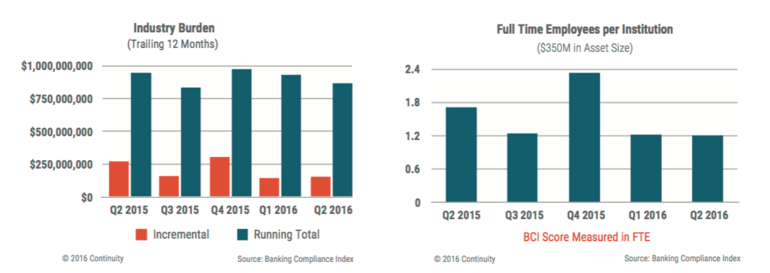
“It’s increasingly difficult for banks and credit unions to handle regulatory change in such an unpredictable environment,” said Pam Perdue, EVP and chief regulatory officer at Continuity. “The resources needed to manage new regulatory changes, to say nothing of those required to prevent or respond to enforcement actions, have fluctuated by tens of thousands of dollars per institution per quarter over the past year.”
The BCI data sources include: CFPB, FDIC, FED, NCUA and OCC. The BCI is calculated using an average size institution of $350 million.