

COSTA MESA, Calif.—American bank customers are expressing “troublingly low” confidence in their financial status, according to the latest Banking and Payments Report from J.D. Power.
“Despite the inflation rate in the United States dropping more than five percentage points in the past year, the financial health scores of banking customers in the U.S. are the lowest they’ve been in a 12-month span,” the company said.
What’s more, J.D. Power said it found customer satisfaction with their financial situation is the lowest it has been in “40 waves” since this data tracking began.
“Now, as more customers find themselves in precarious financial situations, retail banks need to start addressing how to help customers navigate their current troubles without compromising their future financial goals,” J.D. Power stated.
All-Time Lows
In releasing its findings, J.D. Power said there has been a “concerning dip” in overall financial health. Less than one-third (29%) of respondents say they are financially healthy, while 46% say they are vulnerable, J.D. Power reported.
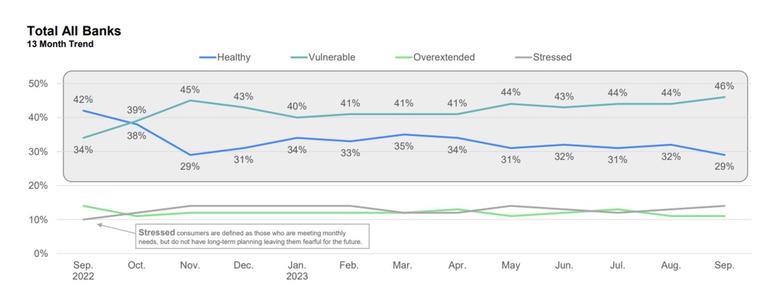
Looking at the overall numbers, J.D. Power said “it’s a discouraging trend as customers entered the final quarter of 2023.”
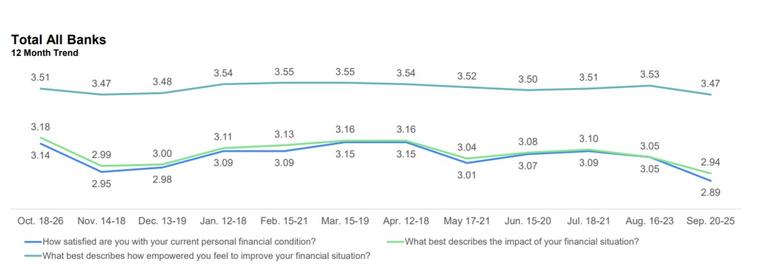
The Anatomy of Customer Savings
According to J.D. Power, as customers watch their financial health deteriorate, there is a “renewed focus” on savings outside of employer-sponsored retirement accounts.
Among its findings:
- 44% of customers say their non-retirement funds are in either a savings or higher yield account at their primary bank
- 24% say retirement funds are in an investment/wealth management firm
- 15% say the funds are in a secondary bank
- 41% say they do not have any savings outside of a retirement account
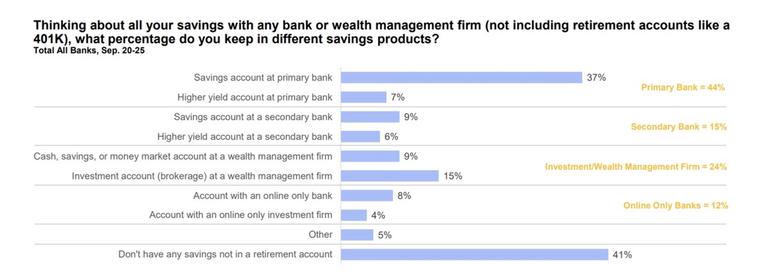
“Predictably, the vulnerable population (60%) and those under 40 (48%) are the most likely groups not to have any non-retirement savings,” J.D. Power said. “A stunning 37% of bank customers over the age of 40 and 18% of those who make more than $100,000 annually say they do not have any non-retirement savings.”
Emergency in Name Only
J.D. Power stated that while retirement may seem like a far-off aspiration to customers that are just trying to make it from month to month, “emergency savings funds may be a more realistic target.”
“Bank customers often think of their savings in buckets and while 41% say they do not have any non-retirement savings; they are more likely to say they have some form of an emergency savings account,” J.D. Power said. “Only 10% of bank customers say they do not have an emergency savings account, while 44% have their emergency funds in a savings account at their primary bank.”
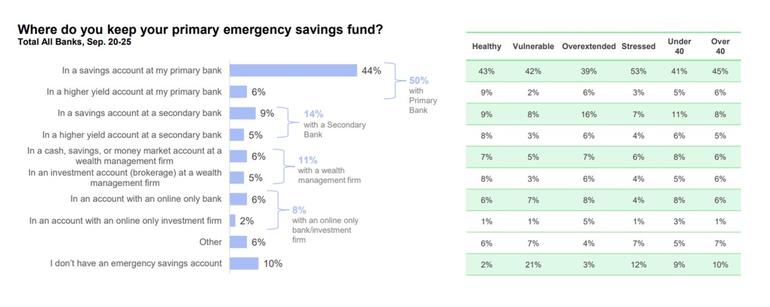
While the intended use of these funds may be for an emergency, J.D. Power said it found some customers have had to pull funds from them to pay for everyday expenses.
Among the findings:
- 28% of customers say they’ve used their emergency savings account in the past 90 days to pay for gas, food or rent. “This helps explain why customers do not view these accounts as being a long-term savings fund,” J.D. Power said.
- 36% have transferred money into these types of accounts in the past 90 days, and 30% have checked the interest earned on their account, “which may imply an opportunity for banks to reach out to their customers with incentives or other high-yield options to help grow these funds all while hoping to stave off any rate shopping these customers may be inclined to do,” according to J.D. Power.
Surviving Now, Preparing for Later
J.D. Power said this month’s data “illustrate how harsh economic conditions can linger for months long after the initial crisis is over. While most analysts see inflation and its corresponding complications as an issue of the past, many banking customers in the U.S. are still grappling with the aftereffects.”
In addition, the company forecast that as customers look to move forward and try to find ways to “safeguard against another bout of turbulence in the future, they are turning their eyes towards savings and how to best optimize these funds when they’re still trying to dig themselves out of a hole.
“Banks could ingratiate themselves to customers by helping in this regard, actively reaching out with tools, advice and options that would help in both the short and long term,” J.D. Power recommended. “Those banking institutions that can forge more meaningful customer relationships will be less vulnerable to rate and shopping and deposits leavings leaving, too.”
As Winter Approaches, the Price for the Best Daily News Update in Credit Remains a Nice, Cozy Free!
The biggest, best and freshest news reporting in credit unions remains free! Each morning CUToday.info delivers its daily Fresh Today news update offering the latest headlines and breaking news right to your email, with the easy-to-read headlines format allowing you to click on the stories that interest you most in order to learn more. So stop paying those bank-fee-like subscription prices from other so-called “news” publications!
If you haven’t yet signed up for the new email solution on which CUToday.info has partnered with ResponseGenius, you can do so here. Signing up requires less than one minute of your time—and it’s free!
Please note that after signing up you may need to go to your Spam/Junk folder and mark the morning headlines email as safe. CUToday.info does not provide its list of readers and emails to outside parties, and we will not be contacting you to sell you an extended warranty or sending you any links so you may cash in on an inheritance you didn’t know was coming.
And did we mention it’s free?