

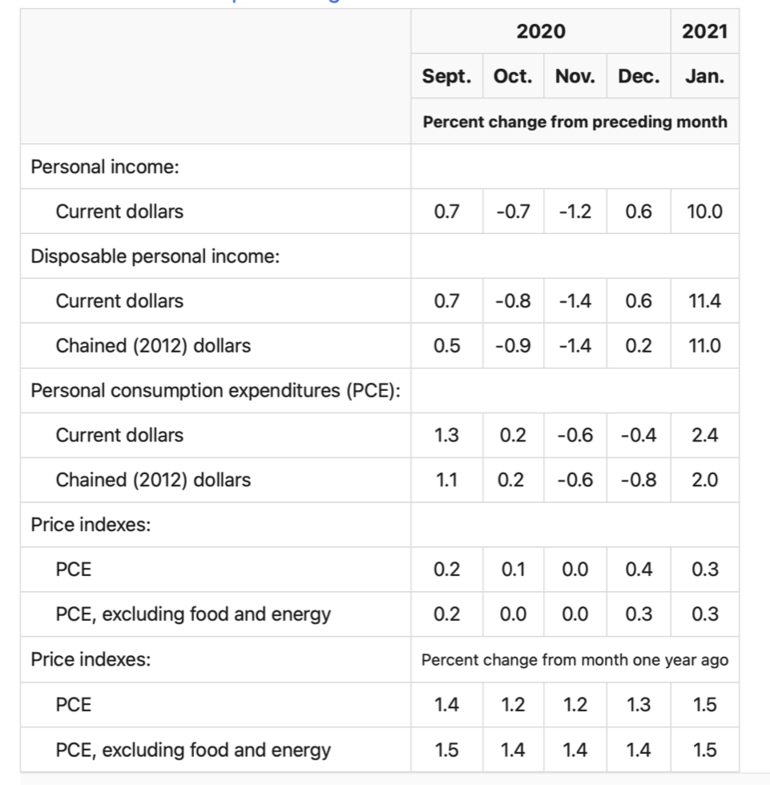
WASHINGTON–Americans’ personal income increased $1,954.7 billion (10.0%) in January, according to estimates released by the Bureau of Economic Analysis.
Disposable personal income (DPI) increased $1,963.2 billion (11.4%) and personal consumption expenditures (PCE) increased $340.9 billion (2.4%).
The BEA further reported Real DPI increased 11.0% in January and Real PCE increased 2.0%, while goods increased 5.1% and services increased 0.5%. The PCE price index increased 0.3%. Excluding food and energy, the PCE price index also increased 0.3%, the federal data show.
“The estimate for January personal income and outlays was impacted by the continued federal response to the spread of COVID-19,” the BEA said in releasing the data. “Economic impact payments and increased unemployment insurance benefits were distributed as a result of the Coronavirus Response and Relief Supplemental Appropriations (CRRSA) Act, which was enacted on December 27, 2020. Additionally, restrictions and closures continued in some areas of the United States. The full economic effects of the COVID-19 pandemic cannot be quantified in the personal income and outlays estimate because the impacts are generally embedded in source data and cannot be separately identified.”
Social Benefits are Driver
The BEA said the increase in personal income in January was more than accounted for by an increase in government social benefits to persons as payments were made to individuals from federal COVID-19 pandemic response programs. The increase in “other” benefits primarily reflected economic impact payments distributed through the CRRSA Act. Unemployment insurance also increased, reflecting an increase in pandemic unemployment compensation, including supplemental weekly payments to unemployment beneficiaries re-introduced by the CRRSA Act, the BEA reported.
The $340.9 billion increase in current dollar PCE in January reflected an increase of $277.2 billion in spending for goods and a $63.7 billion increase in spending for services, according to the Bureau.
Widespread Increases in Goods
Within goods, the increases were widespread across all categories, led by recreational goods and vehicles (notably, information processing equipment) as well as food and beverages, based on Census Monthly Retail Trade Survey (MRTS) data, the BEA said.
Within services, the increase was led by spending for food services and accommodations (more than accounted for by food services), based on MRTS data. Spending for health care (led by outpatient services) also increased, reflecting data on the volume of visits as well as revenue data. Partly offsetting these increases was a decrease in housing and utilities (led by electricity and gas), reflecting data from the Energy Information Administration.
The BEA said personal outlays increased $348.7 billion in January. Personal saving was $3.93 trillion in January and the personal saving rate—personal saving as a percentage of disposable personal income—was 20.5%.