

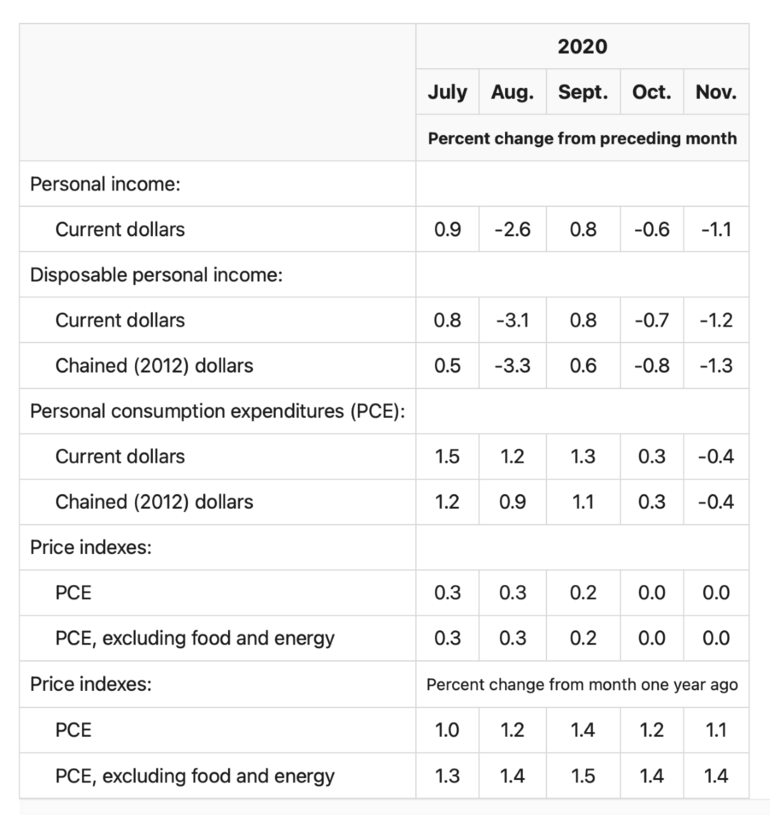
WASHINGTON–Americans’ personal income decreased $221.8 billion (1.1%) in November according to estimates released by the Bureau of Economic Analysis.
Disposable personal income (DPI) decreased $218.0 billion (1.2%) and personal consumption expenditures (PCE) decreased $63.3 billion (0.4%), the BEA added.
According to the Bureau, real DPI decreased 1.3% in November and Real PCE decreased 0.4%. The PCE price index had no change. Excluding food and energy, the PCE price index had no change.
According to the BEA, the November estimate for personal income and outlays was impacted by the response to the spread of COVID-19.
“Federal economic recovery payments slowed as pandemic-related assistance programs continued to wind down,” the BEA said in releasing the data. “The full economic effects of the COVID-19 pandemic cannot be quantified in the personal income and outlays estimate because the impacts are generally embedded in source data and cannot be separately identified.”
The data indicate the decrease in personal income in November primarily reflected decreases in proprietors’ income (both nonfarm and farm) and government social benefits that were partly offset by an increase in compensation, the BEA said.
Additional Data Points
Other data points released in the BEA analysis:
- Within nonfarm proprietors’ income, the decrease reflected a decline in Paycheck Protection Program loans to businesses.
- The decrease in farm proprietors’ income reflected a decrease in payments under the Coronavirus Food Assistance Program related to supporting farmers and ranchers impacted by COVID-19 as well as a decline in Paycheck Protection Program loans to businesses.
- Within government social benefits, “other” social benefits decreased, which primarily reflected a decrease in Lost Wages Supplemental Payments, a Federal Emergency Management Agency program that provides wage assistance to individuals impacted by the pandemic.
- Within compensation, the main contributor was an increase in wages and salaries in service-producing industries.
Decreased Spending
The BEA said the $58.5 billion decrease in real PCE in November reflected decreases of $53.7 billion in spending for goods and $12.1 billion in spending for services. Within goods, the leading contributors to the decrease were spending for clothing and footwear as well as motor vehicles and parts (mainly new motor vehicles).
“A notable offset was an increase in spending for food and beverages purchased for off-premises consumption,” the BEA said. “Within services, the decrease primarily reflected decreases in spending for food services and accommodations as well as in household utilities (electricity and gas).”