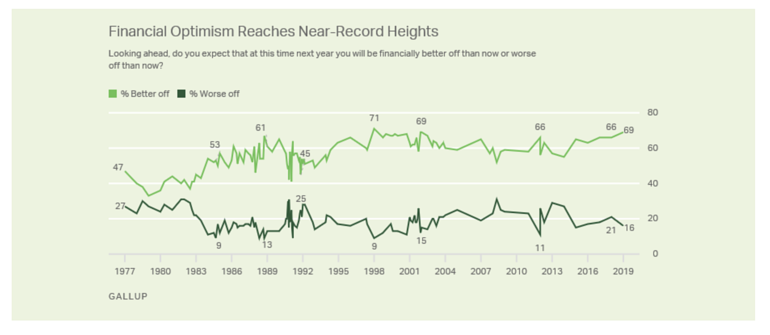
WASHINGTON, D.C. – The optimism of Americans over their personal finances has climbed to levels not seen in more than 16 years, with 69% now saying they expect to be financially better off "at this time next year."
The finding comes at the same time a separate survey finds most Americans are drastically unprepared for a financial emergency.
In the new Gallup Poll, the 69% saying they expect to be better off is only two percentage points below the all-time high of 71%, recorded in March 1998, the company reported.
“Americans are typically less positive about how their finances have changed over the past year than about where they're headed, and that remains the case,” Gallup said. “Fifty percent say they are better off today than they were a year ago. That 50% still represents a post-recession milestone -- the first time since 2007 that at least half of the public has said they are financially better off than a year ago.”
According to Gallup, 10 years ago, as the Great Recession neared its end, the percentage saying their finances had improved from the previous year was at a record low of 23%. More than half the public, 54%, said they were worse off. Now, with unemployment below 1998 levels and the job market growing steadily, the number saying they are worse off than a year ago has dropped to 26%, the lowest level since October 2000, Gallup reported.
The Historical Trends
The company noted that only 11 times in 109 polls stretching back to 1976 have at least half of those polled said they were in better financial shape than they had been a year prior. Only once in 114 polls going back to 1977 have Americans been more optimistic about their personal finances in the coming year than they are today.
“In every one of the 105 Gallup polls since 1977 that asked both questions, more Americans were optimistic about their future finances than said their current finances had improved versus a year prior,” said Gallup. “On average in those 105 polls, 56% have expected to be better off in the next year, while 39% have believed they were better off than they had been the previous year. For both questions, a substantial percentage of the public volunteered a response of ‘the same’ -- indicating either that their finances had not changed in the past year or that they did not expect them to change in the coming year.”
The Role of Partisanship
According to Gallup, members of most major demographic groups are more likely in 2019 to say their financial situation has improved in the past year than to say they are worse off -- with Democrats the one major exception. By 37% to 32%, more Democrats say that compared with a year ago they are worse off financially rather than better off. However, among some of the key groups that generally vote Democratic, a plurality or majority say they are better off.
Among the findings:
- 62% of those under 30 say they are better off; 25% say worse off
- 45% of women say they are better off; 29% say worse off
- 45% of those with annual household incomes of less than $40,000 say better off, 35% worse off
- Among liberals, 40% say better off, 31% worse off
“Republicans are at the other end of the spectrum, with 68% saying they are better off, and only 10% saying worse off,” Gallup reported. “Among groups that are more Republican than the national average, 66% of conservatives say they are better off, as do 57% of those with annual incomes of at least $100,000 and 56% of men.”