

WASHINGTON— U.S. consumers added $86 billion in credit card debt during 2025, pushing total balances to roughly $1.39 trillion, according to a new inflation-adjusted analysis from WalletHub based on the Federal Reserve’s latest G19 consumer credit data.
The increase marks a sharp acceleration from 2024, with credit card balances rising about 75% more than the prior year’s increase, the report found.
Even with the jump, total credit card debt remains about 9% below the inflation-adjusted record set before the Great Recession, suggesting household balances still have not returned to their historical peak.
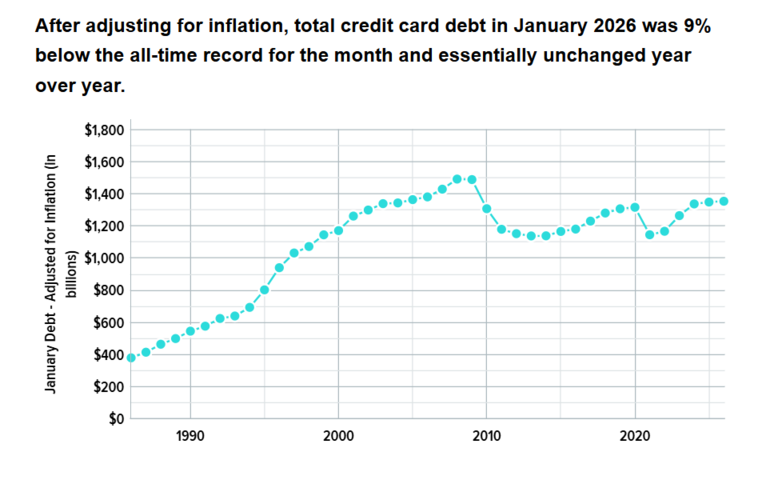
The average household carried $11,507 in credit card debt at the end of 2025, about $1,596 below the record high recorded in 2007 when adjusted for inflation.
Much of the increase came late in the year. Consumers added roughly $73 billion in credit card balances during the fourth quarter alone, a 71% larger increase than in the same quarter of 2024 and about 9% above the average fourth-quarter increase since the Great Recession, WalletHub said.
Early data for 2026 suggests debt levels remain elevated. Preliminary figures show credit card balances in January were about 0.4% higher than a year earlier after adjusting for inflation.
Costs associated with revolving balances also continued climbing. Credit card finance charges rose 2.01% during the fourth quarter, reaching roughly $180 billion, while the charge-off rate increased to 4.03%, up 2.81% from the previous quarter.
“Credit card debt is surging back in a big way,” said John Kiernan, editor at WalletHub. “Consumers managed to keep things together for much of 2025, but the expensive holiday season seemed to have doomed us. We racked up a whopping $73 billion in credit card debt during the fourth quarter of the year alone, pushing our total for the year to roughly $86 billion in new debt.”
Kiernan said consumers can still reduce balances through budgeting and by taking advantage of balance-transfer cards offering temporary zero-interest promotions, though he warned conditions could worsen if the economy weakens.