

MADISON, Wis.–Every consumer credit category in credit unions was down in the first two months--although mortgage lending saw increases-- according to the newest Trends Report from TruStage, which also shows larger CUs reported significantly slower loan growth in 2023 as compared with 2022.
The analysis also found credit union membership growth through February also slowed significantly during the first two months of 2024, but as is the case with lending, seasonal factors played a role, according to the Trends Report, which is authored by TruStage’s Chief Economist Steve Rick.
Here's a look at how credit unions performed according to the April Trends Report, which is based on data through February.
Total Credit Union Lending
Credit union loan balances fell 0.1% in February, below the 0.4% gain reported in February 2023, and 5.5% during the last 12 months, the Trends Report stated.
“Every consumer credit category (credit card, auto loans, etc. declined in February. The only loan categories reporting positive growth were second mortgages (1.1%), home equity loan balances (0.9%) and adjustable-rate mortgages (0.7%),” according to the Trends Report. “February is historically the weakest loan growth month of the year, with seasonal factors typically shaving off 0.6 percentage points from the underlying trend growth rate.”
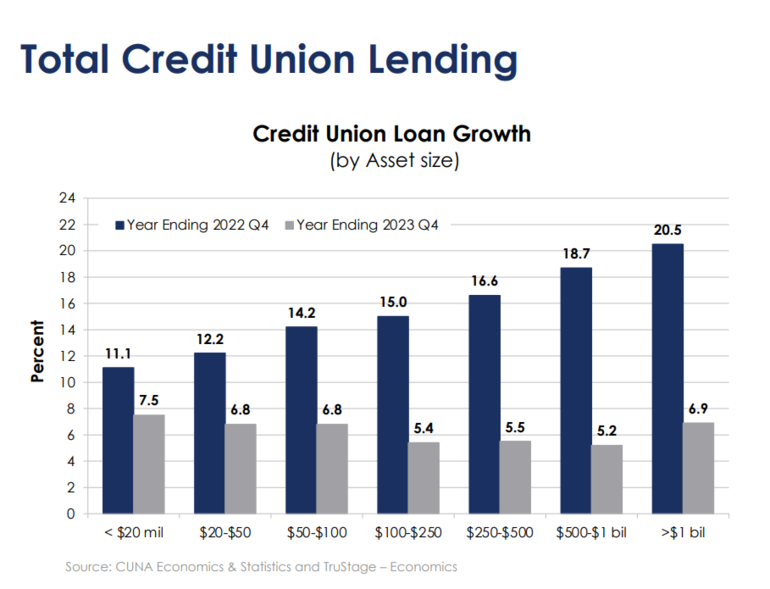
The Trends Report analysis found large credit unions reported significantly slower loan growth in 2023, as compared to 2022, as tighter liquidity conditions at bigger credit unions limited their ability to take on additional credit.
Credit unions with assets greater than $1 billion reported loan-to-savings ratios of 87.8% at year end 2023, significantly higher than the 65% reported for credit unions with assets less than $100 million. All asset size categories reported slower loan growth in 2023, compared to 2022, due to higher interest rates reducing Americans demand for loans, the report said.
“Expect loan growth to slow to 5% in 2024, down from 6.5% in 2023, due to the Federal Reserve keeping interest rate high for most of the year which will reduce the demand for loans,” the Trends Report forecasts. “On the supply side of the credit market, continued low deposit growth will further tighten credit union liquidity and thereby reduce the supply of loans.”
Consumer Installment Credit
According to the new data, credit union consumer installment credit balances (auto, credit card and other unsecured loans) fell 0.5% in February, significantly below the 0.2% gain reported in February 2023.
“This reduced credit union consumer installment credit year-over-year growth rates to 2.5%, due mainly to a slowdown in auto loans. February’s loan seasonal factors typically shave off 0.59 percentage points from the underlying trend growth as members use tax refunds and bonuses to pay down outstanding credit card and home equity loan balances,” the Report notes.
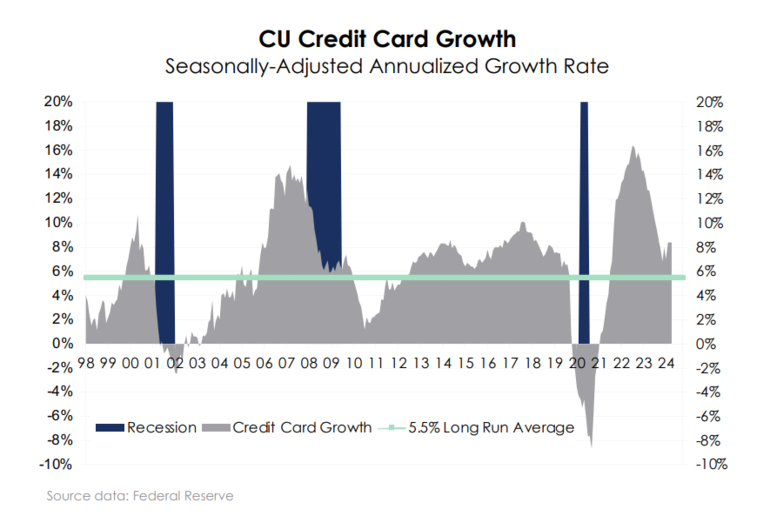
“Credit union credit card balances, however, are still growing at an above trend pace. During the last few years, nominal wage growth has been slower than the rate of inflation, reducing the real incomes of many credit union members,” the analysis continues. “To maintain their level of real spending, some credit union members have either spent some of their excess savings accumulated during the pandemic or have increased their debt levels. Therefore, credit union credit card loan balances rose at an 8.4% seasonally-adjusted annualized rate in February, above the 5.5% long run average.”
The Trends Report further stated credit union consumer installment credit grew only 2.5% during the last year, less than half the total market excluding credit unions which rose 5.4%.
“This indicates credit unions have decreased their market share,” the Trends Report says. “So, credit unions now comprise 13.1% of the consumer installment credit market, down from 13.4% in February 2023.”
Vehicle Loans
Credit union new-auto loan balances fell 1.2% in February, weaker than the 0.3% rise set in February 2023, and fell 1.2% during the last 12 months, according to the Trends Report.
On a seasonally-adjusted annualized basis, new-auto loan balances growth rate was a very weak -2.8% in February, significantly below the 5% long-run average growth rate.
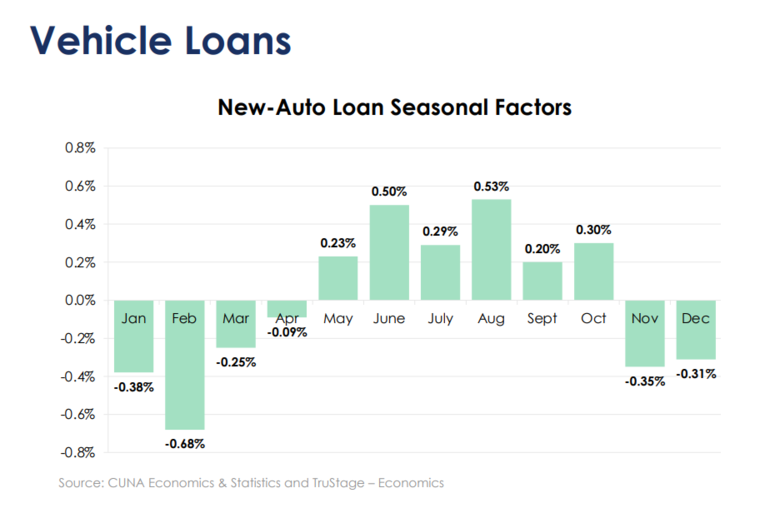
“Credit unions are facing increased competition from finance companies while other credit unions are facing liquidity constraints in the lending arena,” the report observes. “The first quarter is typically the weakest quarter for credit union new-auto loan growth due to various seasonal factors. February is historically the weakest new-auto loan growth month of the year, with seasonal factors typically adjusting -0.68 percentage points from the underlying trend growth rate.”
New vehicle sales were 15.7 million in February, which at a seasonally-adjusted annualized sales rate is 5.5% above the 14.9 million pace set one year earlier and 5.5% above the January sales pace.
“Consumer demand for new vehicles should remain strong for the next year due to a strong labor market, pent up demand, falling new vehicle prices and lower market interest rates in the second half of 2024 as the Federal Reserve slowly takes its foot off the monetary brake,” the report forecasts “So, we expect new vehicle sales to reach 16 million in 2024, still well below the 17.1 million pre pandemic average but above the 15.5 million pace set in 2023.”
Real Estate Information
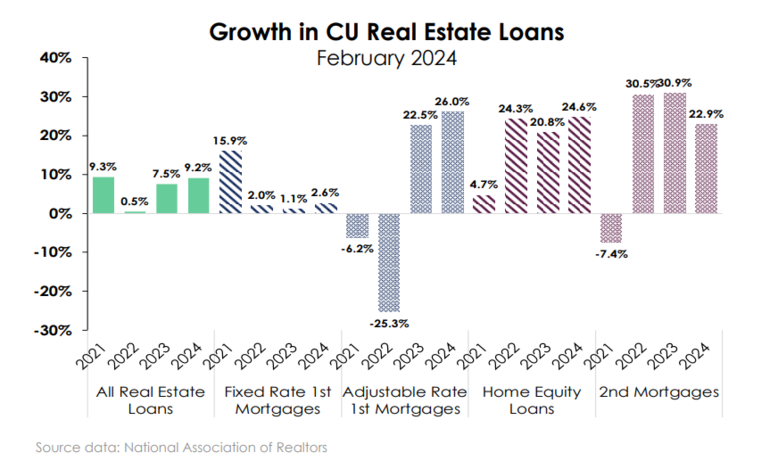
Credit union fixed-rate first mortgage loan balances fell 0.1% in February, below the 1.1% increase reported in February 2023, due to higher interest rates keeping home sales below its long run trend.
Moreover, credit union fixed-rate first mortgage loan balances rose only 2.6% during the last 12 months, less than half the 6.3% pace set in the year ending in February 2023, the report adds.
“Many home buyers have switched to adjustable-rate mortgages which rose 26% over the last year,” the report reminds.
According to the Trends Report, the contract interest rate on a 30-year fixed-rate conventional home mortgage rose 14 basis points to 6.78% in February, up from the 6.64% in January and higher than the 6.26% reported in February 2023. The February increase in mortgage rates was offset slightly due to a smaller credit spread which fell from 2.58 percentage points in January to 2.57 percentage points in February, the report added.
It further noted home prices rose 0.4% in February from January, according to the Core Logic Case-Shiller Home Price Index and are up 6.6% year-over-year as the tight supply of existing homes for sale offset the weight of extremely low affordability.
“Demand will be sustained by buyers who are able to pay cash or who can still afford a mortgage given their incomes, and by existing homeowners who are moving from higher to lower cost areas, including many retirees,” according to the Trends Report analysis. “Listing of homes for sale will increase over the next few years as life events and lower mortgage interest rates prompt more owners to sell. This will cause real home prices to decline given the imbalance between median home prices and median incomes.”
Savings & Assets
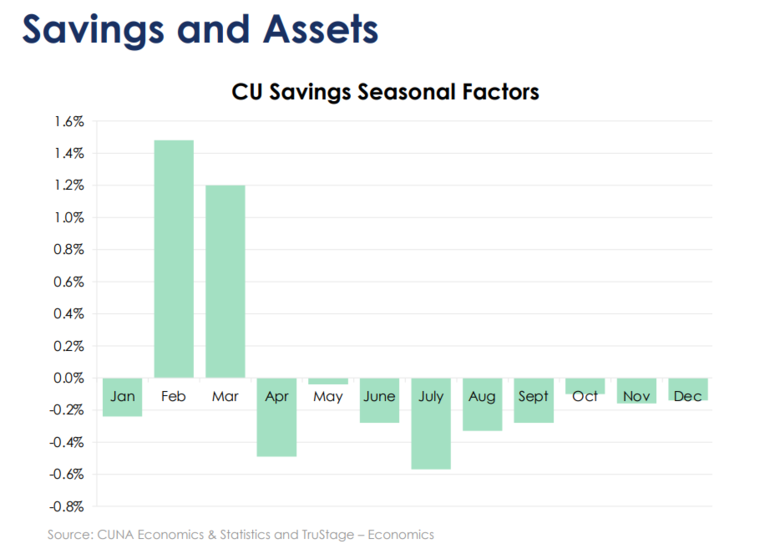
The new Trends Report analysis shows credit union savings balances rose 1.6% in February, above the 1.2% gain reported in February 2023, due to the seasonal factors of tax refunds and bonuses being deposited in credit union members’ share draft accounts, which increased 3.7% this year versus 2.5% last year.
“February’s seasonal factors typically add 1.48 percentage points to the underlying savings trend growth, the biggest of the year,” the report states. “Credit union savings balances rose at a 3.2% seasonally-adjusted annualized growth rate in February, above the 0.7% rate set in February 2023. We are forecasting credit union savings balances to grow 3% in 2024, below the 7% long-run 30-year average, but above the 1.6% deposit growth rate set in 2023. We believe one of the 2023 deposit growth rate headwinds of members withdrawing ‘excess savings’ built up during the COVID-19 Pandemic has come to an end.
“However, there are still some credit union members who hold high-balance non-maturity shares and deposits (particularly money market deposit accounts) who may still withdraw their funds and move them to higher yielding money market mutual funds,” the Trends Report analysis adds. “But if the Federal Reserve lowers short-term interest rates in the second half of the year, this competitive pressure will become less intense. We are forecasting credit union savings growth to be over 5% in 2025.”
Equity and Other Key Measures
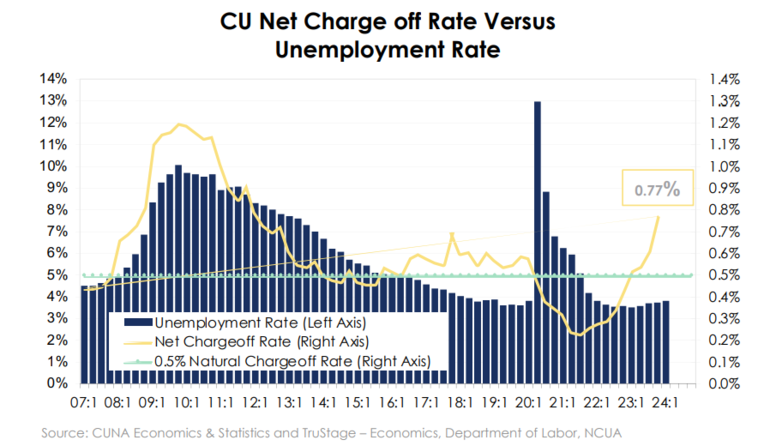
The credit union industry’s average loan net charge-off rate rose to 0.77% in the fourth quarter, from 0.43% one year earlier, the highest rate since the first quarter of 2012. The charge-off rate typically exhibits a quarterly seasonal pattern whereby the loan charge-off rate rises by 0.05% in the fourth quarter and then declines over the next three quarters, according to the Trends Report.
“The loan charge off rate has been rising for the last nine quarters after reaching the lowest in over a generation of 0.23% in the third quarter of 2021,” the analysis states. “The charge-off rate is now above its ‘natural’ long-run rate of 0.5%. In other words, 50 cents of every $100 of credit union loans are normally charged off each year. The charge-off rate is above its natural rate due to high car prices leading to larger borrowed amounts at higher interest rates that are not unaffordable.
“Moreover, high inflation over the last two years have reduced many Americans real wages and therefore purchasing power of their incomes,” the report continues. “They then relied on credit cards to maintain their spending levels. These growing loan balances have now become unsustainable.”
According to the report, younger and lower-income households are most at risk of falling behind on loan payments right now.
Delinquencies
When it comes to delinquencies, the report further found:
- The credit union loan delinquency rate (loans two or more months delinquent as a percent of total loans outstanding) rose to 0.67% in February from the 0.46% reported one year earlier.
- A delinquency rate around 0.75% is considered the “natural delinquency rate,” or the rate due to idiosyncratic life events (divorce, large medical expense, job loss), not due to the business cycle.
- The loan delinquency rate exhibits an annual seasonal pattern whereby the rate drops on average 0.04-0.06 percentage points in February and again in March as members use tax refunds and bonuses to catch up on late loan payments. “Delinquency rates therefore typically reach their nadir in the first quarter and then slowly rise as the year progresses, reaching their apex late in the fourth quarter,” the report states.
Credit Unions and Members
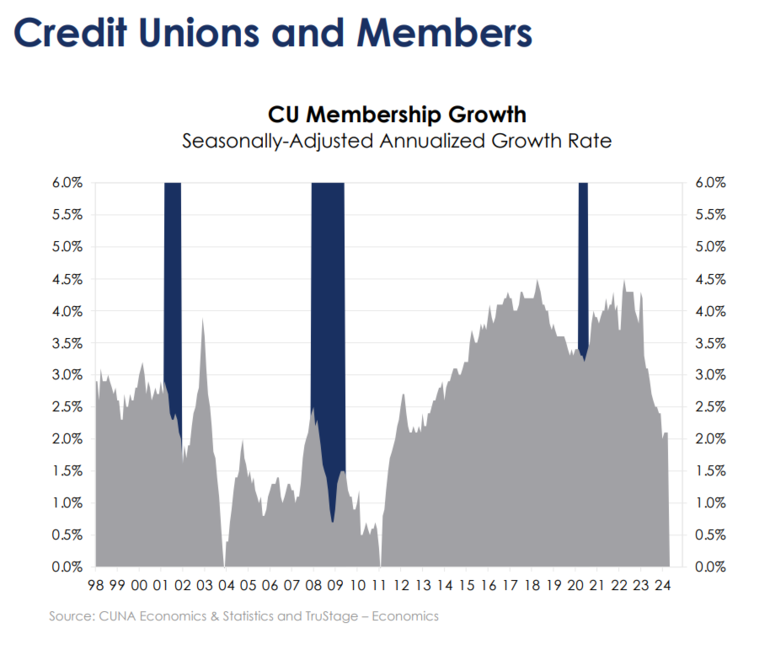
The Trends Report analysis found credit union membership growth slowed significantly during the first two months of 2024, adding 323,000 new memberships versus the 774,000 reported in the first two months of 2023.
In percentage terms, credit union memberships rose 0.14% in February, 0.29 year-to-date, and 2.6% during the last 12 months. Memberships grew at a 2.1% seasonally-adjusted annual rate in February, down from 4.2% in February 2022, the report stated.
“Americans typically join credit unions to obtain credit. With loan growth expected to be only 4% this year and 6% in 2025, membership growth is expected to grow only 2.5% for the next two years, below its long-run average of 3.5%,” the report states. “Americans also join credit unions when they obtain a job at a business with an associated credit union. With job growth expected to slow this year, this avenue of membership growth will be weaker than last year. And finally, the decline in membership growth in 2020 was due to a decline in indirect auto lending. Indirect auto lending is expected to be weak in 2024, due to more aggressive pricing from other lenders besides credit unions.”