

KODIAK, Alaska–Credit unions here were given a spirited defense of the work they do and why critics are wrong when they say the nation’s financial cooperatives no longer deliver value to their members—and even non-members.

Mike Schenk
They were also offered a prediction for what the economy holds and why unemployment is going to spike in several years.
Mike Schenk, deputy chief advocacy officer and chief economist with America’s credit Unions, told the Alaska Credit Union League’s annual meeting his role has evolved, as has the message from credit unions, when it comes to talking about whether and how credit unions are fulfilling their mission.
A Big Pivot
“For about 30 years in my tenure at CUNA we would lobby using two tactics: one to complain bitterly about the uneven playing field and, two, to complain bitterly about regulatory burden. Both of those things are very important, but generally legislators don’t care to hear about it,” he said. “In the last few years we have spent less time talking about that and more time talking about your impact in your community and how you fulfill your mission. And what is your mission? The Federal Credit Union Act says it is to encourage thrift and provide credit for provident and productive purposes, especially for people of small means.”
CU Contributions to Alaska
Specifically looking to Alaska, Schenk said:
- In 2023, Alaska CUs $173 million direct financial benefits to members.
- The CU presence in the marketplace caused repricing by other banks, resulting in $65 million in additional benefits.
- Alaska’s CUs collectively employ about 2,800 people, and through indirect and other effects overall employment is about 6,000 people.
- CUs had $740 million in direct economic output.
- Alaska CU paid $106 million in federal taxes, $34 million in state and local taxes, and “perhaps more importantly, your members paid a $13.4 billion in taxes.”
Other Issues
During his remarks Schenk covered a wide variety of issues. Here’s a look at some of them:
Regulatory Criticism of CUs
Schenk called it “disturbing” that NCUA is being critical of credit unions OD/NSF pricing and other fees, saying it’s almost as if the agency sees CUs as the “bad actors in the marketplace.”
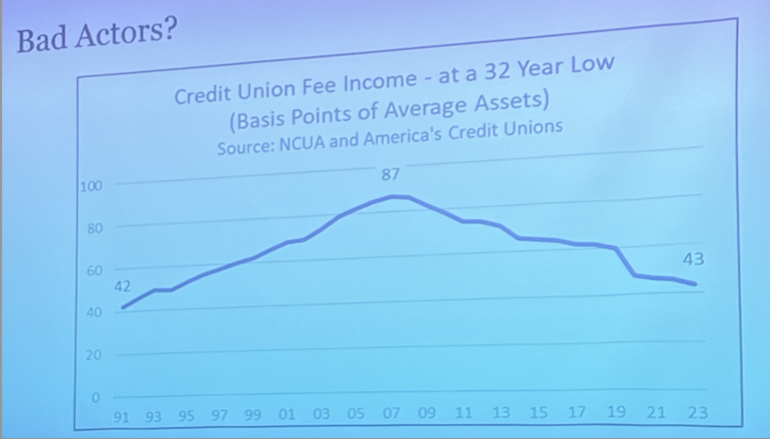
And yet Schenk shared a graphic showing credit union fee income is at a 32-year low (basis points of average assets).
“We know (fees are appropriate) because our members tell us. If we were screwing people the way our regulators say we are screwing people, this would not be happening,” he said, pointing to ongoing credit union membership growth. “A graph like this shows it is a relevant industry. We change lives. People tell their friends. We get more members.”
Financial Well-Being
There is considerable discussion about financial well-being, with just about every provider in the market claiming it’s a priority for them, he said.
“You’re competing with people saying the exact same thing you are, even though their mission has nothing to do with financial well-being. Their mission is to enrich stockholders,” he said. “What I want you to think about is not your mission, but purpose. Your purpose is why do you do it? What’s your gig? When you nail it down, talk about it all the time. That’s your differentiator. That’s how you deliver.”
Schenk likes the Financial Health Network’s FinHealth Score, which is based factors that include spend, save, borrow and planning to create the score to measure an individual’s financial well-being. He urged CU employees to visit the website and take the test themselves.
Serving the Underserved?
Do credit unions serve people of modest means?
“You bet your sweet petunias we do,” answered Schenk “When bankers say that we have lost our way and we are not focused on people of modest means, it’s obviously not true in the Federal Reserve’s latest data. It’s a really big deal and it’s helpful for policymakers to see.”
What Survey Shows
Schenk shared result of ACU’s 2024 Consumer Pulse Survey, which involves 2,500 Americans sharing their feedback:
The findings include:
- Survey results unambiguously reveal CU members view their CUs more favorably than nonmembers view their financial service providers
- The differences appear to stem from credit unions taking more of a consultative approach and by offering more consumer friendly pricing, more thoughtful products and services, and delivering an overall sense of trust fostered by member-ownership
What Doesn’t Work
When it comes to financial health and what doesn’t improve well-being, Schenk said, is printing brochures or pasting the same information on a website. “You have to sit down with people and talk with them,” he said.
According to Schenk, the two most important drivers of financial health as identified by the Financial Health Network, include:
- Have you had the conversations about where members are and where they want to go, along with how they are going to get there? “Recognize financial well being is not a destination, it’s an ongoing journey,” he recommended.
- Just thinking about planning to put money aside in a savings account or emergency fund has an effect on resilience.
Schenk reviewed numerous pieces of data showing credit unions save people substantial amounts of money during their lives, especially those in low-income brackets.
Delinquencies
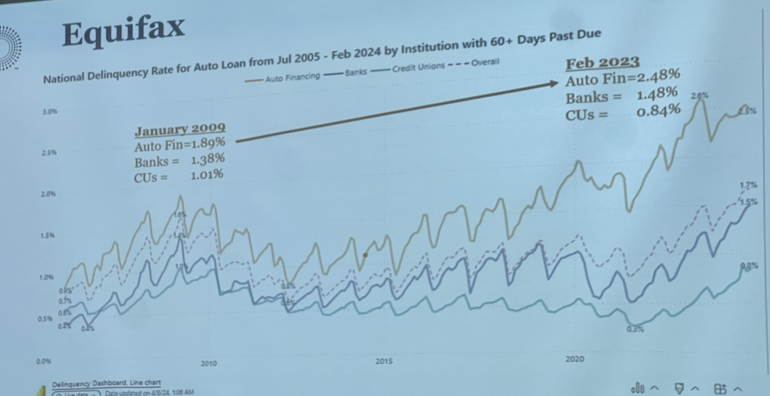
Schenk said the market is starting to see some big increases in delinquency rates, with “phenomenal” increases being reported by banks and finance companies.
“I think the guys that were screwing people in the mortgage market back in the 2000s have pivoted away from toxic mortgages to preying on the same group of people in auto loans,” he said. “Currently in the auto loan arena, even with unemployment at 3.9%, the delinquency rates are 30% higher than in the depths of the Great Recession.”
Looking Forward
Schenk said he and the other members of America’s Credit Unions’ group of economists have a generally favorable economic outlook and that it appears the Fed has actually delivered on the so-called “soft landing.”
“Overall, there is pretty good news. But I am very concerned about exogenous shocks that could come back to bite,” he said.
Risk at Certain Banks
Among those threats is a potential repeat of the failure of several big banks similar to what occurred in March of 2023. He noted there remain some 600 banks that have 40% or more of their deposits uninsured.
“If people detect some sort of material weakness, they can do a podcast or send notes to their subscribers on blogs and next thing you have is deposits flowing out,” he said. “These banks control 50% of banking institution assets. My concern is a lot of people don’t know the difference between credit unions and banks and if banks get in trouble, it could be a contagion.”
Unemployment
Schenk said his analysis of Fed monetary policy and rate increases indicates the country is in for a “big surprise” with unemployment.
“Unemployment tends to spike three years after rate increases. They could lower rates tomorrow and it will still happen. They are going to put 800,000 or a million people out of work,” he predicted.
The good news, Schenk added, is household debt levels are quite low.
A Reminder
Rather than staring at themselves in the mirror, Schenk shared a quote that urged credit unions to instead “look out the window. Because out the window are the people who need our credit union to help them manage through this mess.”
How to Sign Up For the Best Daily News Email in Credit Unions? (It’s Free!)
Every workday CUToday.info delivers the most comprehensive, freshest daily newsletter with the day’s news headlines, including links to the related articles. The Fresh Today newsletter is the most timely, relevant and widely-read source of news and information in the CU community. And it’s free!
If you haven’t yet signed up for the new email solution on which CUToday.info has partnered with ResponseGenius, you can do so here. Signing up requires less than one minute of your time—and it’s free!
Please note that after signing up you may need to go to your Spam/Junk folder and mark the morning headlines email as safe. CUToday.info does not provide its list of readers and emails to outside parties,
And did we mention it’s free?