

KETCHIKAN, Alaska–Credit unions must be looking at their members and potential members through a multicultural and multigenerational lens if they plan to be around for the long haul, according to one person.

Edgar Hernandez addresses the meeting.
Speaking to the Alaska Credit Union League’s annual meeting, Edgar Hernandez, senior director with TruStage’s Multicultural Business Strategy Group, outlined for attendees why they should pay attention to the company’s extensive research as part of “What Matters Now 2022: A Multicultural and Multigenerational Consumer Lens.”
“Why a multicultural and multigenerational look at consumers?” asked Hernandez. “With multicultural consumers becoming a growing force and as Gen Z and Millennials continue to change life stages, we need to understand all parts of their identify and serve them with intentionality.”
Moreover, since coming to the United States with his family from Mexico in the 1980s, Martinez noted the demographics in the U.S. have already changed significantly in a relatively short period of time.
Throughout his remarks, Hernandez stressed that credit unions that apply a multicultural/multigenerational approach to their strategies are significantly more successful than other CUs.
About the Research
CUNA Mutual launched its consumer research in 2015 with “Insights from Middle America,” followed by “Insights from Millennials” in 2016, “Insights from Non-Members” in 2017, and “Insights from Multicultural Consumers” in 2018.
Among the findings in the Mutlicultural research in 2019, for example, was that African-Americans were two times more likely to have a student loans, and Hispanic consumers are nine times more likely to take out a small business loan.
In 2022, CUNA Mutual set out to freshen up the findings as more credit unions were contacting the company about their efforts to reach out to new demographic groups, he said.
That led to some interesting new insights, such as Native-Americans are the most likely to say credit unions are their primary financial institution (21%), compared to White/Non-Hispanic (15%), Black Non-Hispanic (15%), Hispanic/Latino/Spanish (16%).
“We are seeing significant increases in the US. Native populations,” Hernandez said. “The American-Indian and Alaska Native along populations grew 27.1% from 2010-20.”
Why pay attention to the groups with which people identify?
“With identity comes sets of values,” said Hernandez.
Worries by Generation
Millennials are the group that is most worried overall about “pretty much everything,” said Hernandez, before adding that overall, “if you understand what keeps your members up at night, you can develop products and services that meets them where they are.”
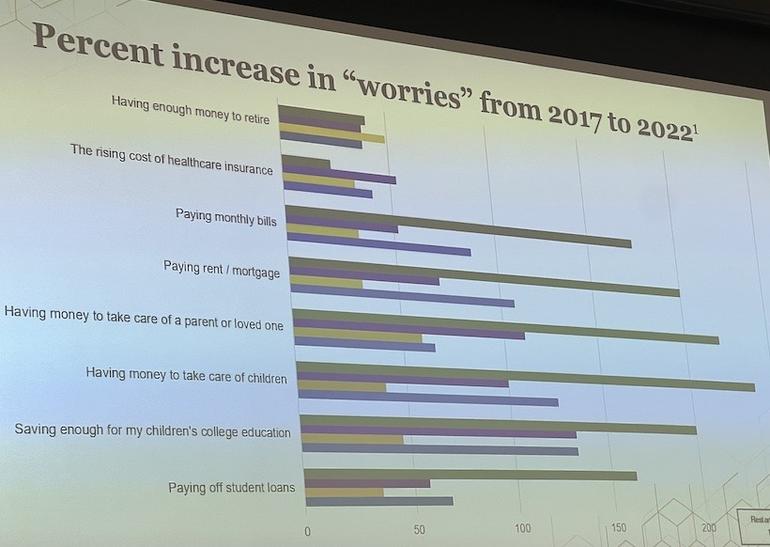
What Hernandez said was most fascinating was that percentage increase in “worries” from 2017 to 2022. Whites showed the biggest jumps in financial worries, which he said may be due to pandemic making people aware they aren’t as well prepared as they should be. The chief ulcer-inducers, he said, were worries over having money to take care of children, followed by having money to take care of a parent or a loved one.
One Positive
According to Hernandez, the research found one positive during the pandemic is the time and focus people place on what is most important increased, which helped clarify goals, aspirations and priorities.
But it also found people struggling. Nearly half of Black, Hispanic and Native Americans and multiracial consumers—and more than half of Millennials—believe one job isn’t enough to fulfill their goals.
Types of Products/Accounts
When it comes to the types of products/services various groups tend to prefer and use, Hernandez said the findings include:
- Hispanic consumers are more likely to have debit cards
- Asian consumers are most likely to have checking, credit cards and investments
- Black consumers are more likely to leverage loans and life insurance
- Native Americans are least likely to have financial products
Payment Protection
While all groups indicated credit card payments is the main reason they buy payment protection, Black and multiracial consumers indicated a stronger preference for protecting new auto loans.
The research found payment protection is a product that many people lack “clarity” around what it actually is, said Hernandez. Similarly, many people misunderstand what “wealth management” involves and the level of income required to leverage such offerings.
Investments & Financial Advising
When consumers were asked “Are you currently working with a financial advisor?” the research found multiracial, white, Black and younger consumers are more likely to work with a financial advisor. Hispanic/Latino/Spanish, Asian/Pacific Islander/Native Hawaii, and Native American/Native Alaskan indigenous were least likely to work with a financial advisor.
Similarly, the research showed Native-American and Hispanic consumers most likely to not own any investment products, he said.
The First Question
“I get calls every week from credit unions looking to grow,” said Hernandez, “and the first question I ask them is, ‘Do you have people who represent the population you are trying to attract?’”
Credit unions also have to be intentional about recruiting multicultural financial advisors, recommended Hernandez.
Encouraging News
The “encouraging news,” according to Hernandez, is that across almost all investment products, credit union members outperform non-credit union members.
“This means something is working and to me it is trust, have my interests at heart,” Hernandez explained.
He showed a slide with detailed information around the top five motivators for choice of PFI by race/ethnicity to illustrate the importance of understanding what matters to the respective groups, as their priorities differ.
Additional Findings
Hernandez said the research also shows:
- Multicultural and younger consumers opting for mobile-first options, but Gen Z is dissatisfied with mobile apps.
- Younger generations want to know where brands stand and most Gen X Americans also want brands to speak out. “The message here is standing on the sidelines and not play is also a signal.”
- When asked which social causes are most important to all consumers, the top three were financial well-being, food insecurity and education.
Additional information on the research findings can be found at www.cunamutual.com/whatmattersnow