

ALEXANDRIA, Va.–With all three members of the NCUA board sharing different versions of the phrase “what gets measured gets done,” the board has approved its 2023 Annual Performance Plan.
Prior to voting in favor of approving the plan, the board received an update on progress being made in a number of areas, including the hiring of new examiners and how often examinations are occurring within prescribed time frames.
According to agency staff, NCUA is monitoring its progress in the plan on an ongoing basis, including reviewing the effectiveness of its examination responsibilities, addressing barriers to access, adopting new technology, measuring feedback from credit unions, measuring access for members to affordable and equitable financial products and services from CUs, and reviewing metrics around the quality of agency operational support, human capital management and more.
The agency said its 2022–2026 Strategic Plan also outlines how it will achieve its core objectives and fulfill its mission of protecting the system of cooperative credit and its member- owners through effective chartering, supervision, regulation, and insurance.
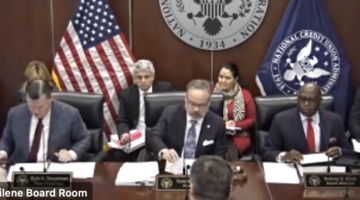
Members of NCUA Board during Thursday meeting.
Harper: Numerous Measures in Place
NCUA Chairman Todd Harper noted that overall NCUA has three strategic goals supported by 10 strategic objectives and 19 performance goals. To meet these goals and objectives, the NCUA has identified 45 indicators to measure performance, Harper said.
“This year, the NCUA will pay particular attention to liquidity risk, interest rate risk, and credit risk, as noted in the agency’s recently announced 2023 supervisory priorities,” said Harper. “And, the agency will once again focus on ever-present cybersecurity threats, not only within credit unions but also within the broader financial system. The implementation of this plan will contribute to our success in addressing these risks.”
Harper said other priorities include:
- Continuing to adjust its examination program and operations to maintain safety and soundness, protect consumers, and ensure compliance with anti-money laundering law
- Using the Community Development Revolving Loan Fund and other initiatives to encourage credit unions to expand access to safe, fair, and affordable financial products and services to underserved communities and populations.
A ‘Must-Do’ Goal
“One of the must-do goals for me is the new metric for onboarding 70 new examiners, positions that have already been approved by the board,” Harper said. “In recent years, we have seen an increase in examiner vacancies. Too many vacancies could have real consequences for credit unions and the agency going forward.”
The agency said the 70 new positions will not add to NCUA headcount, as it is currently short on examiners and other examiners are retiring or being let go.
Harper said he is also pleased to see that there will be measures around consumer financial education, an issue that is “very important to me.”
Hauptman: ‘Outcome-Oriented Results’
NCUA Vice Chairman Kyle Hauptman, noting the agency’s overarching goals in the plan are to ensure a safe, sound, and viable system; improve the financial well-being of individuals and communities, and maximize NCUA organizational performance, said he was pleased to see there are more emphasis on quantifiable indicators.
“This year’s plan continues that trend with a greater focus on output-oriented and outcome-oriented results,” he said. “I am a firm believer that safety and soundness – one of our core guiding principles – is enhanced by regulatory clarity. Vague regulation is bad regulation.”
He said he further appreciated his fellow board members’ “foresight” in 2022 to improve regulatory clarity by issuing Proposed Rule Parts 701 and 714 Financial Innovation – Loan Participation, Eligible Obligations and Notes of Liquidating Credit Unions, adding that this year’s plan includes the next step of issuing a final rule on financial technology and loan participations – among other things.
“I’m pleased that one of my priorities in the plan, to ensure the quality and consistency of examinations and examination reports through rigorous quality assurance processes, including by normalizing quality-assurance tools such as feedback surveys and the use of recordings during exit meetings and joint conferences" has also been included.
“I continue to urge federal credit unions to record their exit meetings and joint exam conferences. The recordings are beneficial for the credit unions and the agency as they provide a resource for new examiners, credit union staff, and boards,” he said.
Hood: Pleased to see ACCESS Included
For his part, NCUA Board Member Rodney Hood said he was delighted to see the ACCESS initiative included in the plan, as well as specific deliverables around fintech, including finalizing the loan participation and eligible obligations fintech rule this year.
In response to a question from Hood related to metrics around examinations, agency staff said 88% of exams for federal credit unions had started on time as of the most recent data, while performance was better for federally insured, state-chartered CUs, where 99% of exams were conducted within the prescribed time frame.