

Editor's Note: This story has been updated to reflect a statement from NCUA on the health of Chairman Todd Harper.
ALEXANDRIA, Va.–The NCUA board has voted 2-0 to approve amendments to its subordinated debt rules to better align them with Treasury’s Emergency Capital Investment Program (ECIP). The vote would have been 3-0, but NCUA Chairman Todd Harper exited the board meeting shortly after calling it to order and reading an opening statement. A spokesperson for NCUA told CUToday.info that Harper "suddenly felt unwell, and out of an abundance of caution, sought an evaluation at the hospital."
Later, spokesperson Joe Adamoli said, "After experiencing sudden pain in his stomach and chest, Chairman Harper sought a medical evaluation. The Chairman was sent home after all tests were found normal. He looks forward to resuming his schedule (Friday)."
In his prepared remarks provided to CUToday.info, Harper indicated he had planned to vote in favor of the final rule.
The final rule, technically Part 702, Subordinated Debt, requires any credit union seeking to issue subordinated debt notes with maturities longer than 20 years to demonstrate how such instruments would continue to be considered “debt,” and also extends the regulatory capital treatment of grandfathered secondary capital underwritten to the later of 30 years from the date of issuance or Jan. 1, 2052.
In addition, the final rule makes four minor modifications to the current rule that are designed to make the regulation more user-friendly and increase flexibility for credit unions, according to the agency.
Ahead of the vote, NCUA staff noted the changes were driven in part to accommodate Treasury’s Emergency Capital Investment Program. In October 2021, NCUA issued a Letter to Credit Unions clarifying that low-income credit unions could issue 30-year notes under ECIP.
“There was a natural mismatch with an instrument with a 30-year maturity that only received 20 years of regulatory capital treatment,” noted Justin Anderson, staff attorney in NCUA’s Office of General Counsel. “Today's rule therefore eliminates that mismatch and provides credit unions with additional flexibilities.”
Anderson said other changes in the rule are aimed at helping credit unions take “full advantage of the ECIP” program.
Harper: A ‘Much-Needed Boost’
In his prepared remarks, Chairman Harper stated the rule facilitates the access of eligible credit unions to ECIP.
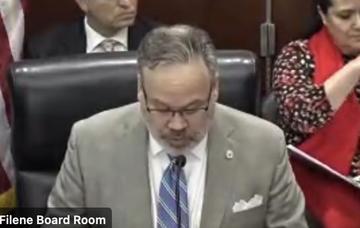
NCUA Chairman Todd Harper at board meeting prior to exiting.
“Congress created ECIP to support the communities of color and low-income households hit hardest by the COVID-19 pandemic’s financial and economic disruptions,” Harper’s comments read. “With rising interest rates, lingering inflation, and continuing economic uncertainty, under-resourced families and communities face many challenges. ECIP funding is a much-needed boost to these communities, allowing them to address short-term needs and achieve long-term financial stability.”
Harper noted that since the launch of ECIP in 2021, 83 credit unions have received approximately $2.3 billion in capital investments. “Over the years, many small, low-income, and minority depository institution credit unions have prudently used secondary capital, a form of subordinated debt, to increase their regulatory capital levels to protect against future losses and to serve as a foundation for strategic initiatives and growth,” Harper said. “These funds have enabled some low-income credit unions to provide much-needed loan products and other member services within under-resourced communities.”
A Doubling of Issuance
According to the NCUA chairman, a number of complex credit unions--those with $500 million or more in assets — have used subordinated debt to remain well capitalized under the agency’s risk-based capital and complex credit union leverage ratio rules. He said 154 credit unions of all types had issued $3.4 billion in subordinated debt; that’s a doubling of credit unions from a decade ago.
In his prepared remarks, Harper said he remains committed to getting the rule right and taking further action, whether through regulatory amendments, additional guidance, or some other means.
Hauptman: Addressing a Chicken & Egg Scenario
In his remarks prior to the vote, NCUA Vice Chairman Kyle Hauptman said for years the agency has been considering how to create a regulatory environment where credit unions could utilize alternative forms of capital, such as secondary capital and subordinated debt.
He called ECIP an “unprecedented opportunity” for additional capital.
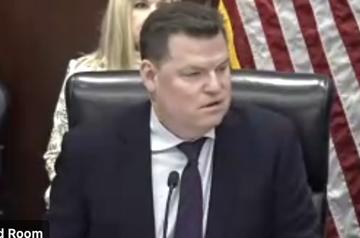
NCUA Vice Chairman Kyle Hauptman at board meeting.
But for credit unions to take full advantage of that program – specifically treating Treasury’s 30-year certificates as regulatory capital – required additional adjustments, said Hauptman, adding, “that brings us to today’s rule.”
Hauptman, who formerly worked at Lehman Brothers prior to the company becoming the first firm to fail and contribute to the financial crisis of more than a decade ago, said much of NCUA’s final rule is about “synching up” the subordinated debt rule with Treasury’s ECIP program, which he said brings welcomed flexibility to the maximum maturity of subordinated debt notes. In addition, he said the rule brings clarity on the qualified counsel, cashflow projections, and filing requirements.
‘Not an equity Security’
“Subordinated debt in a credit union is a debt security, not an equity security,” said Hauptman. “The only authority under the FCU Act for FCUs to issue sub debt is the borrowing authority. That means the issuances must be in the form of debt. Issuances under the sub debt rule are securities. As such, subordinated debt notes are likely, to some degree, to be subject to the multitude of federal and state securities laws — particularly those related to disclosures and anti-fraud.”
Hauptman reminded that subordinated debt is subordinate to all other claims against the issuing credit union, including those of members, other creditors, and the National Credit Union Share Insurance Fund.
“Those who buy subordinated debt get paid last in the event the credit union is liquidated,” he said.
Hauptman called subordinated debt a powerful tool that can assist credit unions in bringing financial services to underserved communities, and added that chartering new credit unions is one of his priorities and that capital is one of the most critical requirements for chartering a new credit union.
Resolving a Dilemma
“I’m pleased that that the subordinated debt rule allows new credit unions to use subordinated debt to meet capital requirements. Additionally, we are working on a provisional charter option which will solve the chicken and egg challenge of ‘We need capital to get a charter, but we need a charter to get the capital.’ Anything that makes it easier to start a new credit union is a step towards true financial inclusion.”
In response to a question from Hauptman, who noted that credit unions may only issue debt, not equity, before asking if there are any concerns that a note longer than 20 years is outside the statute, NCUA staff responded by saying the final rule contains “sufficient safeguards” to ensure subordinated debt issuances remain squarely in the debt space.
Hood: A Culmination of Two Years of Work
NCUA Board Member Rodney Hood noted the final rule culminates two years of work by the agency, lauding the fact it addresses the “distinct mismatch” between a 30-year ECIP subordinated debt instrument and the 20-year maximum regulatory capital treatment under NCUA regs.
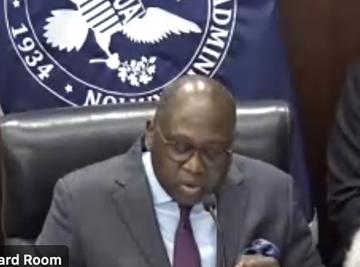
NCUA Board Member Rodney Hood at board meeting.
“I'm very pleased in addition in today's rule the board also recognizes that a fixed, stated maturity date is but one factor in a debt versus equity analysis and as noted by the U.S. Supreme Court…” Hood said. “I'm pleased that this rule adds additional flexibilities for credit unions while maintaining strong guardrails to ensure subordinated debt issuances remain within a federal credit union's statutory authority. I'm really pleased that rule provides our minority depositories and CDFIs with the resources to continue providing access to affordable financial services for the most vulnerable in our communities.”
Hood said the rule also provides parity for credit unions with other financial institutions.
22 Transactions Took Place
In response to a question from Hood regarding privately issued debt transactions by credit unions, staff said during 2022 there were 22 transactions totaling $385 million, an amount that exceeded what was historically outstanding in the industry at any time up to 2022.
In response to a separate question from Hood, agency staff said there were approximately 30 applications submitted to NCUA for regulatory capital treatment last year, some of which are still pending. Five credit unions had their applications denied, staff said.
Hood further asked NCUA staff for its interpretation of the growth in subdebt instruments in the credit union system. Staff members responded by saying the staff believes that if done safely along with the utility of using it for regulatory capital, subordinated debt can be effective tool for managing new membership programs and liquidity risk management.
In addition, Hood said he has been asked by credit unions why subordinated debt only counts toward the net worth ratio for low-income credit unions. Staff responded by noting that under the Federal Credit Union Act, Congress only permits LICUs to count these instruments as net worth. As such, this limitation is statutory rather than regulatory.